Vaping Flavors & E-Liquids
Understanding E-Liquids: The Heart of the Vaping Experience
If the vaping device is the engine, then the e-liquid is the fuel that defines the entire journey. Also known as vape juice, e-liquid is the flavored liquid that a vaporizer heats into an inhalable aerosol. For anyone starting out, the sheer variety of vaping flavors can feel overwhelming: hundreds of brands, dozens of flavor families, different nicotine strengths and technical terms like PG, VG and nicotine salts. This pillar page serves as a complete introduction, connecting all the essential concepts so you can navigate the world of e-liquids with clarity and confidence.
Think of this page as a map. Each section explores a key territory — composition, flavor families, nicotine options, and practical selection advice — so that by the end, what once seemed confusing becomes a set of simple, logical choices.
What Exactly Is an E-Liquid Made Of?
Despite the endless variety on shelves, nearly every e-liquid is built from the same four building blocks. Understanding them is the first step toward making informed decisions, much like knowing the basic ingredients of a recipe before attempting to cook it.
- Propylene Glycol (PG): a thin, odorless liquid that carries flavor remarkably well and produces a stronger throat sensation. It is a common food additive used for decades in everyday products.
- Vegetable Glycerin (VG): a thicker, slightly sweet liquid responsible for dense, visible vapor clouds. Higher VG liquids are smoother on the throat.
- Flavorings: food-grade concentrates, the same type used in candies, beverages and baked goods, blended to create everything from ripe mango to creamy tobacco notes.
- Nicotine (optional): present in varying strengths, or entirely absent in zero-nicotine formulas for those who enjoy vaping purely for the flavor.
The ratio between PG and VG — often displayed on bottles as 50/50, 70/30 or 80/20 VG/PG — acts like the balance of a musical instrument: it changes the texture, the flavor intensity and the vapor production without changing the melody itself. A 50/50 blend suits most small starter devices and delivers crisp flavor, while a high-VG liquid pairs better with powerful sub-ohm hardware and produces thick clouds with a softer draw.
The Major Flavor Families: Finding Your Taste Profile
Flavor is the most personal dimension of vaping. What delights one person may leave another indifferent, which is precisely why the market offers such extraordinary diversity. That said, nearly all vaping flavors fall into a handful of recognizable families, and understanding these categories is like knowing the sections of a record store before hunting for a specific album.
Tobacco Flavors
Tobacco e-liquids reproduce or reinterpret the taste of traditional cigarettes, ranging from dry and earthy to smooth and slightly sweet, sometimes enriched with caramel, vanilla or nut undertones. They are frequently the starting point for people transitioning away from cigarettes, offering a familiar anchor during the switch.
Fruit Flavors
The largest and most popular category, fruit flavors span single fruits — strawberry, watermelon, mango — and elaborate blends such as tropical mixes or berry medleys. They are generally bright, refreshing and forgiving, making them an excellent first choice for beginners. A useful analogy: if tobacco flavors are like black coffee, fruit flavors are fresh juice — lighter, sweeter and easier to appreciate immediately.
Dessert and Creamy Flavors
Vanilla custard, caramel, pastry, chocolate and cheesecake profiles dominate this family. These liquids tend to be rich and indulgent, with layered notes that reveal themselves over time. Because of their sweetness, they are often favored by experienced vapers as an all-day comfort flavor, similar to a favorite dessert one never tires of.
Menthol and Mint Flavors
Menthol provides a cooling sensation that can stand alone or be combined with fruit — mentholated mango or icy berries are very common hybrids. Former menthol cigarette smokers often gravitate here first, as the familiar chill eases the transition.
Beverage and Original Creations
Coffee, cola, lemonade, cocktail-inspired profiles and entirely invented combinations round out the landscape. These are the experimental wing of the flavor world: occasionally surprising, sometimes delightful, and always a reminder of how creative e-liquid formulation has become.
Nicotine Strengths: Matching the Dose to Your Needs
Choosing a nicotine strength is less about preference and more about matching your current habits. Too little nicotine may leave a former smoker feeling unsatisfied, while too much can cause lightheadedness or an unpleasantly harsh throat hit. The following progression reflects a common and sensible approach:
- High strengths (approximately 12–20 mg/ml): typically suited to heavier former smokers or to low-power pod devices using nicotine salts, where each puff delivers a modest amount.
- Moderate strengths (approximately 6–12 mg/ml): a balanced middle ground for lighter smokers or those gradually reducing their intake.
- Low strengths (approximately 3–6 mg/ml): popular with sub-ohm users who take larger puffs and vape more frequently on flavor rather than nicotine.
- Zero nicotine: for those who enjoy the ritual, the flavors and the vapor without any nicotine at all.
It is also worth distinguishing between freebase nicotine and nicotine salts. Freebase is the traditional form: it provides a pronounced throat hit and works well at lower concentrations in larger devices. Nicotine salts are chemically stabilized for smoother absorption, allowing higher strengths to feel gentle — a feature that made small pod systems so popular. The analogy often used is espresso versus a slow-brewed cup: same substance, different delivery and sensation.
How to Choose Your First E-Liquid: A Practical Method
Theory is useful, but a simple decision framework helps beginners act with confidence. Rather than agonizing over hundreds of options, narrow the field step by step:
- Identify your device type. Small pod systems generally perform best with 50/50 PG/VG liquids or nicotine salts; larger sub-ohm kits favor high-VG juices at lower nicotine strengths. Matching liquid to hardware is the single most important technical decision.
- Estimate your nicotine needs. Base your starting strength on your previous smoking habits if applicable, and adjust after a few days of real use.
- Pick a flavor family, not a specific bottle. Start broad — fruity, tobacco, menthol or dessert — then refine within the family that appeals to you.
- Buy small sizes first. Taste is subjective; a 10 ml bottle that disappoints costs little, while a large bottle of an unsuitable flavor gathers dust.
- Let liquids steep when needed. Some complex blends, especially dessert profiles, improve after a week or two of resting in a cool, dark place, much like a stew tastes better the next day.
Safety, Storage and Quality Considerations
A responsible approach to e-liquids involves a few non-negotiable habits. Quality products from reputable manufacturers list their ingredients, PG/VG ratio and nicotine content clearly on the label, often with child-resistant caps and regulatory compliance markings depending on the region. When comparing products, use this quick checklist:
- Transparent labeling of ingredients, nicotine strength and PG/VG ratio.
- Child-resistant packaging and clear nicotine hazard warnings where required.
- Storage away from direct sunlight, heat and the reach of children or pets.
- Purchase from established vendors rather than unverified sources, since counterfeit liquids exist in the market.
- Proper disposal of bottles and expired liquids according to local guidelines.
Nicotine is a toxic substance in concentrated form, and e-liquids should always be handled with the same caution as any household product containing it. Skin contact with concentrated liquid should be washed off promptly, and accidental ingestion should be treated as an emergency.
Frequently Asked Questions About Vaping Flavors and E-Liquids
Do e-liquids expire?
Yes. Most carry a best-before date, typically one to two years after production when stored properly. An expired liquid may darken, lose flavor intensity or develop an off smell; when in doubt, replace it.
Why does my e-liquid darken over time?
Gradual darkening is a natural oxidation process, particularly in nicotine-containing and dessert-style liquids. Mild darkening with unchanged taste is generally harmless, but a drastic color change accompanied by a harsh or strange flavor is a signal to discard the bottle.
Can I mix different e-liquids together?
Technically yes, as long as they share compatible PG/VG ratios and nicotine strengths, but flavor combinations can be unpredictable. Start with small test mixes, in the spirit of a curious cook rather than a chemist.
What is vaper’s tongue?
It is a temporary phenomenon where a vaper suddenly loses the ability to taste a familiar flavor, often after extended use of the same juice. Rotating flavors, staying hydrated and taking short breaks usually resolve it within days.
The Broader Picture: Flavors as the Core of Modern Vaping
Flavors are far more than a marketing device — they are the reason vaping developed into such a diverse culture. For many adults, the availability of appealing alternatives to tobacco taste has been a decisive factor in moving away from cigarettes. At the same time, the flavor landscape keeps evolving: formulation techniques improve, regulatory frameworks shape what can be sold and how it is labeled, and consumer preferences continually push manufacturers toward new blends.
Understanding e-liquids — their composition, their flavor families, their nicotine options and their practical handling — empowers you to make choices based on knowledge rather than trial and error. As you browse the articles and products in this category, treat this page as your reference point: the vocabulary and concepts introduced here will recur everywhere, and each new exploration will simply deepen a foundation you have already built. Take your time, stay curious, and let taste — guided by sound information — lead the way.

How Do Vapour Liquid Ingredients Affect Flavour, Vapour and Wick Performance?
Two e-liquids used in the same vape device can produce noticeably different clouds, flavour intensity and coil performance. The difference often starts with their ingredients, particularly the proportions of vegetable glycerin (VG) and propylene glycol (PG). These carrier liquids influence…
Lire la suite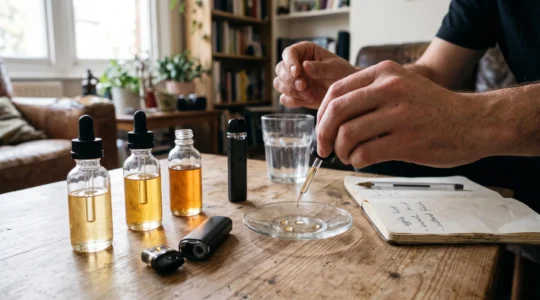
How Do Dessert and Fruit Flavour Notes Combine in Layered E-Liquids?
Fruit and dessert flavour notes combine in layered e-liquids through contrasts in perceived sweetness, aroma intensity, acidity, richness and persistence. A bright berry note may stand out against a soft vanilla background, while the same berry character can seem jam-like…
Lire la suite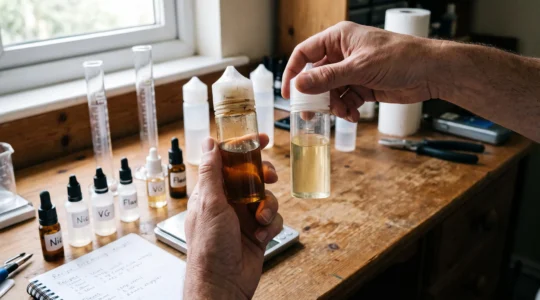
How Do Steeping Processes Change E-Liquid Flavour Over Time?
E-liquid steeping is the practice of allowing a freshly mixed formulation to rest before evaluating its flavour. During this period, the liquid may become more uniform, certain flavouring ingredients can undergo chemical reactions, and some aromatic compounds may gradually degrade….
Lire la suite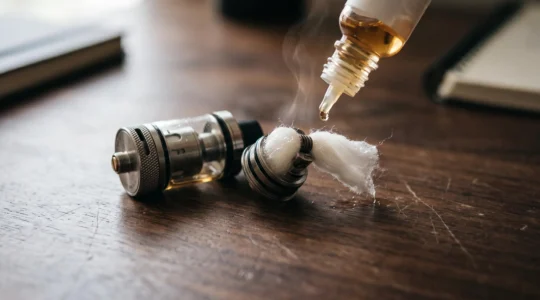
How Can You Maintain Proper Wick Saturation Without Flooding the Coil?
Proper wick saturation means keeping enough e-liquid in contact with the heating coil to replace what evaporates during each puff, without allowing excess liquid to accumulate inside the atomizer. The goal is not to make the cotton as wet as…
Lire la suite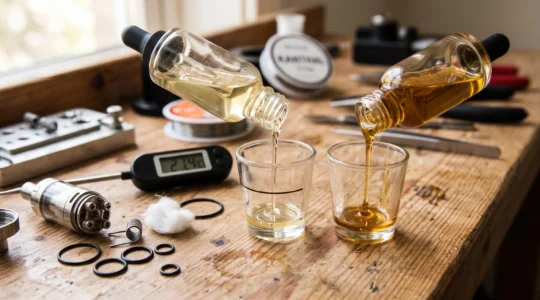
How Does E-Liquid Viscosity Affect Wicking, Leaks and Coil Performance?
E-liquid viscosity determines how readily liquid travels from a pod or tank reservoir into the coil’s absorbent wick. When the liquid flows too slowly for the amount being vaporised, the wick can become insufficiently saturated and produce a dry hit….
Lire la suite
How Do Aromatic Flavour Profiles Develop From First Puff to Aftertaste?
An e-liquid described as strawberry cheesecake may not taste like a single, uniform mixture. One adult vaper might notice a bright berry impression immediately, recognise a creamy character during exhalation, and detect a faint baked note afterwards. Another might experience…
Lire la suite
How Do E-Liquid Flavourings Shape Taste Across Different Vape Setups?
An e-liquid that tastes bright and sharply defined in a compact pod may seem rounder, sweeter or less distinctive in a larger tank. The flavour concentrate has not necessarily changed. Instead, the device alters how the liquid is heated, how…
Lire la suite
Why Is High-Purity Vegetable Glycerin Used in Vape Liquid Formulations?
High-purity vegetable glycerin (VG) is used in vape liquid formulations because it provides a relatively thick, mildly sweet base that contributes to visible aerosol production while allowing manufacturers to control ingredient quality and consistency. Its physical characteristics influence how an…
Lire la suite