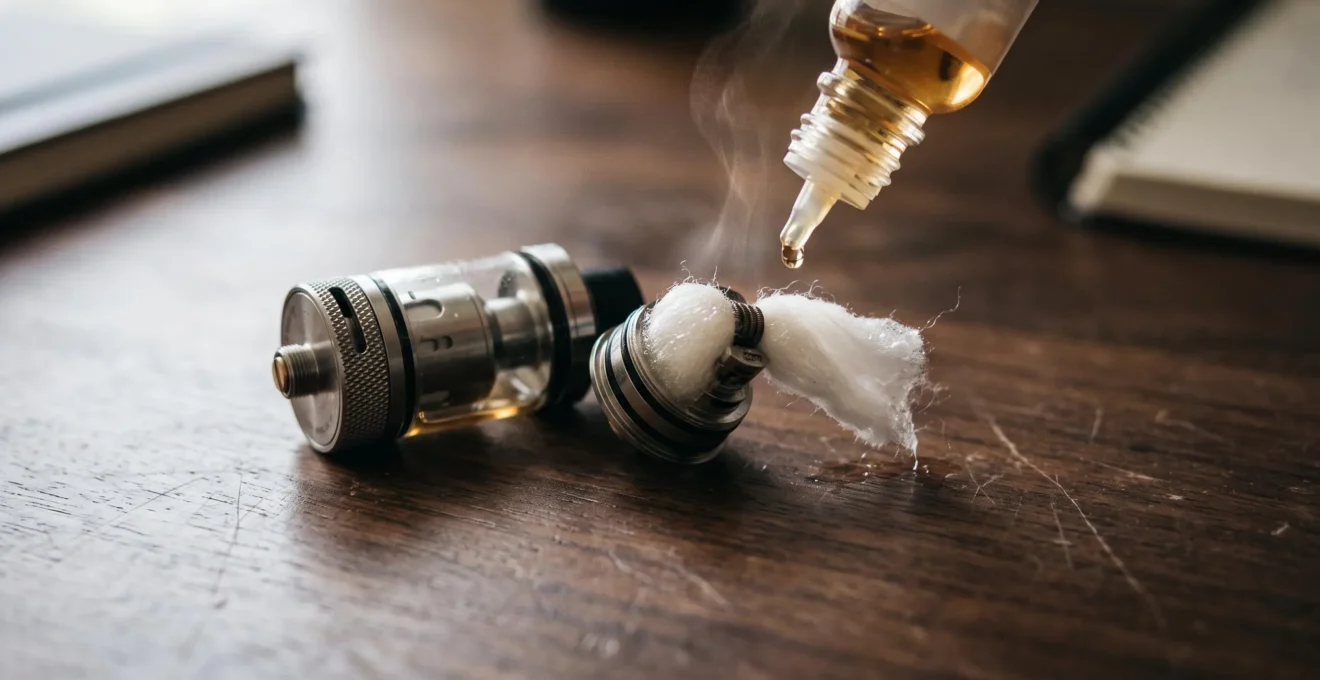
Proper wick saturation means keeping enough e-liquid in contact with the heating coil to replace what evaporates during each puff, without allowing excess liquid to accumulate inside the atomizer. The goal is not to make the cotton as wet as possible. It is to maintain a controlled, continuous supply of liquid at the heating surface.
In a vape tank or rebuildable atomizer, the wick acts as a capillary transport system. Its material, density, placement and contact with the coil determine how readily liquid moves from the reservoir into the heated region. Power settings, puff frequency and e-liquid viscosity affect how quickly that supply is consumed and replenished.
When the balance fails, the symptoms can appear contradictory: a tank may contain plenty of liquid yet produce a dry hit, while an excessively wet coil may gurgle, spit or leak. Understanding the difference makes it easier to identify whether the problem lies in priming, wick geometry, liquid compatibility or operating conditions.
Wick saturation: the essentials
- Balance supply with consumption. The wick must replenish liquid at a rate that supports the coil’s operating power and puff frequency.
- Prime thoroughly but avoid pooling. Allow liquid to penetrate the cotton before firing a new coil, without filling the central airflow passage.
- Match the complete setup. Cotton density, liquid viscosity, wick placement and power settings must work together to avoid both dry hits and flooding.
- Why Do Dry Hits Happen Even When a Vape Tank Still Contains E-Liquid?
- Why Can a Saturated-Looking Wick Still Produce a Dry Hit?
- How Should You Saturate a New Vape Wick Before the First Puff?
- Loose or Tight Wick: Which Cotton Density Gives More Stable Saturation?
- Which Wicking Mistakes Cause Dry Hits at One Extreme and Flooding at the Other?
- When Should You Wait for Wick Saturation Before Using a Freshly Filled Vape?
- How Can You Restore Wick Saturation After a Dry Hit Without Immediately Replacing the Coil?
- Which Viscosity Mismatches Cause Flooding or Dry Hits in a Vape Tank?
Why Do Dry Hits Happen Even When a Vape Tank Still Contains E-Liquid?
Dry hits occur when insufficient e-liquid reaches the heated coil, even though the tank may still contain liquid. The problem is often a mismatch between the coil’s evaporation rate and the wick’s capillary replenishment rate. Restricted liquid channels, poor cotton contact, excessive power or repeated puffs can all create this imbalance.
The reservoir stores e-liquid, but it does not deliver liquid directly across the entire heating surface. That function belongs to the wick. Capillary forces draw liquid through the cotton or other porous material toward the coil, where heat converts part of it into aerosol.
As the coil evaporates liquid, the wick must continuously replace it. If consumption exceeds replenishment, the liquid content near the heating surface decreases. Less energy is then absorbed by evaporation, allowing temperatures to rise and creating conditions associated with an unpleasant dry or burnt sensation.
A Scientific Reports study on capillary evaporation in electronic cigarette wicks examined how electrical power, wick porosity and PG/VG composition influence this process. Its numerical investigation covered 64 combinations of operating and material parameters, demonstrating the importance of matching heat input to liquid transport. The research examined a particular low-power configuration, so it does not establish universal settings for modern atomizers.
Three situations require different responses:
- Insufficient reservoir liquid: The intake openings are no longer adequately supplied. Refill the tank within its specified limits.
- Restricted liquid delivery: Compressed cotton, obstructed ports or poor wick placement prevent liquid from reaching the heating surface. Correct the obstruction or wick installation.
- Temporary local depletion: Liquid reaches the wick but cannot replenish the heated region quickly enough during repeated or powerful puffs. Reduce power or allow more recovery time.
Airflow and puff duration also affect the thermal conditions around the coil. A setting that behaves adequately during short, spaced puffs may become unstable during longer consecutive draws.
Once the reservoir and liquid path have been checked, the next distinction is whether the cotton is genuinely saturated throughout or merely appears wet where it is visible.
Why Can a Saturated-Looking Wick Still Produce a Dry Hit?
A wick can look saturated while delivering too little liquid to the coil because visible surface wetness does not guarantee uniform saturation inside the cotton. Compressed fibers, incomplete priming, trapped air or uneven coil contact can leave local dry regions. These problems may remain unnoticed until sustained heating exposes the poorly supplied area.
Cotton is a porous network rather than a solid sponge that wets uniformly at once. Liquid must penetrate interconnected spaces between fibers. The movement depends on capillary pressure, permeability, liquid viscosity and the geometry of the wick.
When liquid first contacts the exterior, it may darken the visible fibers before reaching the center. This is particularly relevant when thick cotton is tightly compressed through a coil or when a new wick has only been wetted briefly.
Surface tension and trapped air can further restrict penetration. Air remaining within the wick or around the intake openings may interfere with liquid entry until the pressure and wetting conditions change. Gentle unpowered draws can sometimes encourage liquid movement, although repeated suction can also pull excess liquid into the chamber.
Another misleading sign is the presence of flavor and visible aerosol. A partially supplied wick may continue producing both for several puffs because some regions remain wet. A hotter, under-supplied region can develop gradually, making harshness or a burnt note appear late rather than immediately.
Experimental research supports the distinction between available liquid and adequate coil wetting. An experimental study of electronic cigarette coil temperatures found that a tested top-coil clearomizer operated at higher peak temperatures when liquid arrived through the wick than under fully wetted conditions.
145–334°C
Reported peak coil temperatures under wet-through-wick conditions in the tested top-coil clearomizer. These values are specific to the experimental apparatus and must not be treated as universal vaping temperatures or dry-hit thresholds.
Original experimental coil-temperature study, 2018.
For a practical check, first ensure that the tank is assembled correctly and that liquid can reach the wick openings. An unpowered draw may help identify obvious airflow or gurgling problems, but it cannot prove that the cotton core is fully wet. If the device permits it, follow with a short test puff at the lower end of the coil’s approved power range.
Unexpected harshness or an altered flavor is a reason to stop firing and investigate, not to continue until the cotton appears wetter.
Visual inspection is therefore only one part of a saturation check. Reliable preparation starts with allowing liquid to reach the wick interior before the coil is heated.
How Should You Saturate a New Vape Wick Before the First Puff?
To saturate a new vape wick, apply a controlled amount of compatible e-liquid to its accessible cotton intake areas, install the coil correctly and allow additional liquid to soak through from the filled reservoir. Avoid pouring liquid into the central airflow passage. Begin at a low permitted power setting and stop if the first test puff tastes dry or burnt.
Priming gives the capillary network time to fill before evaporation begins. The correct technique depends on whether the device uses a replaceable factory coil or a user-installed wick in a rebuildable atomizer.
For a replaceable coil, the priority is wetting the manufacturer’s designated cotton openings without saturating the central air channel. For a rebuildable, exposed cotton can be wetted directly before final assembly, ensuring the material inside the coil receives liquid rather than only the visible tails.
Innokin‘s official coil and tank troubleshooting instructions provide an example of manufacturer-specific priming advice. One documented procedure calls for approximately one drop of liquid per cotton juice port, followed by installation in a tank filled to roughly three-quarters of capacity and a wait of at least 15 minutes. These quantities and timings should not be generalized to unrelated coil designs.
A careful priming sequence is:
- Confirm that the e-liquid and power requirements are compatible with the coil or atomizer.
- Identify accessible wick intake openings and apply small amounts of e-liquid where the cotton is exposed, following the device instructions.
- For rebuildables, wet the cotton passing through the coil and check that the tails sit correctly in their liquid channels.
- Reassemble the tank, inspect its seals and fill it without exceeding the designated fill limit.
- Allow sufficient soak time, then make a short, gentle test puff at the lowest suitable setting within the manufacturer’s recommended range.
Do not dry-fire installed cotton. Heating a poorly saturated wick can scorch fibers before adequate liquid delivery is established. Later saturation cannot necessarily remove a burnt flavor produced by damaged cotton.
Excessive priming creates a different problem. Liquid that pools inside the central chamber rather than entering the cotton can contribute to gurgling, spit-back and leakage. More liquid is not a substitute for sufficient absorption time.
Five checks before using a freshly primed wick
- Confirm the coil specification: Identify the compatible liquid guidance and the printed or documented power range.
- Inspect wick access: Verify that the visible cotton intake ports are unobstructed and correctly positioned.
- Apply liquid carefully: Confirm that accessible cotton is wetted without a visible pool in the central airflow passage.
- Check the assembled tank: Verify that the coil is seated, seals are fitted and liquid remains within the specified fill limit.
- Perform a cautious readiness test: After the recommended soak period, confirm that a brief low-power puff produces no immediate harsh or burnt note.
Priming can establish initial wetness, but it cannot compensate for a wick that is permanently too compressed or incorrectly positioned. Cotton density becomes especially important in rebuildable atomizers.
Loose or Tight Wick: Which Cotton Density Gives More Stable Saturation?
Neither extremely loose nor tightly packed cotton produces universally stable saturation. A wick needs enough contact with the coil to deliver liquid across its heating surface, while retaining sufficient permeability for fresh e-liquid to move through the fibers. The best density depends on coil geometry, liquid viscosity, power and the design of the intake channels.
Compression changes the spaces between cotton fibers. Moderate contact helps distribute liquid near the metal surface, but excessive compression can reduce permeability and slow replenishment. The cotton may remain wet at its exposed ends while the heated center becomes insufficiently supplied.
Too little cotton introduces another difficulty. Gaps between the wick and coil can produce inconsistent contact, while loosely filled juice channels may admit liquid faster than the atomizer can retain and vaporize it.
In rebuildable systems, two dimensions must be considered independently: the density of cotton passing through the coil and the amount of cotton occupying the liquid channels.
Their effects are not interchangeable. Increasing the length of a wick tail does not necessarily increase saturation. A longer tail may increase resistance or block a channel, while a tail that is too short to maintain the intended liquid contact can also interrupt supply.
The following comparison is a practical diagnostic guide rather than a universal cotton-density specification.
| Condition | Likely effect | Adjustment to evaluate |
|---|---|---|
| Cotton compressed tightly inside the coil | Restricted liquid transport through the heated region | Reduce compression while preserving reliable coil contact |
| Cotton too loose inside the coil | Uneven coil contact and localized overheating | Increase contact without forcing the cotton into place |
| Juice channels packed too firmly | Slower liquid entry and possible dry hits | Reduce tail density or reposition fibers |
| Juice channels insufficiently filled | Excess liquid entry, gurgling or leakage | Restore the channel coverage required by the atomizer design |
High-VG e-liquids generally have greater viscosity and may require a less restrictive liquid path. Thinner high-PG mixtures may enter more freely, making insufficient channel coverage particularly problematic. These tendencies must be considered alongside the actual atomizer geometry.
For rebuildables, change one variable at a time and evaluate the result at an appropriate power setting. A change in cotton density is easier to interpret when liquid composition and puff behavior remain the same.
Factory coil heads do not normally allow cotton density adjustments. In those systems, the practical options are checking compatibility, modifying permitted power settings and replacing a defective or unsuitable coil.
Once the wick has an appropriate fit, remaining problems often come from operating habits or installation mistakes that push liquid delivery toward either starvation or flooding.
Which Wicking Mistakes Cause Dry Hits at One Extreme and Flooding at the Other?
The most common wicking mistakes disrupt the balance between liquid entering the atomizer and liquid consumed at the coil. Over-compressed cotton, obstructed channels, inadequate priming and excessive puff frequency tend to produce under-saturation. Poorly sealed tanks, insufficient wick coverage, over-priming and excess liquid entering the airflow chamber can produce flooding instead.
A dry hit signals inadequate liquid at the heating surface. Flooding indicates excessive liquid in a region where it cannot be adequately contained or vaporized. Although both involve liquid delivery, their causes are not always opposites, and some symptoms reflect mechanical faults rather than wick density alone.
Chain vaping illustrates the distinction. Closely spaced puffs can consume liquid faster than capillary action replenishes it, increasing the risk of local dryness. However, gurgling during repeated use does not automatically mean the wick is too wet because of puff frequency; the problem may instead involve poor atomization, excess liquid intake or condensation.
Heat also complicates diagnosis. Repeated activation can alter liquid viscosity and the thermal state of the coil, while uneven cotton contact creates areas with different local temperatures. The result may be inconsistent vapor production rather than a simple all-dry or all-wet condition.
Different symptoms call for different investigations:
- Burnt taste after successive puffs: Examine puff spacing, operating power and the wick’s replenishment path.
- Gurgling immediately after priming: Check for excess liquid in the central airflow channel.
- Leakage after reassembly: Inspect seals, coil seating, fill level and channel coverage before changing the liquid.
- Dry hits immediately after installing cotton: Check priming, coil contact and compressed or misplaced fibers.
- Persistent burnt taste despite rewetting: Inspect for scorched cotton or a coil that requires replacement.
For example, an excessively long wick tail may obstruct a feed channel in one atomizer, while another design requires longer tails to reach and cover its intake area. Treating wick length as a universal adjustment can therefore make the original fault worse.
Repeated firing when the wick is under-supplied is particularly undesirable. Overheating can scorch cotton or leave persistent deposits that interfere with normal operation. Once damage is established, adding more liquid will not restore the original condition.
The most reliable correction is to identify the failure mode before changing hardware. A gurgling tank should not automatically receive more cotton, just as a dry-tasting tank should not automatically receive more liquid.
Correcting these faults becomes easier when the wick has been allowed to absorb liquid fully after installation or refilling, without assuming that every refill requires the same waiting period.
When Should You Wait for Wick Saturation Before Using a Freshly Filled Vape?
Wait for wick saturation whenever a new coil, newly installed cotton or previously depleted wick needs time to absorb e-liquid. A coil that is already wet usually requires less replenishment time than a completely fresh one. The correct waiting period depends on manufacturer guidance, wick density, liquid viscosity and the atomizer’s liquid-feed design.
A single waiting time is not reliable across all tanks. A small wick with open liquid channels behaves differently from a densely packed coil head supplied through narrow intake openings.
The first distinction is whether the wick has been replaced. Fresh cotton needs liquid to penetrate throughout the material before heating begins. In contrast, refilling a tank while its wick remains adequately wet may require little additional soaking, provided the liquid supply was never interrupted.
Rebuildable users should distinguish dry-burning a bare metal coil during maintenance from heating an installed cotton wick. Cotton must be removed before any dry-burning procedure, and the replacement wick must then be fully saturated before use.
The PG/VG mixture also matters. More viscous liquids generally penetrate restrictive channels more slowly. Temperature, coil construction and fiber packing can further influence the time required.
Manufacturer instructions should take precedence over generic advice. Some coil manufacturers specify a minimum soak period or a staged power increase, while others provide different procedures for their products.
Readiness indicators are useful, but none provides a perfect independent measurement of internal saturation. Visible wetting at accessible ports indicates that liquid has reached those areas; it does not prove the entire wick is uniformly supplied. Similarly, the absence of gurgling confirms only that obvious excess liquid is not present in the air channel.
After the recommended waiting period, a short test puff at an approved low setting provides an additional check. Consistent vapor and the absence of unexpected harshness are encouraging observations, although they cannot guarantee that every fiber is fully saturated.
Any inspection should be performed with the device switched off where appropriate, and the tank should be fully reassembled before activation. Loosening a coil base is not a standard readiness test and may compromise the seal or electrical connection.
Waiting longer cannot correct obstructed liquid ports, incorrectly installed cotton or defective seals. If the wick repeatedly fails to supply liquid after an appropriate soak, the next step is to investigate the delivery path.
The same distinction applies after an accidental dry hit: some wicks are only temporarily depleted, while others have already suffered damage that additional waiting cannot reverse.
How Can You Restore Wick Saturation After a Dry Hit Without Immediately Replacing the Coil?
After a dry hit, stop activating the device and allow the wick to absorb e-liquid again before testing it at reduced power. Check that the reservoir supplies the intake ports and that the wick is not obstructed. If the cotton was only temporarily depleted, normal operation may return; persistent burnt flavor suggests damage requiring replacement.
A brief dry sensation does not necessarily mean the entire coil is unusable. Sometimes the liquid supply has fallen behind consumption without permanently scorching the cotton. Stopping immediately reduces the risk of further overheating.
Begin with the cause rather than the symptom. Check the remaining liquid level, inspect any accessible feed openings and confirm that the operating power remains within the coil’s approved range.
Next, leave the device unpowered while the cotton reabsorbs liquid. Several minutes may be useful for a temporarily depleted wick, but the appropriate period depends on the hardware and liquid. If the wick is exposed in a rebuildable atomizer, a small amount of compatible liquid can be applied directly to dry-looking cotton without creating a pool.
Gentle unpowered draws may help establish liquid flow in some designs. They should not be forceful or repeated excessively, because suction can move surplus liquid into the airflow chamber.
Once the wick has had time to recover, reassemble the atomizer correctly and use a short test puff at a lower approved power setting. If flavor and vapor production return without harshness, temporary under-saturation may have been responsible.
If the burnt note persists, stop using the coil. Scorched cotton cannot be repaired simply by adding e-liquid. Replace the wick in a rebuildable atomizer or the replaceable coil head in a factory-coil tank, following the relevant maintenance instructions.
Recovery should also change the conditions that caused the problem. If repeated puffs depleted the wick, increase the interval between draws. If the coil was operating at excessive power, reduce it within the approved range. If liquid delivery is structurally restricted, correct the wick placement or use suitable replacement hardware.
Adding large quantities of liquid after a dry hit is not a reliable remedy. It can flood the chamber while leaving the original transport restriction unresolved.
When a correctly installed, adequately primed wick repeatedly dries out, liquid viscosity becomes an important remaining variable to assess.
Key takeaways before choosing an e-liquid
- A wick can be correctly positioned yet remain under-supplied if the liquid cannot move through its channels quickly enough.
- Persistent gurgling may indicate excessive liquid entry, but seals, assembly and power settings must also be checked.
- Evaluate VG/PG composition together with the atomizer’s intended liquid range rather than relying on a universal mixing ratio.
Which Viscosity Mismatches Cause Flooding or Dry Hits in a Vape Tank?
Viscosity mismatches occur when an e-liquid is too resistant to flow, or flows too freely, for the atomizer’s wick and liquid channels. Thick high-VG liquids may replenish restrictive coils too slowly and contribute to dry hits. Thin high-PG liquids may enter loosely wicked systems too readily, increasing the possibility of flooding or gurgling.
Vegetable glycerin (VG) and propylene glycol (PG) have different physical properties. Increasing the VG proportion generally makes an e-liquid more viscous, while increasing the PG proportion generally produces a thinner mixture. Water content, flavor ingredients and temperature can also affect the final formulation.
This relationship has an experimental basis. American Chemical Society research on PG, glycerol and water viscosity developed an empirical model relating liquid composition and temperature to viscosity, evaluated over a range of 20–80°C. The study provides physical evidence for viscosity differences but does not directly establish consumer-specific thresholds for flooding or dry hits.
For practical device selection, the width of the feed channels and the manufacturer’s intended liquid specifications matter more than a single universal VG/PG recommendation.
| Setup | Potential mismatch | What to investigate |
|---|---|---|
| Low-power pod with narrow intake channels | Very thick liquid may replenish the wick too slowly | Use the manufacturer’s supported liquid range and check for restricted feed ports |
| High-power sub-ohm tank | Very thin liquid may enter certain coil designs excessively | Verify coil compatibility, sealing and liquid recommendations |
| Rebuildable atomizer with tightly packed cotton | High viscosity combined with restricted permeability can produce local dryness | Adjust cotton compression and channel coverage within the atomizer’s design requirements |
| Rebuildable atomizer with insufficient channel coverage | Low-viscosity liquid may enter the chamber faster than it is retained or consumed | Correct wick placement and inspect liquid seals |
High-power sub-ohm systems often accommodate relatively VG-rich liquids because their wicking structures may be designed for greater liquid consumption. Smaller mouth-to-lung systems and some pod devices frequently operate more effectively with thinner liquids that can pass through narrow feed openings. These are broad compatibility patterns, not guarantees for every product.
Temperature adds another variable. Liquids generally become more viscous as they cool. A formulation that feeds reliably in a warm indoor environment may move more slowly through the same cotton and channels in colder conditions. The precise change depends on composition, and the available viscosity study does not directly establish performance at outdoor temperatures below its investigated range.
Symptoms can help narrow the diagnosis:
- Dry hits at moderate approved power: If the coil is correctly primed and its liquid channels are clear, check whether the e-liquid is too viscous for the feed geometry.
- Persistent gurgling or spit-back: Check for excess liquid entry, incorrect power, poor sealing and condensation before concluding that the liquid is too thin.
- Problems that worsen in cold conditions: Consider whether reduced liquid mobility is contributing to slower wick replenishment.
- Different behavior after changing e-liquid: Compare the previous and current formulations, while keeping power and puff behavior consistent during troubleshooting.
Viscosity is only one part of capillary transport. Wick porosity, contact area, channel dimensions, reservoir pressure and coil heat input also determine how reliably liquid reaches the heating surface. Changing liquid formulation without addressing an obstructed or damaged wick may not solve the problem.
For the next practical check, use the coil manufacturer’s liquid and power specifications, confirm unobstructed wicking, and observe whether the problem occurs immediately or only after repeated puffs. This helps identify the limiting factor without over-priming the coil or unnecessarily replacing working components.
Can a vape wick be too saturated?
Yes, in the practical sense that excess e-liquid can accumulate outside the cotton and enter the atomizer’s airflow chamber. Cotton saturation itself is not the same as flooding. Flooding occurs when liquid enters or remains in areas where the device cannot retain or vaporize it properly, often causing gurgling, spit-back or leakage.
Does increasing airflow improve wick saturation?
Airflow can change coil temperature and vaporization conditions, but it does not directly remove a restriction inside the cotton. Increasing airflow may affect thermal behavior in some atomizers, yet a compressed wick, obstructed intake or incompatible liquid still requires a correction to the liquid-delivery system.
Can a coil flood even when the wattage is within its recommended range?
Yes. The recommended wattage range does not guarantee correct liquid containment. Poor seals, incorrect coil seating, inadequate wick coverage, overfilling or excess liquid from priming can contribute to flooding even when electrical power is appropriate. Check assembly and liquid-feed conditions before increasing wattage.
Should cotton be completely replaced after every dry hit?
Not necessarily. A briefly depleted wick may recover after the liquid supply is restored and the cotton has time to re-saturate. However, persistent burnt taste after adequate rewetting suggests scorching or deposits that cannot be corrected by adding more liquid. In that situation, replacing the cotton or coil is the appropriate response.
Is visible bubbling near the wick ports proof that e-liquid is feeding correctly?
No. Bubbles can indicate air displacement as liquid enters a wick or feed channel, but their presence or absence does not establish adequate saturation at the coil. Liquid transport depends on the internal wick structure and operating conditions, so bubbling should be treated as an observation rather than a definitive diagnostic test.