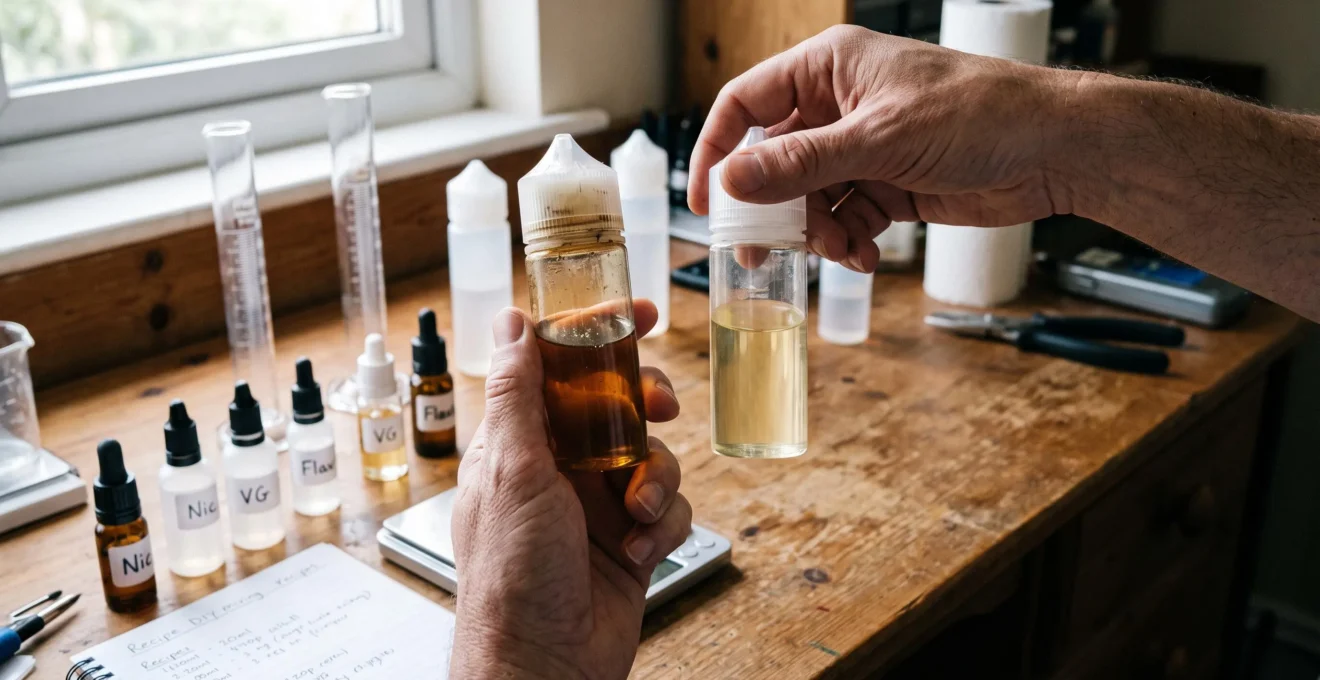
E-liquid steeping is the practice of allowing a freshly mixed formulation to rest before evaluating its flavour. During this period, the liquid may become more uniform, certain flavouring ingredients can undergo chemical reactions, and some aromatic compounds may gradually degrade. These processes can change the balance between individual flavour notes, although the result is not necessarily an improvement.
Propylene glycol (PG), vegetable glycerin (VG), flavour concentrates and, where present, nicotine form a mixture whose composition can continue evolving after preparation. Resting may affect how the liquid is perceived, particularly in recipes containing several flavour components. However, flavour changes also depend on storage conditions, the ingredients involved and the equipment used to evaluate the liquid.
The practical purpose of steeping is therefore not to achieve the longest possible resting period. It is to identify whether a particular formulation develops a preferred sensory profile while limiting unnecessary exposure to heat, light and oxygen. Scientific evidence supports the existence of chemical changes during storage, but does not establish a universal steeping duration or guarantee better flavour.
E-Liquid Steeping: Essential Points
- Resting can change flavour balance through physical mixing, ingredient reactions and gradual degradation, but it does not automatically improve taste.
- Consistent storage in tightly closed containers, protected from excessive heat and light, helps reduce unwanted changes.
- Comparing small samples under consistent conditions is more informative than following a fixed steeping schedule.
- Why Do Some E-Liquids Taste Different After Several Days of Resting?
- How Should You Store E-Liquid During a Steeping Period Without Adding Unwanted Variables?
- Freshly Mixed or Steeped E-Liquid: Which Better Suits Complex Flavour Blends?
- Which Steeping Mistakes Can Degrade E-Liquid Instead of Improving Flavour?
- When Should You Stop Steeping an E-Liquid and Evaluate the Final Flavour?
- How Should Vegetable-Glycerin-Based E-Liquid Be Stored After Opening?
- How Can You Compare Two E-Liquid Flavours Without Your Previous Liquid Distorting the Result?
- How Do Aromatic Flavour Profiles Develop From First Puff to Aftertaste?
Why Do Some E-Liquids Taste Different After Several Days of Resting?
E-liquids can taste different after several days because their ingredients may become more evenly distributed and some flavouring chemicals react or degrade during storage. These changes can alter the relative prominence of individual notes. However, perceived differences may also reflect palate adaptation, equipment conditions or expectations rather than changes in the liquid itself.
Immediately after mixing, a formulation may not be completely uniform, especially if viscous VG and flavour concentrates have not been thoroughly combined. Adequate initial mixing helps distribute the ingredients. Subsequent resting can allow further diffusion, although physical homogenisation should not be confused with chemical maturation.
The expression « flavour bonding » is often used informally to describe steeping. In chemical terms, however, not all flavour ingredients bond with one another. Some remain relatively stable, whereas particular molecules undergo identifiable reactions.
For example, the PubMed record of the Kerber and Peyton e-liquid reaction study describes how selected aldehyde flavourants react with PG and glycerol to form acetals. Reaction rates and product formation depended on solvent composition and additives. These findings establish that some mixtures undergo genuine chemical change, not that the resulting flavour necessarily becomes more pleasant.
Flavour family also matters. A layered vanilla, cream or tobacco-style recipe may be perceived as more cohesive after resting because initially prominent components become less dominant relative to others. This is a practical formulation expectation rather than a scientifically established rule for every dessert or tobacco liquid. Simple fruit formulations may already deliver their intended character when freshly mixed.
Changes in perception can complicate the comparison. Repeated exposure to the same aroma can reduce its apparent intensity, while different devices or coil conditions may produce different impressions. A liquid that seems smoother later might not have changed as much as the user’s sensory response.
Resting can also have an undesirable effect. Some aromatic compounds deteriorate during storage, potentially reducing the intensity of delicate notes. Longer steeping should therefore never be assumed to produce a better balance.
To distinguish desirable development from degradation, the next priority is keeping storage conditions sufficiently consistent that time remains the main variable under observation.
How Should You Store E-Liquid During a Steeping Period Without Adding Unwanted Variables?
Store e-liquid in a clean, compatible, tightly closed bottle, away from direct sunlight, excessive heat and unnecessary air exposure. Keep storage conditions consistent between samples, label the mixing date and avoid repeatedly opening the container. These measures reduce confounding variables, making it easier to evaluate changes associated with resting time.
Three environmental influences deserve particular attention: light, temperature and oxygen exposure. Their effects are not interchangeable. Light can promote photochemical degradation, elevated temperatures may accelerate chemical reactions, and contact with oxygen can contribute to oxidation of susceptible ingredients.
A 2025 ACS Omega study on e-liquid flavour stability examined 20 flavouring chemicals in reference formulations, alongside commercial e-liquids, under different storage conditions over 24 months. The findings illustrate why environmental control matters, although the study investigated chemical stability rather than short-term sensory steeping.
11 of 20
Individual flavouring compounds in reference solutions lost at least 50% of their measured concentration after six months at ambient temperature with light exposure. The figure concerns laboratory chemical stability, not a measured loss of perceived flavour or a recommended steeping period.
Page and colleagues, ACS Omega, 2025.
A closed cupboard or drawer in a temperature-stable room is a practical default. By contrast, a sunny windowsill introduces light and temperature fluctuations, while a radiator or warm appliance creates avoidable heating. Bottles kept in separate locations may therefore develop differently even when prepared from the same recipe.
Common steeping shortcuts involve trade-offs. Leaving the cap off, sometimes called « breathing », increases contact with air and can allow volatile compounds to escape. Warm-water baths may temporarily lower viscosity and help with physical mixing, but deliberate heating also changes reaction conditions. Neither technique has been demonstrated by the supplied research to deliver a universally better flavour outcome.
Container compatibility is another consideration. Certain concentrated flavouring ingredients, including some citrus- or cinnamon-associated compounds, can interact with unsuitable plastics. For formulations with uncertain packaging compatibility or prolonged storage requirements, appropriately selected glass containers may be preferable. Compatibility depends on the specific ingredients, concentration and container material; glass should not be treated as a guarantee against every storage problem.
Labels recording the recipe, preparation date and storage location make observations easier to interpret. Store nicotine-containing liquids securely, away from children and pets, and follow the manufacturer’s storage guidance where available.
Once storage is controlled, the next decision is whether a particular recipe offers any sensory reason to be rested in the first place.
Freshly Mixed or Steeped E-Liquid: Which Better Suits Complex Flavour Blends?
Complex e-liquid blends may be perceived as more integrated after resting, particularly when several strong flavour components compete for attention. Simpler formulations may already express their intended profile when freshly mixed. Neither approach is universally preferable: the appropriate evaluation point depends on the recipe, its chemical stability and the user’s sensory preferences.
Recipe complexity increases the number of potential sensory interactions. A single flavour concentrate may present a relatively straightforward aromatic profile, while a bakery-style formulation might combine vanilla, cream, caramel, nut and toasted notes. The intended balance can be harder to judge immediately after preparation.
Mixers often describe the apparent blending of multiple notes as « flavour marriage ». This expression refers to a perceived outcome, not a universal chemical reaction. In some mixtures, actual reactions between certain ingredients and solvents may contribute to compositional changes. In others, differences may mainly reflect physical distribution, loss of volatile compounds or the way aromas are perceived together.
The following grid provides a practical starting point for evaluation, not experimentally established steeping requirements.
| Recipe type | Freshly mixed evaluation | Rested evaluation |
|---|---|---|
| Single-note fruit | Useful for assessing immediate brightness and clarity | Useful for detecting fading or unwanted changes |
| Light fruit combinations | Shows whether the opening notes are distinct | Reveals whether the balance changes during storage |
| Cream and vanilla blends | Highlights individual components and possible imbalance | Tests whether perceived cohesion develops |
| Layered bakery or dessert | Establishes the initial balance of competing notes | Tests whether the intended flavour structure becomes more coherent |
| Complex tobacco-style blends | Documents prominent aromatic components | Checks for changes in balance, sharpness or overall intensity |
Freshness may itself be desirable. Someone who values a bright citrus opening or a sharply defined fruit note might prefer a newly prepared mixture. Another person may favour a rounder profile in which no individual component stands out as strongly.
A single formulation can also pass through several perceptible stages. For example, a hypothetical vanilla-fruit mixture might initially emphasise fruit, later appear more balanced, and eventually lose some of its brighter character. This illustrates possible sensory development rather than a predictable sequence or validated timeline.
The most useful comparison is therefore between the same recipe at multiple points, with storage and device conditions held as consistent as possible. Testing separate small samples can also limit repeated exposure of the main bottle to air.
Because waiting can change a formulation in unwanted ways as well, any decision to continue steeping should consider the possibility of flavour deterioration.
Which Steeping Mistakes Can Degrade E-Liquid Instead of Improving Flavour?
The main avoidable steeping mistakes are excessive heating, prolonged light exposure, unnecessary bottle opening and continuing to rest a liquid after its preferred sensory profile has passed. These practices can accelerate chemical changes or introduce additional variables. A longer or more intensive steep does not necessarily create a smoother, more balanced or safer formulation.
Deliberate heating is particularly difficult to control outside a laboratory. Placing bottles on radiators, inside hot vehicles or near other strong heat sources can accelerate several reactions simultaneously. Any apparent increase in mixing speed must be weighed against the possibility of flavourant degradation and changes to nicotine-containing formulations.
Some ingredients are more chemically reactive than others. Research on selected aldehyde flavourants demonstrates that reactions can begin after mixing at room temperature and generate new compounds.
The PubMed record of the Erythropel e-liquid chemistry study reports the formation of flavourant–PG acetals from particular aldehyde-containing ingredients. The investigators also examined the transfer of these reaction products into aerosol and identified toxicological properties different from those of the original compounds. Such findings caution against equating chemical maturation with improved safety.
Endless steeping creates a different problem. A mixture that initially seems well balanced may later become less expressive if some volatile or unstable components decline. The remaining notes can then appear disproportionately prominent without necessarily increasing in absolute concentration.
Possible warning signs include weaker fruit or floral top notes, an unexpectedly muted profile, unusual odours or an increasingly unpleasant sensation during use. Darkening can accompany chemical changes, but colour alone cannot establish whether a liquid is degraded, acceptable or safe.
Frequent testing directly from the main bottle also complicates interpretation. Every opening changes the exposure conditions, especially as the bottle empties. Smaller, separately labelled samples provide a more controlled comparison.
Finally, a formulation that already has its intended flavour does not require an elaborate steeping ritual. Unnecessary delays may simply give unstable components more time to change.
The remaining challenge is identifying that state through repeatable observations rather than relying on a predetermined number of days.
When Should You Stop Steeping an E-Liquid and Evaluate the Final Flavour?
Stop steeping when repeatable sensory checks show that the liquid has reached the balance you prefer and further resting produces no meaningful improvement. Two consecutive evaluations with no perceptible change can provide a practical stopping signal, although they cannot prove chemical stability. Unusual deterioration is a reason to stop rather than continue experimenting.
Evaluation should begin with a baseline recorded soon after mixing. Note the dominant aromas, the relationship between prominent and supporting notes, and any obvious imbalance. A dated record is more useful than attempting to remember a subtle taste impression several days later.
At subsequent intervals, inspect the bottle and compare the aroma with the original notes. Changes in colour may be worth recording, but they are not a reliable standalone measure of flavour quality or chemical safety. Any unexplained contamination, damaged packaging or abnormal appearance should take precedence over tasting goals.
Where sensory testing is undertaken by existing adult users, compare only liquids from known, appropriately formulated sources using suitable equipment. Avoid changing device settings during comparisons. Inhaling aerosol is not a chemical safety test, and improved subjective flavour does not establish reduced exposure or reduced risk.
A plateau means that changes are no longer noticeable under the chosen evaluation conditions. It does not mean all molecular reactions have stopped. Storage-related reactions and degradation may continue after the preferred sensory point is reached.
Five Checks for a Consistent Steeping Evaluation
- Label each sample with its recipe, mixing date and storage location; keep a dated identification record.
- Record the initial aroma and perceived balance of the flavour components; create a baseline tasting note.
- Keep comparison samples in equivalent closed containers under consistent storage conditions; document the conditions used.
- Assess samples at recorded intervals with comparable equipment conditions; add a dated observation for each check.
- Compare consecutive observations and mark the preferred evaluation point; record a decision to stop, continue or discard a questionable sample.
After reaching the preferred point, keep the liquid properly closed and protected from environmental stress. If several bottles are available, clearly dated stock makes it easier to use older suitable batches before newer ones, subject to manufacturer guidance and any applicable use-by information.
A bottle described as « ready » is therefore ready according to a sensory preference, not chemically frozen in time. Long-term stability remains a separate consideration.
This distinction becomes especially relevant once a bottle is opened and begins experiencing repeated changes in air exposure, temperature and handling.
How Should Vegetable-Glycerin-Based E-Liquid Be Stored After Opening?
After opening, high-VG e-liquid should be kept tightly closed, away from excessive heat and light, and handled in a way that minimises unnecessary exposure to air. Its greater viscosity can change with temperature, affecting handling and device wicking. Refrigeration may slow some chemical processes but introduces practical complications and is not universally required.
VG-rich mixtures are generally thicker than formulations containing a higher proportion of PG. The difference becomes more noticeable in cooler conditions, where increased viscosity can make the liquid harder to dispense and may affect how quickly it reaches a coil. These handling effects should not automatically be interpreted as changes in flavour chemistry.
Opening a bottle introduces fresh air into its headspace. Subsequent exposure can contribute to changes in susceptible ingredients, although the extent depends on the formulation, remaining liquid volume, temperature and frequency of opening. It would be inaccurate to assign one oxidation rate to all opened high-VG products.
Refrigeration is sometimes proposed as a way to protect flavouring compounds. The ACS Omega stability study described earlier found better preservation of several compounds under cold, dark experimental conditions than under ambient light exposure. However, the investigation does not establish refrigeration as the best everyday practice for every opened commercial liquid.
Cold storage can increase viscosity and complicate dispensing or wicking until the product returns to an appropriate operating temperature. Temperature transitions and handling also need to be managed. Follow manufacturer instructions rather than imposing refrigeration on a formulation without considering its packaging and intended use.
For daily storage, a stable location protected from light and heat is a reasonable starting point. Secure the cap after use, avoid transferring the liquid unnecessarily and keep nicotine-containing products inaccessible to children and pets. Clean handling matters because storage precautions cannot compensate for contamination introduced during use.
Over time, an opened high-VG liquid may continue changing. A perceived increase in cohesion during an early resting period does not mean later fading or ingredient degradation will be beneficial.
Even with careful storage, determining whether a change is real requires a tasting method that controls the influence of previously used flavours.
How Can You Compare Two E-Liquid Flavours Without Your Previous Liquid Distorting the Result?
To compare e-liquid flavours fairly, minimise residue from the previous liquid, allow time for sensory adaptation to subside and keep equipment conditions consistent. A clean or dedicated atomiser can reduce flavour carry-over, while recorded settings and balanced testing intervals help distinguish liquid changes from differences caused by the device or the user’s palate.
Flavour carry-over occurs when residual liquid or aromatic compounds remain in a tank, wick or other equipment components. A strongly flavoured previous formulation can influence the next sample even after the reservoir has been refilled. Replacing the liquid alone may not remove that influence.
Palate fatigue introduces another variable. Repeated exposure to a strong aroma can temporarily reduce perceived intensity or alter the contrast between samples. This makes back-to-back comparisons particularly difficult when a delicate fruit blend follows menthol, cinnamon or a strongly aromatic tobacco-style formulation.
For a controlled comparison, use separate compatible testing hardware where practical, or clean and maintain equipment according to its manufacturer’s instructions. A dedicated atomiser for each sample can avoid some carry-over problems, although differences between devices and coils must still be considered.
Keep power settings, airflow, coil type and general coil condition comparable. These precautions are methodologically important because equipment conditions can affect perceived flavour. They do not eliminate every source of individual sensory variation.
For steeping comparisons, samples should come from the same formulation and be stored under documented conditions. Record the evaluation date, equipment state and perceived profile. Comparing the notes with an earlier baseline is more reliable than asking whether the latest sample simply « tastes better ».
When possible, avoid always evaluating samples in the same order. Alternating the sequence across separate sessions can help reveal order-related impressions, although this remains an informal sensory method rather than a validated laboratory protocol.
A perceived difference that disappears after cleaning the equipment or allowing sensory recovery should not immediately be attributed to steeping. Similarly, a difference observed with substantially changed power or coil condition is difficult to interpret as a liquid-only effect.
Once comparisons are sufficiently controlled, describing the individual stages of flavour perception helps identify exactly which aspects of a formulation have changed.
Key Takeaways Before Evaluating Flavour Structure
- Describe aroma development in separate stages rather than relying on a single overall judgement.
- Consider whether a weaker top note reflects chemical change, sensory adaptation or different device conditions.
- Prefer the point where the intended balance is clearest, not automatically the oldest available sample.
How Do Aromatic Flavour Profiles Develop From First Puff to Aftertaste?
E-liquid flavour is perceived through several overlapping stages: the initial aromatic impression, the fuller body of the flavour and the lingering aftertaste. Steeping may change the relative intensity of compounds contributing to these stages. However, perception also depends on volatility, sensory adaptation and device conditions, so a changed flavour sequence does not necessarily prove chemical maturation.
The initial impression, often called the top note, can involve relatively volatile aromatic ingredients that become noticeable quickly. Citrus-associated and certain light fruit compounds may contribute to this stage, although a flavour’s name alone does not reliably predict its chemical stability.
The middle of the sensory experience provides the perceived body of the blend. In a layered dessert formulation, this might include vanilla, cream-like and bakery-associated notes interacting with brighter components. These descriptions are sensory categories, not evidence that all compounds assigned to one category behave identically during storage.
The finish or aftertaste describes sensations that remain after the main flavour impression fades. Persistent aromatic compounds, cooling sensations, sweetness and other formulation characteristics may influence this stage. Duration and character can vary with the liquid and the individual evaluating it.
Steeping can change the balance between these perceived stages. If an initially prominent ingredient decreases in concentration, other components may become relatively more noticeable. Some particular aldehyde flavourants can also undergo solvent-related reactions, but the sensory implications cannot be inferred uniformly across all recipes.
Equipment further complicates interpretation. Power, airflow and coil condition influence aerosol generation and the resulting sensory experience. A comparison between an old coil and a newly fitted one may therefore produce a different flavour impression even when the liquid formulation has not changed.
A practical vocabulary helps keep observations specific:
- Sharper: a more prominent or clearly defined opening sensation.
- Rounder: a perceived reduction in contrast between competing components.
- More merged: individual notes are harder to distinguish within the overall profile.
- Flatter: reduced differentiation or intensity across the perceived flavour stages.
These descriptions are subjective and should be treated as comparative sensory observations, not direct measurements of molecular concentrations. A rounder flavour may suit one preference, while another person may regard the same shift as a loss of definition.
Tracking opening notes, body and finish separately creates a more useful record than an overall satisfaction score alone. It also makes it easier to identify when a supposedly improved blend has simply lost some of its distinctive top notes.
For an existing adult user assessing a known formulation, the practical next step is to compare dated sensory notes under consistent conditions and stop resting once the preferred balance has been reached. If a product shows unexplained deterioration, do not rely on taste or appearance to establish its safety. No steeping method makes vaping risk-free.
Does steeping reduce the health risks of vaping?
No. Steeping can alter the chemical composition of an e-liquid, and some reactions produce compounds with properties different from the original ingredients. A smoother taste is not evidence of reduced toxicity, and the supplied research does not establish steeping as a method of making vaping safer.
Can an e-liquid be chemically changing even when its flavour seems unchanged?
Yes. Chemical stability and sensory perception are different measurements. Laboratory research has identified changes in flavouring compounds during storage, but some concentration changes may not produce an obvious sensory difference. A stable perceived flavour does not establish chemical stability.
Does a darker e-liquid mean that steeping has worked?
No. Darkening may accompany chemical changes involving ingredients or storage conditions, but colour does not establish successful flavour integration. It cannot independently indicate whether a liquid tastes better, has degraded or is safe to use.
Can shaking replace a steeping period?
Shaking can help distribute components physically, particularly in a viscous mixture, but it does not reproduce every chemical process that may occur during storage. A well-mixed liquid may need no additional resting for the intended sensory profile, while other formulations may continue changing after mixing.
Can an e-liquid continue changing after it reaches its preferred flavour?
Yes. A sensory plateau indicates that further differences are not apparent under the chosen comparison conditions. Chemical reactions and degradation may nevertheless continue, particularly during prolonged or poorly controlled storage. Reaching a preferred flavour does not stop the underlying chemistry.