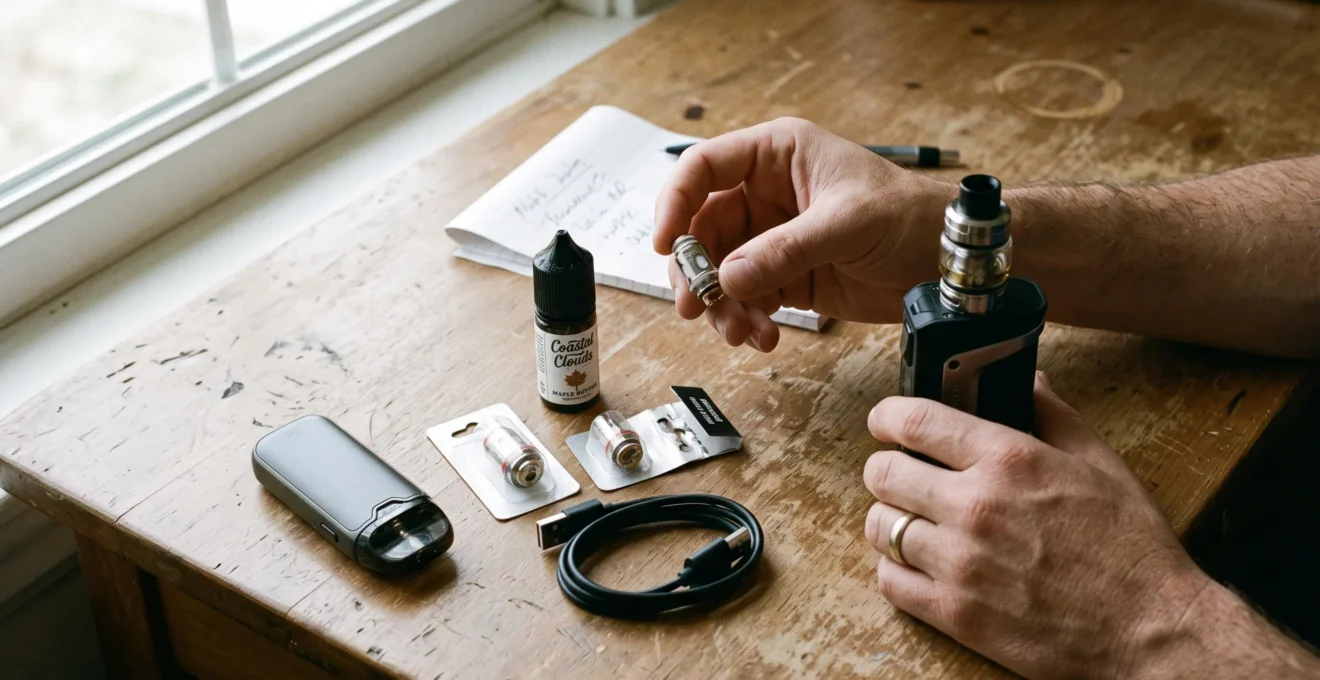
A vaping setup works best when its components are selected as a system rather than as separate products. The device must support the coil’s resistance and operating power, the tank must accommodate the correct coil family, and the airflow should suit the intended draw. Battery capacity, reservoir size and physical dimensions then determine whether the combination is practical away from home.
A powerful device is not automatically a more suitable device. A modest adjustable-power unit paired with an appropriate tank may offer more consistent operation than a larger mod running a coil outside its recommended range. Equally, a portable pod that fits comfortably in a pocket may be inconvenient if its battery or reservoir cannot cover a typical day.
For adults who already vape, or adults who smoke and are considering switching, the practical approach is to establish the required draw style and daily capacity first, verify electrical and mechanical compatibility, and then minimise unnecessary adjustments. This reduces avoidable installation problems without assuming that any vaping configuration is risk-free.
Building a compatible vaping setup: essential decisions
- Match the electrical requirements: confirm coil resistance, recommended wattage, supported device range and tank compatibility before assembly.
- Choose for actual daily consumption: assess battery endurance, e-liquid use, charging access and carrying comfort together.
- Keep the configuration manageable: standardise compatible components, check installation carefully and change one variable at a time.
- Why Can a Powerful Vape Setup Still Perform Poorly With the Wrong Component Pairing?
- How Can You Check Whether a Tank, Coil and Device Will Work Well Together?
- Compact or High-Capacity Vaping Setup: Which Better Fits a Full Day Away From Home?
- Which Compatibility Errors Should You Check Before Fitting a New Atomiser?
- How Can You Simplify a Vaping Setup for More Consistent Everyday Use?
- High-Volume or Restricted Airflow: Which Better Matches Your Draw Style?
- Straight or Bubble Glass: Which Vape Reservoir Fits Your Daily Routine Better?
- How Can You Swap Interchangeable Vape Components Without Creating Compatibility Problems?
Why Can a Powerful Vape Setup Still Perform Poorly With the Wrong Component Pairing?
A powerful vape setup can perform poorly when the device delivers power that the fitted coil cannot use effectively. Excessive power may overheat insufficiently saturated wicking, while insufficient power can produce weak vapour or inconsistent liquid vaporisation. Tank airflow and liquid supply also affect performance, so maximum device wattage alone cannot establish whether a combination will work well.
The coil’s resistance, construction and recommended operating range are more informative than the mod’s headline output. A device capable of high wattage does not require every attached coil to operate near that maximum. The appropriate setting depends on the particular coil family and its manufacturer-defined operating conditions.
For example, Innokin publishes a 30–40 W recommendation for its 0.3-ohm Z coil, compared with 10–14 W for its 0.8-ohm Z coil. These are specifications for different coils within one product family, not universal values for all coils sharing those resistance ratings. Innokin’s EZ Tube technical support documentation illustrates why resistance and coil identity must be checked together.
Nominal output is not the same as effective heating behaviour. Battery voltage under load, power regulation, ramp-up characteristics and device limits can affect how a coil responds. Two devices displaying the same wattage may therefore feel different, although such differences require device-specific testing to quantify.
Experimental evidence: liquid supply affects dry-puff conditions
A 2015 experiment published in the journal Addiction compared two atomiser configurations with different wicking arrangements. Seven experienced users tested the equipment at power settings of 6.5 W, 7.5 W, 9 W and 10 W.
All seven identified dry-puff conditions at 9 W and 10 W with the conventional single-wick atomiser, while the tested double-wick configuration did not produce reported dry puffs at those settings. The researchers also observed markedly elevated aldehyde measurements under the tested dry-puff conditions. These findings concern the specific older equipment studied and do not establish universal operating limits or prove that the absence of a burnt taste indicates safe emissions.
Operating symptoms can help narrow down the cause, but they are not definitive diagnoses:
- Burnt taste: possible insufficient wicking, unsuitable power, inadequate priming or a damaged coil.
- Gurgling: possible excess liquid in the coil chamber, incorrect assembly or filling problems.
- Weak vapour: possible low power, restricted airflow, depleted battery or coil deterioration.
- Rapid battery drain: potentially linked to power demand, usage frequency or battery ageing.
Poor matching can also increase running costs. A coil repeatedly overheated or flooded may require earlier replacement, although actual lifespan and costs depend on the product and usage conditions.
The next decision is more concrete: confirming that the selected tank, coil and device are compatible before using them together.
How Can You Check Whether a Tank, Coil and Device Will Work Well Together?
To check whether a tank, coil and vaping device will work together, confirm four things: the device supports the coil’s resistance, its adjustable power covers the coil’s recommended wattage, the tank accepts that exact coil family, and the tank’s connector is compatible with the device. Airflow and e-liquid suitability should then be assessed separately from physical and electrical compatibility.
Start with the device manual, tank specifications and coil packaging. These should provide the relevant model numbers, resistance ratings, supported components and recommended settings. If any critical compatibility detail is missing, obtain confirmation from the manufacturer rather than relying on visual similarity.
A 510-threaded tank and mod may physically connect without forming a suitable operating combination. Conversely, a pod using a proprietary magnetic connection cannot be treated as interchangeable with a conventional threaded tank simply because both contain replaceable coils.
Some devices also have operating modes or resistance limits that differ between modes. Confirm the intended mode and use the manufacturer’s supported configuration rather than assuming the chipset can safely operate every coil it detects.
Technical compatibility is only the first stage. A tank designed around a restricted draw may be inconvenient for someone seeking an open direct-lung experience, even if its resistance and power requirements are supported. Similarly, liquid viscosity and the coil’s wicking design must be considered together.
| Decision criterion | Restricted mouth-to-lung use | Open direct-lung use |
|---|---|---|
| Draw characteristics | Tighter airflow and a smaller inhaled aerosol volume | More open airflow and typically greater aerosol volume |
| Coil selection | Choose a coil explicitly supported for the intended restricted setup | Choose a coil designed for the selected airflow and power requirements |
| E-liquid compatibility | Check the manufacturer’s suitable liquid composition and wicking guidance | Confirm the coil supports the viscosity and consumption demands of the intended liquid |
| Nicotine considerations | Consider nicotine delivery, existing smoking or vaping habits and professional cessation advice | Avoid assuming that increased vapour volume requires or justifies a particular nicotine concentration |
| Device requirements | Supported resistance and power range matter more than maximum wattage | Suitable supported output, airflow and liquid supply are all necessary |
Before buying, compare the manufacturer’s specifications for the exact coil model with the device’s supported resistance range and power settings. Where available, user reports about that specific combination may reveal practical issues, but individual experiences should not replace manufacturer compatibility instructions.
Adapters and tanks that accept several coil families deserve additional scrutiny. An adapter might solve a physical connection problem without establishing electrical suitability, and coils that appear interchangeable may have different dimensions or sealing requirements.
Once compatibility is established, the next constraint is whether the resulting setup provides enough battery and liquid capacity for daily use without becoming inconvenient to carry.
Compact or High-Capacity Vaping Setup: Which Better Fits a Full Day Away From Home?
A compact vaping setup is generally more convenient to carry, while a higher-capacity configuration may reduce charging and refilling interruptions. Neither guarantees all-day operation. Actual endurance depends on battery condition, selected power, draw frequency, e-liquid consumption and access to charging. The better choice is the smallest compatible configuration that can reliably accommodate an adult user’s established routine.
Battery capacity is commonly expressed in milliamp-hours (mAh), but that figure alone does not establish how many hours a device will last. Energy consumption changes with output power and usage, and differences in battery voltage and regulation complicate direct comparisons between devices.
Reservoir size matters for the same reason. A device with a large battery but a small liquid reservoir may need refilling before recharging, while a compact, low-power configuration may use comparatively little liquid during the day.
To estimate practical requirements, record one representative day of existing use. Note when charging becomes necessary, whether the reservoir needs refilling, the usual power setting and whether the device remains comfortable to carry. This produces a personal reference point without relying on generic puff-count claims.
| Daily consideration | Compact configuration | Higher-capacity configuration |
|---|---|---|
| Portability | Usually easier to carry in a pocket or small bag | May require more storage space |
| Battery endurance | May require earlier charging depending on use | Can support longer intervals if consumption and battery design permit |
| Liquid capacity | Often prioritises a smaller reservoir | May accommodate a larger reservoir |
| Maintenance | Can be simpler when using an integrated compatible pod system | May involve additional detachable parts |
| Main inconvenience | Charging or refilling during the day | Weight, bulk or potential leakage while carrying |
There is also a middle ground: a moderately sized device with manufacturer-supported replacement pods, or a regulated model designed for replaceable batteries. The latter requires particular attention to the specified battery type, condition, handling and charging instructions. Removable lithium-ion cells should never be carried loose with metal objects.
For adults considering vaping as an alternative to smoking, the NHS advice on vaping to quit smoking distinguishes compact pods, refillable vape pens and more customisable mods. It notes that variable-power mods are generally more complicated and require more maintenance.
A travel-friendly arrangement should also account for charging safety. Use the manufacturer’s recommended charging equipment, avoid unattended charging and keep nicotine-containing liquids away from children and pets.
Having sufficient capacity is useful only if the components remain correctly installed, making a systematic atomiser check the next important step.
Which Compatibility Errors Should You Check Before Fitting a New Atomiser?
Before installing a new atomiser, check its connector, supported coil resistance, recommended wattage, coil seating and airflow design. Inspect the tank’s seals and confirm that the intended parts belong to compatible product families. A tank that attaches physically may still operate incorrectly, while a poorly primed or incorrectly seated coil can create symptoms that resemble genuine hardware incompatibility.
Begin with the device powered off. Inspect the atomiser’s connection and the device’s corresponding contact for visible dirt, damage or unusual movement. Do not force a threaded connection that resists normal engagement; damaged threads can prevent proper attachment.
Next, confirm that the fitted coil is intended for the tank and that its specified resistance falls within the device’s supported range. A secure physical fit does not justify using an unsupported resistance or exceeding the coil’s recommended operating settings.
Installation errors are particularly relevant when the tank has been used successfully before but develops a problem immediately after a coil change. A displaced seal, incorrectly aligned coil or excessive filling can produce leakage without proving that the hardware families are incompatible.
Priming is an important part of installing coils that use absorbent wicking. The correct approach depends on the product, but typically involves allowing the recommended liquid to saturate the wick before the first use. Starting within the manufacturer’s recommended lower operating range can help avoid unnecessarily stressing a new coil.
Innokin’s tank troubleshooting instructions recommend checking coil alignment, O-rings, glass condition and cross-threading. For the covered troubleshooting procedure, the manufacturer also describes wetting the wick and waiting at least 15 minutes after filling the tank. That waiting period should not be treated as a universal instruction for every coil technology.
Mixing components from different product generations introduces another risk. Similar connectors and external dimensions do not guarantee the same coil seating, airflow alignment or electrical requirements. Verify exact model compatibility rather than assuming that parts sharing a brand will work together.
Five checks before using a newly fitted atomiser
- Confirm the component identity: record the tank and coil model numbers and verify that the manufacturer lists them as compatible.
- Check the electrical range: write down the coil’s labelled resistance and recommended wattage alongside the device’s supported limits.
- Inspect the physical installation: confirm that the connection engages correctly, the coil is seated and the seals and glass show no visible damage.
- Prepare the coil as instructed: complete the manufacturer’s priming and filling procedure and note the recommended waiting period where applicable.
- Verify operation before normal use: check the displayed resistance where available, look for leaks and test only within the supported settings. Stop if the device displays an error, overheats or behaves abnormally.
A repeatable fitting routine becomes even more useful when the everyday configuration contains fewer interchangeable parts and settings to manage.
How Can You Simplify a Vaping Setup for More Consistent Everyday Use?
A vaping setup becomes easier to maintain when unnecessary variables are reduced. Using one confirmed coil family, a compatible e-liquid profile and a familiar supported power setting makes changes in performance easier to identify. Simplification should preserve the draw style and nicotine requirements relevant to an adult’s existing habits rather than prioritising the smallest possible number of components at any cost.
Customisable devices allow users to vary tanks, coils, airflow and power, but every additional combination creates another compatibility question. When an established setup works reliably, changing several components at once makes it difficult to identify which modification caused a new problem.
A practical approach is to decide which adjustments provide a genuine benefit. Someone who prefers experimenting with airflow may keep that control adjustable while standardising the coil family and power range. Another user may prefer fixed airflow and power with only routine coil replacement.
Standardising replacement parts reduces the risk of accidentally installing an incompatible coil and makes it easier to check which spares are needed. Consistent maintenance also creates a useful baseline: if vapour production changes while the liquid, settings and tank remain the same, the coil or its installation becomes a reasonable first area to inspect.
Consider an explicitly hypothetical example. An adult currently uses two different tanks with several compatible coil options and changes power frequently. After selecting one preferred draw style and documenting a supported coil and power combination, fewer variables need checking when performance changes. This illustrates a troubleshooting advantage, not a guaranteed improvement in coil lifespan or safety.
Over-simplification has limits. A minimal device that does not meet the needs of an adult switching from smoking may prove impractical. Nicotine dependence, withdrawal symptoms and smoking-cessation goals deserve appropriate professional support; hardware simplicity alone cannot ensure a successful transition away from cigarettes.
The aim is not to eliminate every adjustable feature. It is to keep only the adjustments that serve a clearly identified purpose while avoiding needless changes to the rest of the setup.
One adjustment remains fundamental even in a simplified setup: airflow, because it determines much of the draw experience and influences which coils and power settings are appropriate.
High-Volume or Restricted Airflow: Which Better Matches Your Draw Style?
Restricted airflow generally suits a mouth-to-lung draw, where aerosol is drawn into the mouth before inhalation, while more open airflow is associated with direct-lung inhalation and larger aerosol volumes. The appropriate option depends on the adult user’s existing draw preference, nicotine requirements and compatible coil design. Airflow should be selected before choosing a device primarily on maximum power.
Mouth-to-lung, or MTL, configurations typically create a tighter inhalation sensation. This can resemble the drawing pattern familiar to some cigarette smokers, although the experience and nicotine delivery are not identical to smoking.
Direct-lung, or DL, configurations generally allow a less restricted inhalation and greater aerosol production. Such operation may require coils designed for different liquid-supply and power conditions, and it can increase liquid consumption depending on actual usage.
Airflow and power must be compatible. A coil designed for a more open draw should not automatically be operated with severely restricted airflow at its usual higher-power setting. The combination may alter coil cooling and liquid vaporisation. Manufacturer guidance remains the primary reference for supported operating conditions.
Nicotine strength must also be considered carefully. Higher aerosol volume does not automatically mean that a particular nicotine concentration is appropriate, and a simple universal conversion between MTL and DL nicotine strengths is not established by the available sources. Nicotine delivery depends on multiple factors, including device characteristics and inhalation behaviour.
For an adult who already smokes or vapes, a useful self-assessment is to consider the familiar inhalation pattern, desired draw resistance and current nicotine exposure. Those observations can guide which hardware category to investigate, but they are not a scientifically validated test that guarantees a particular configuration will be suitable.
Adjustable airflow provides some flexibility without turning every tank into a universal solution. A tank designed predominantly for restricted inhalation may offer only a limited open-draw range, while a wide-airflow tank may remain unsuitable for a genuinely tight draw even when mostly closed.
Rather than treating the widest adjustment range as automatically superior, identify the airflow positions the manufacturer intends for the supported coil family.
Once the preferred airflow and coil configuration are settled, reservoir geometry becomes a more straightforward portability and maintenance decision.
Straight or Bubble Glass: Which Vape Reservoir Fits Your Daily Routine Better?
Straight glass generally keeps a vape tank narrower, while bubble glass can provide additional e-liquid capacity by expanding the reservoir’s diameter. The better option depends on daily consumption, carrying space, device clearance and replacement-part availability. Extra capacity is worthwhile only when it reduces inconvenient refilling without creating problems with fit, handling or durability.
A straight-glass reservoir follows a relatively consistent outer profile and can be easier to accommodate in a narrow pocket or fitted case. Bubble glass expands outward around part of the tank, potentially providing additional capacity without increasing the overall tank height.
That capacity difference is model-specific. The shape of the glass does not establish its actual liquid volume, and compatible products may use different internal chamber dimensions. Check the capacity stated for the exact replacement glass rather than estimating it from appearance.
| Criterion | Straight glass | Bubble glass |
|---|---|---|
| Tank profile | Usually narrower and more uniform | Wider around the expanded reservoir |
| Liquid capacity | Depends on the tank’s specified design | May increase capacity when designed as a larger replacement |
| Portability | Often easier to accommodate in compact storage | May protrude beyond the device’s body |
| Handling | Less outward projection | Greater exposure around the widest section |
| Replacement requirements | Exact dimensions and sealing compatibility required | Exact dimensions and sealing compatibility required |
Additional diameter can have consequences beyond pocket fit. On a narrow mod, an enlarged reservoir may overhang the body or interfere with access to a nearby control. Depending on the design, it may also change the tank’s balance and how comfortably the assembled device rests on a surface.
For someone whose existing consumption rarely requires a refill away from home, extra volume may provide little practical benefit. For someone who regularly needs to refill a compatible tank, a larger reservoir may reduce interruptions, provided its dimensions remain suitable.
Spare-part availability is an important long-term consideration. Both formats can break, and glass replacements are not necessarily interchangeable between tank revisions. Check whether compatible glass and seals can still be obtained before making a reservoir format central to the setup.
Local regulations may also limit the permitted reservoir capacity or product configuration. Because the target audience spans English-speaking countries, capacity rules must be checked for the relevant jurisdiction rather than assumed to be universal.
The final consideration is how to preserve these compatibility decisions when changing or replacing individual components over time.
Key takeaways before changing your setup
- Maintain one identifiable baseline configuration, including the exact device, tank, coil family and supported operating settings.
- Treat mechanical fit, electrical compatibility, liquid supply and airflow as separate checks rather than assuming one proves the others.
- Reassess the complete configuration when several components have changed, especially if new adapters or replacement parts are involved.
How Can You Swap Interchangeable Vape Components Without Creating Compatibility Problems?
Interchangeable vape components can be swapped more reliably by verifying compatibility before each change, powering off the device, following the replacement part’s installation instructions and checking operation before resuming normal use. Keep a record of the previously working combination. If a new component introduces errors or abnormal behaviour, stop and investigate rather than trying to compensate with unsupported settings.
Begin by identifying the component being replaced. A new coil within an established tank family may require a different operating range, while replacing the entire tank introduces questions about connection type, resistance support, airflow and physical clearance.
Record the existing configuration before removing parts. Include the device model, tank, coil family, resistance, usual supported power setting and any relevant airflow position. This baseline can be compared with the new configuration if an issue appears.
A sensible replacement sequence is to switch the device off, remove the relevant component according to the manufacturer’s instructions and inspect the connection. Verify that the incoming component is explicitly compatible with the remaining hardware before installing it.
For a replacement wick-based coil, follow the specified priming procedure. After assembly, compare the displayed resistance with the expected rating where the device provides such a reading. Minor displayed differences do not automatically prove a fault, but unexplained readings, short-circuit warnings or resistance outside the supported range require investigation before use.
Only operate within the manufacturer-supported settings. If the device becomes excessively hot, behaves abnormally or shows persistent electrical errors, discontinue use rather than repeatedly attempting to fire it.
Keeping a simple compatibility log prevents successful arrangements from being forgotten. It can also distinguish a genuinely incompatible part from an installation problem. A useful entry records what changed, the specifications checked and whether the resulting configuration operated normally.
Compatibility can deteriorate gradually as a setup evolves. A new tank may technically suit the mod, followed later by a different coil family, airflow arrangement or adapter. Each individual change may appear reasonable, yet the eventual combination can be further removed from the manufacturer’s documented configuration.
Reassess the entire setup after multiple modifications. If essential components are unsupported, compatible replacements are unavailable or safe operation cannot be established, continued adaptation is not a sensible substitute for an appropriately specified device. Replacement may be preferable, although there is no universal cost threshold at which it becomes cheaper.
The practical next step is to write down the hardware currently in use, check each component against its manufacturer’s specifications, and keep only combinations that can be verified as compatible. For an adult who smokes and wants to quit, equipment decisions should sit alongside appropriate smoking-cessation support rather than replace it.
Does a 510 connector mean any tank will work with my vape mod?
No. A matching 510 connection establishes a potential physical attachment, not universal compatibility. The device must also support the installed coil’s resistance and operating range, and the tank must fit without obstructing important controls or connections. Manufacturer compatibility instructions take priority over connector appearance.
Can two vape coils with the same resistance use different wattages?
Yes. Resistance alone does not specify coil construction, surface area, wicking capacity or intended operating conditions. Different coils with the same nominal resistance may have different manufacturer-recommended wattage ranges. Always check the exact coil family and model rather than selecting power from resistance alone.
Should I replace a tank if it leaks after a coil change?
Not necessarily. First switch off the device and check whether the replacement coil is compatible and correctly seated. Inspect accessible seals, glass and threaded connections, and review the manufacturer’s filling instructions. If the leak persists, a component is damaged or the cause remains uncertain, stop using the tank until the problem is resolved.
Is a larger vape battery always better for portability?
No. A higher-capacity battery can be useful, but the physical size and weight may reduce carrying comfort. Endurance also depends on power demand, frequency of use and battery condition. Compare real charging needs and overall device dimensions instead of evaluating battery capacity in isolation.
Can I reuse the same coil in different tanks from one manufacturer?
Only when the manufacturer identifies the coil family as compatible with each specific tank. Products from the same company can use different seating mechanisms, seals or coil generations. Verify the exact model numbers and operating specifications before transferring a coil between tanks.