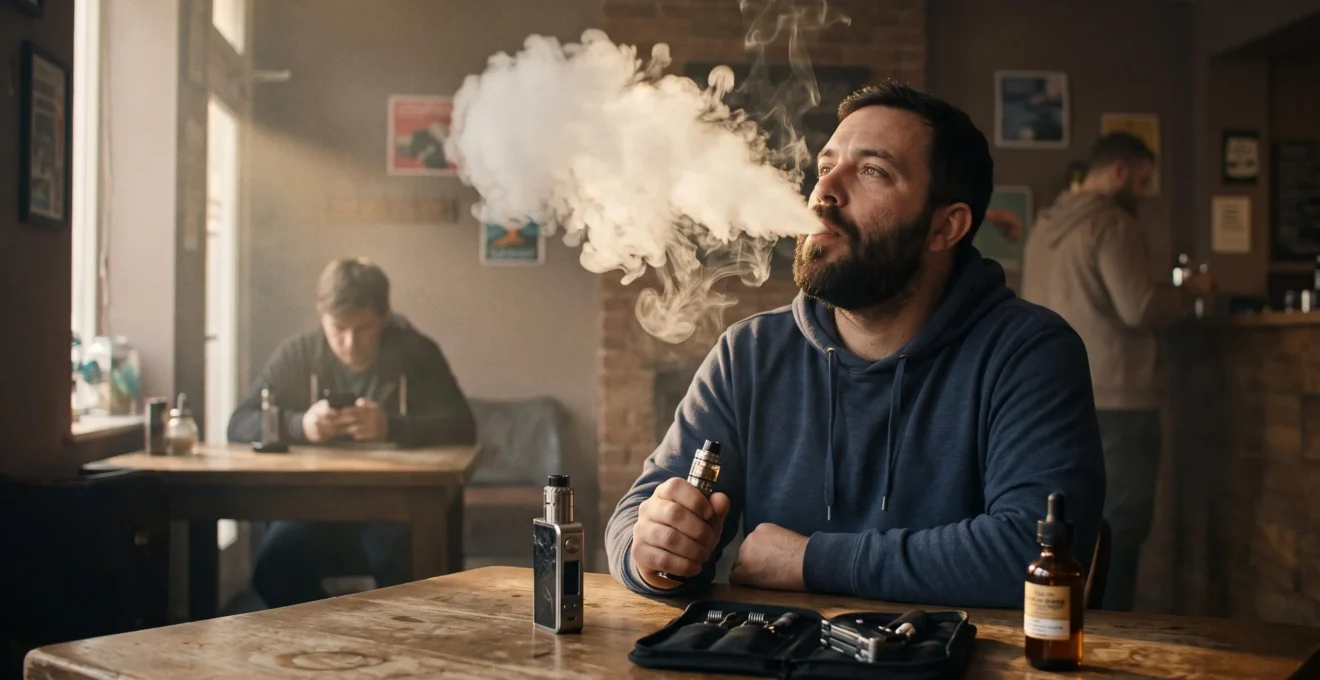
Cloud-chasing culture emerged when producing unusually large e-cigarette aerosol clouds became more than a by-product of vaping. For a segment of enthusiasts, visible vapour became a way to demonstrate technical knowledge, compare equipment, exchange techniques and participate in a recognisable community.
The development of more powerful vaping devices helped make this possible. Online forums, social-media videos and vaping conventions then gave enthusiasts opportunities to display their results and learn from one another. What began as experimentation developed into a subculture encompassing rebuildable coils, airflow discussions, informal gatherings and organised cloud competitions.
Yet cloud chasing has never represented every vaping preference. Its emphasis on visible aerosol production contrasts with the priorities of people who prefer restricted draws, smaller devices or less conspicuous use. High-output vaping also raises practical questions about battery safety, indoor air quality and consideration for bystanders.
Understanding cloud chasing therefore requires looking at its social history, the engineering behind aerosol production and the settings in which enthusiasts practise it.
Cloud-chasing culture at a glance
- Cloud chasing developed into a recognisable vaping subculture through technological experimentation, social media and community events, with particular visibility during the mid-2010s.
- Coil characteristics, liquid delivery, airflow and power influence aerosol production, while introducing compromises involving maintenance, consumption and device safety.
- Large vapour plumes create different considerations in dedicated vaping environments and shared public spaces, making local rules and bystander comfort important.
- Why Did Large Vapour Clouds Become a Focus for Some Vaping Enthusiasts?
- How Did Coil Building and Airflow Tuning Become Part of Cloud-Chasing Culture?
- Cloud Competition or Casual Meet-Up: How Do These Vaping Events Differ?
- Why Can Large Vapour Clouds Create Problems in Shared Public Spaces?
- When Is a High-Vapour Setup Unsuitable for Everyday Surroundings?
- High-Volume or Restricted Airflow: Which Better Matches Your Draw Style?
- When Are Vape Plumes Most Likely to Remain Visible for Longer?
- What Role Do Dedicated Vaping Lounges Play in Vaping Communities?
Why Did Large Vapour Clouds Become a Focus for Some Vaping Enthusiasts?
Large vapour clouds became a focus for some vaping enthusiasts because they offered a visible demonstration of equipment capability, technical experimentation and personal technique. As more powerful devices became available, enthusiasts could compare aerosol production and share results online. Cloud chasing consequently developed both as a technical hobby and as a form of social identity within vaping communities.
Earlier e-cigarette designs generally offered fewer opportunities for extensive hardware adjustment. Subsequent generations introduced devices with greater power capability, adjustable settings and rebuildable components. These developments allowed enthusiasts to explore how equipment characteristics affected visible aerosol production.
The resulting clouds were easy to photograph and film. Video platforms and online discussions helped turn an otherwise private technical interest into an activity that could attract audiences beyond local vaping communities.
A Preventive Medicine Reports analysis of cloud-chasing culture identifies Instagram, Reddit, YouTube and vaping conventions as important channels in the phenomenon’s development. Its authors describe a popularity peak around 2015, followed by declining attention to cloud chasing and associated competitions.
2015
The approximate peak period of cloud-chasing popularity identified in a 2021 scientific commentary. This historical observation does not establish current participation levels or imply that competitions have disappeared.
Brett, Krissinger and King, Preventive Medicine Reports, 2021.
Two motivations became closely associated with the activity. For technically minded hobbyists, cloud chasing created a reason to investigate resistance, airflow, liquid absorption and device behaviour. For socially motivated participants, large clouds could communicate experience, group membership or competitive achievement.
These interests often overlapped, but they were not identical. Someone could enjoy rebuilding atomisers without entering competitions, while another participant might value the spectacle of an event more than the engineering behind it.
Informal demonstrations and organised competitions both contributed to the culture’s visibility. However, available historical evidence does not establish that competitions originated exclusively at informal meet-ups or independently of manufacturers and commercial promotion.
Cloud chasing also developed alongside different vaping preferences. Some enthusiasts prioritised flavour perception, familiar inhalation patterns or discretion rather than aerosol volume. Those differences produced distinct discussions about what constituted a satisfying device.
That history provides context for the technical knowledge enthusiasts began exchanging, particularly around rebuildable atomisers and airflow control.
How Did Coil Building and Airflow Tuning Become Part of Cloud-Chasing Culture?
Coil building and airflow tuning became central to cloud-chasing culture because aerosol production depends on interacting technical variables. Heating elements, liquid supply, incoming air and electrical power influence how an e-cigarette generates aerosol. Rebuildable atomisers made these relationships accessible to hobbyist experimentation, encouraging enthusiasts to exchange observations and develop a shared technical vocabulary.
The fundamental process involves a heating element transferring energy to liquid supplied by a wick. The heated liquid forms an aerosol that mixes with incoming air and is carried through the device during inhalation.
Several connected factors affect this process:
- Coil geometry and surface area: the heating element’s construction affects heat distribution and contact with liquid-bearing material.
- Wicking: the absorbent material must deliver sufficient liquid to the heated region under the device’s operating conditions.
- Airflow: incoming air affects aerosol transport, cooling and the way the device responds during a draw.
- Power delivery: electrical input influences heating behaviour, although its effect depends on the coil, liquid and device design.
These variables do not operate independently. Changing airflow, for example, can alter aerosol production without requiring a change to the coil itself.
Experimental evidence supports the importance of device characteristics. A Chemical Research in Toxicology study on coil resistance and aerosol generation examined selected third- and fourth-generation e-cigarettes, including differences in coil resistance, age, material and airflow.
Within the tested conditions, airflow restriction reduced measured aerosol mass compared with fully open airflow in the adjustable tank device. The researchers also observed differences in aerosol mass between selected pod coils. These are device-specific findings, not universal rules for constructing high-output equipment.
Rebuildable atomisers also created a practical learning culture. Participants could compare observations about coil designs, wicking arrangements and device performance instead of discussing only finished commercial products. Online conversations and face-to-face demonstrations helped establish a specialised vocabulary shared by experienced hobbyists.
That knowledge carries significant safety responsibilities. Electrical resistance affects current draw, while damaged batteries, unsuitable components and short circuits can create dangerous conditions. Understanding Ohm’s law, battery limitations and manufacturer specifications is therefore more important than pursuing a particular cloud size.
Technical compromises extend beyond safety. High aerosol output can increase liquid consumption and battery demand. Changes intended to increase volume may also affect flavour perception, comfort and maintenance requirements.
Nor does producing more aerosol establish that a device is safer. Laboratory research has identified relationships between device operating characteristics and chemical emissions, including carbonyl compounds. Larger clouds should not be interpreted as evidence of reduced exposure.
Once these technical skills became visible community achievements, gatherings offered another setting in which enthusiasts could compare knowledge and performance.
Cloud Competition or Casual Meet-Up: How Do These Vaping Events Differ?
Cloud competitions and casual vaping meet-ups differ primarily in their purpose and structure. Competitions organise aerosol-production demonstrations around defined rounds and judging criteria, while informal gatherings focus more on conversation, equipment discussions and shared interests. Both can support community learning, but competitions place greater emphasis on performance and public evaluation.
At an organised cloud competition, participants generally demonstrate their ability to produce substantial visible plumes under event-specific rules. Depending on the format, assessment may consider apparent size, density or consistency. Procedures are not standardised across every event, so the organiser’s published criteria determine what is actually judged.
Casual meet-ups usually operate more flexibly. Attendees may discuss device characteristics, compare experiences, demonstrate equipment or exchange maintenance knowledge without formal scoring.
The distinction matters because the same participant may approach each format differently: preparing for an evaluated demonstration is not equivalent to using an everyday vaping device.
A practical comparison illustrates the differences.
| Characteristic | Cloud competition | Casual meet-up |
|---|---|---|
| Main purpose | Demonstrate and evaluate aerosol production | Socialise and exchange practical knowledge |
| Structure | Defined rounds and event-specific rules | Flexible conversations and demonstrations |
| Evaluation | Judging may consider plume size, density and consistency | No formal evaluation is normally required |
| Participant preparation | Familiarity with competition procedures and equipment requirements | Knowledge of venue expectations and discussion topics |
| Community role | Public recognition and shared spectacle | Peer learning and relationship building |
Beyond the visible demonstrations, gatherings can function as informal learning environments. Someone unfamiliar with rebuildable equipment may encounter experienced hobbyists who can explain terminology, identify maintenance concerns or discuss why different devices behave differently.
This knowledge exchange is one reason the culture cannot be understood solely through competition footage. The social relationships surrounding equipment discussions may be as important to participants as the clouds themselves.
Attending either type of event nevertheless requires preparation. Age restrictions, venue rules, equipment policies and applicable vaping laws differ between jurisdictions and establishments. A competition-oriented venue should not be assumed to permit unrestricted vaping throughout its premises.
Organisers also have responsibilities concerning ventilation, crowd management and bystander exposure. The fact that participants share an interest in vaping does not remove those considerations.
These dedicated activities also highlight an important distinction: behaviour accepted within a particular event may be inappropriate in ordinary shared public spaces.
Why Can Large Vapour Clouds Create Problems in Shared Public Spaces?
Large vapour clouds can create problems in shared spaces because their visibility, density and persistence may affect people nearby. Bystanders may mistake a substantial vaping plume for tobacco smoke, find its odour intrusive or object to aerosol exposure. Even where vaping is legally permitted, these concerns can influence workplace policies, venue rules and social expectations.
The immediate issue is often visibility. A dense aerosol cloud can attract attention in a crowded room, particularly when people cannot readily identify its source. Some may associate the plume with smoking, while others may simply dislike having their immediate surroundings filled with exhaled aerosol.
Indoor air quality presents a separate concern. E-cigarette aerosol is not merely harmless water vapour. It can contain propylene glycol, vegetable glycerin, nicotine when present in the liquid, and other substances associated with the liquid and heating process.
An Annual Review of Public Health review of vaping and indoor air quality examines airborne particles, aerosol composition and secondhand exposure. It reports that indoor vaping can increase concentrations of fine and ultrafine particles, while noting that some aerosol droplets evaporate rapidly after release.
These observations require two distinctions. Visible plume size is not a direct measurement of chemical exposure, and the disappearance of a visible cloud does not establish that every emitted substance has disappeared.
Social friction is influenced by three readily observable conditions:
- Plume volume: larger visible emissions are more likely to attract attention or occupy nearby airspace.
- People nearby: a crowded area provides less separation between the person vaping and bystanders.
- Enclosure: confined spaces may allow aerosol to accumulate or remain noticeable, depending on ventilation.
Consider a hypothetical comparison. A large plume produced in an otherwise empty, appropriately designated environment presents a different practical situation from an equally large plume released beside several people in a small waiting area. The device may be unchanged, but surrounding conditions substantially alter the potential for inconvenience.
Public displays of cloud chasing may also shape perceptions of vaping more generally. However, it would be inaccurate to claim that cloud competitions or large public plumes have directly caused particular legal restrictions without jurisdiction-specific evidence.
For this reason, consideration for others is not merely a matter of avoiding complaints. It also involves recognising that non-users may have legitimate preferences concerning shared air.
That distinction becomes especially important when deciding whether high-output equipment is appropriate for ordinary daily activities.
When Is a High-Vapour Setup Unsuitable for Everyday Surroundings?
A high-vapour setup is generally unsuitable when its aerosol output conflicts with location rules, bystander comfort or practical daily requirements. Offices, public transport, crowded areas and shared accommodation often demand greater discretion or prohibit vaping altogether. High-output devices may also be inconvenient because they can consume more liquid, require more charging and involve additional maintenance.
Suitability therefore involves two separate questions: whether vaping is permitted and whether a substantial visible plume is appropriate in the circumstances. Permission does not automatically establish that every type of device use is considerate.
Dedicated adult-only events or private settings where vaping is lawful and explicitly allowed may provide more appropriate environments for discussing or demonstrating high-output equipment. Even in those places, ventilation and the preferences of other occupants still matter.
Conversely, reducing aerosol volume does not override restrictions. A small device remains unsuitable in a location where all vaping is prohibited.
The practical implications vary by setting.
| Setting | Main consideration | Practical implication |
|---|---|---|
| Dedicated vaping event | Event rules, safety and ventilation | Check whether high-output demonstrations are specifically permitted |
| Private residence | Household consent, tenancy terms and local rules | Consider other occupants and shared indoor air |
| Office or workplace | Employer policy and colleagues’ exposure | Follow designated-use rules or refrain from vaping |
| Public transport | Operator restrictions and limited shared space | Do not assume any vaping device is permitted |
| Crowded public area | Proximity, local restrictions and bystander comfort | Avoid producing intrusive aerosol clouds |
Some enthusiasts separate their hobby equipment from devices used during ordinary routines. For example, they may reserve a larger, maintenance-intensive setup for permitted dedicated settings and use a more compact device in other places where vaping is allowed.
This is a description of a community approach, not evidence that possessing two devices is necessary or that lower-output vaping is risk-free.
Daily practicality also matters. Increased aerosol generation can entail greater liquid consumption and electrical demand, although actual differences depend on device design and use patterns. Rebuildable equipment may require inspection, cleaning and component replacement that some users find inconvenient.
For readers comparing environments, a structured assessment is more useful than assuming that one device suits every situation.
Five checks before using a vaping device in a shared setting
- Check applicable local restrictions and the venue’s vaping policy. Record a clear permitted, prohibited or uncertain status.
- Identify whether other people will share the immediate space. Note the relevant occupants or bystander groups.
- Assess enclosure, ventilation and expected plume visibility. Write a brief description of the conditions rather than assuming an indoor setting is suitable.
- Review the device’s maintenance condition and manufacturer safety information. Complete a basic condition checklist, without operating questionable equipment.
- Choose a compliant action based on the findings. Record whether to refrain from vaping, use an expressly permitted designated area or reconsider the setting.
Workplace, transport and residential arrangements deserve particular attention. Policies may differ even between organisations operating within the same country.
Historical Public Health England guidance on vaping in public places and workplaces recommends clear communication about where e-cigarette use is permitted or prohibited. Published in 2016, it provides policy principles rather than a complete statement of legislation applicable in 2026.
For readers in English-speaking countries, current restrictions must be checked locally. Rules and commencement dates can differ between the United Kingdom, United States, Canada, Australia and other jurisdictions.
Beyond location, the experience of a vaping device also depends on how much air passes through it and how the user naturally draws from the mouthpiece.
High-Volume or Restricted Airflow: Which Better Matches Your Draw Style?
High-volume airflow is associated with a more open, direct-to-lung draw and generally supports greater aerosol production in compatible devices. Restricted airflow is associated with a tighter, mouth-to-lung draw and typically produces less visible aerosol. Neither approach is universally better: the relevant differences concern inhalation preference, equipment design, liquid characteristics and practical circumstances.
Direct-to-lung, often abbreviated DTL, describes an inhalation pattern in which air and aerosol are drawn directly towards the lungs rather than being held in the mouth first. Devices designed around this pattern commonly provide relatively open airflow.
Mouth-to-lung, or MTL, resembles a two-stage inhalation: aerosol enters the mouth before being inhaled further. Devices associated with this style generally offer a more restricted draw.
The relationship between these styles and cloud chasing is important but not absolute. Open airflow is common in high-output equipment because it can accommodate the operating characteristics of certain aerosol-generating systems. Nevertheless, draw style alone does not determine the quantity or composition of emitted aerosol.
| Characteristic | High-volume airflow (DTL) | Restricted airflow (MTL) |
|---|---|---|
| Draw sensation | Relatively open | Tighter and more resistant |
| Typical inhalation pattern | Directly towards the lungs | Into the mouth before further inhalation |
| Visible aerosol | Often greater in compatible high-output devices | Often lower in compatible low-output devices |
| Common equipment emphasis | Airflow capacity and aerosol production | Controlled draw and compact operation |
| Potential compromises | Greater consumption and conspicuous output | Less emphasis on large clouds |
Liquid composition introduces another variable. Vegetable glycerin, commonly abbreviated VG, is a major constituent of many e-liquids and contributes to aerosol formation. Liquids with higher VG proportions are frequently associated with open-airflow equipment, while other formulations may be used with more restricted systems.
However, suitability depends on the complete device design, including its liquid-delivery system. A broad statement about VG content cannot replace manufacturer compatibility information.
Nicotine concentration also requires care. Different device categories are associated with different commercial formulations, but no particular strength should be inferred as appropriate merely from a preferred draw style. Nicotine is addictive, and high aerosol output does not indicate low nicotine exposure.
As a descriptive way to recognise the distinction, readers can consider whether their natural inhalation preference resembles an open breath or a two-stage mouth-first draw. This observation identifies a terminology preference; it is not a reason for non-users to begin vaping or a substitute for professional cessation advice.
Someone transitioning away from smoking may have different practical priorities from a hobbyist interested in cloud production. Neither preference should be reduced to an assumption that more airflow means higher-quality equipment.
Regardless of draw style, the appearance of an exhaled plume also depends on environmental conditions beyond the device itself.
When Are Vape Plumes Most Likely to Remain Visible for Longer?
Vape plumes are more likely to remain noticeable when surrounding conditions allow aerosol droplets to persist and disperse slowly. Air movement, humidity, temperature and aerosol composition can all influence the appearance of an exhaled cloud. Still indoor air may make a plume more conspicuous than a windy outdoor environment, although visibility alone does not establish exposure levels.
An e-cigarette produces an aerosol containing suspended particles or droplets rather than a simple cloud of water vapour. Once released, those particles undergo physical changes as they interact with surrounding air.
Some droplets evaporate or change size, while others move with air currents, mix into the room or settle onto surfaces. The combined effects determine how long a plume remains visible and how its appearance changes over time.
Three environmental influences are particularly relevant:
- Ventilation and air movement: moving air can disperse a concentrated plume, while insufficient air exchange may permit emitted material to accumulate indoors.
- Humidity and temperature: environmental conditions influence droplet evaporation and aerosol behaviour, but their effects are not captured by a single universal rule.
- Aerosol composition: the proportions of liquid constituents, together with device operating characteristics, influence the physical properties of the emitted aerosol.
These factors help explain familiar differences between locations. A plume may become visually diffuse relatively quickly in a breezy outdoor area, while remaining noticeable for longer in a poorly ventilated room.
However, apparent dispersal should not be confused with removal of all emitted substances. The scientific literature on indoor vaping identifies fine airborne particles and chemical constituents that cannot be evaluated simply by watching a visible cloud disappear.
The distinction also matters when comparing devices. An especially dense visible plume does not provide a reliable measurement of aerosol mass, chemical emissions or bystander exposure without appropriate measurement methods.
A simple observational assessment can help identify situations where visible emissions would be conspicuous. Rather than creating a test plume around uninvolved people, observe existing permitted use in an appropriate setting and note whether the room appears hazy, whether airflow disperses visible emissions and whether other occupants are affected.
This qualitative observation cannot certify adequate ventilation or establish that the environment is safe. It is only a way to recognise obvious visibility and courtesy concerns.
For shared indoor environments, a lack of lingering visible vapour is therefore not sufficient evidence that continued use is appropriate. Venue rules, ventilation arrangements and the preferences of other occupants remain relevant.
These considerations help explain the appeal of dedicated environments where vaping-related activities can be managed under explicit rules.
Key takeaways before visiting a vaping lounge
- A lounge’s suitability depends on its actual vaping policy, ventilation arrangements and applicable local requirements, not simply its name.
- Community learning is most useful when technical discussion includes equipment limitations, battery safety and responsible behaviour.
- Age eligibility, permitted activities and consideration for other occupants should be established before attending a gathering.
What Role Do Dedicated Vaping Lounges Play in Vaping Communities?
Dedicated vaping lounges provide physical meeting places for communities that often develop through online discussions. Where legally permitted and appropriately managed, they can accommodate equipment conversations, practical demonstrations and social gatherings more effectively than ordinary public spaces. Their broader cultural role is to connect individual technical interests with shared knowledge, community norms and face-to-face interaction.
The importance of a physical meeting place becomes clearer when considering cloud chasing’s online development. Videos and forum discussions can demonstrate equipment behaviour or introduce technical concepts, but they do not reproduce every aspect of a conversation around actual devices.
In a lounge, enthusiasts may be able to examine equipment, discuss maintenance concerns or compare experiences directly. More experienced participants can explain terminology and highlight problems that are difficult to communicate through short online demonstrations.
Some dedicated venues may also host organised discussions, informal demonstrations or competitions. Others function primarily as retail-adjacent social spaces, and not every establishment welcomes large-cloud activities.
The functions of a lounge depend on its management, facilities and applicable rules. Possible community activities include:
- Conversations about equipment characteristics and maintenance practices.
- Peer explanations of electrical safety and rebuildable-component terminology.
- Discussions comparing airflow styles and different vaping preferences.
- Informal gatherings involving regular community members.
- Supervised or organised demonstrations where expressly authorised.
In venues that provide suitable facilities, dedicated work surfaces or equipment discussion areas may support learning. Such arrangements should not be assumed to exist in every lounge, and informal instruction is not equivalent to professional technical certification.
Community norms are also transmitted through these interactions. Experienced participants may discuss the importance of respecting neighbouring tables, avoiding unwanted exposure, following safety guidance and keeping demonstrations within designated areas.
This kind of informal apprenticeship helps explain how cloud-chasing knowledge can persist even when its broader online popularity changes. The activity is maintained not only through public performances but also through conversations, shared terminology and community relationships.
However, a lounge is not automatically exempt from public-health or indoor-air regulations. Some jurisdictions prohibit or restrict indoor vaping, including in establishments marketed towards vaping enthusiasts. Others may apply specific exemptions, conditions or licensing requirements.
Age restrictions and rules concerning product demonstrations, sampling or retail activity also vary. Visitors should verify current legal requirements and the individual venue’s policies rather than assuming that all lounges operate under the same framework.
Finally, a purpose-designed social environment does not eliminate the potential for secondhand aerosol exposure. Ventilation, room occupancy and responsible venue management remain important, even among adults who have chosen to attend.
For anyone interested in understanding the culture, the most useful next step is to examine a community’s documented practices, event rules and approach to safety and shared-space etiquette. Those details reveal more about cloud chasing than plume size alone.
Is cloud chasing the same as performing vape tricks?
Not exactly. Cloud chasing generally emphasises producing substantial visible aerosol clouds, whereas vape tricks involve manipulating exhaled aerosol into particular shapes or movements. The activities can overlap, and historical accounts of the subculture include both large-cloud displays and artistic aerosol demonstrations.
Did social media create cloud-chasing culture?
Social media helped spread and popularise cloud chasing, but it was not the sole factor in its development. More capable vaping devices, technical experimentation, vaping conventions and commercial promotion also contributed. Historical research does not establish one exclusive origin for the practice.
Does producing a bigger vape cloud mean a device is more powerful?
Not necessarily. Power is one influence on aerosol generation, but coil characteristics, liquid supply, airflow, puffing behaviour and surrounding conditions also affect visible output. Cloud size alone cannot establish device power, aerosol mass or chemical exposure.
Are large vape clouds just water vapour?
No. E-cigarette emissions are aerosols that can contain droplets derived from propylene glycol, vegetable glycerin and other liquid constituents, along with substances produced or released during device operation. Nicotine may also be present. Their composition varies, and the disappearance of a visible plume does not mean every emitted constituent has disappeared.
Are cloud-chasing events and vaping lounges legal everywhere?
No. Rules governing vaping, indoor use, age restrictions, product demonstrations and organised events vary by country and sometimes by region or locality. A venue may also impose stricter conditions than applicable legislation requires. Current local requirements and the organiser’s specific policies should be checked before attending.