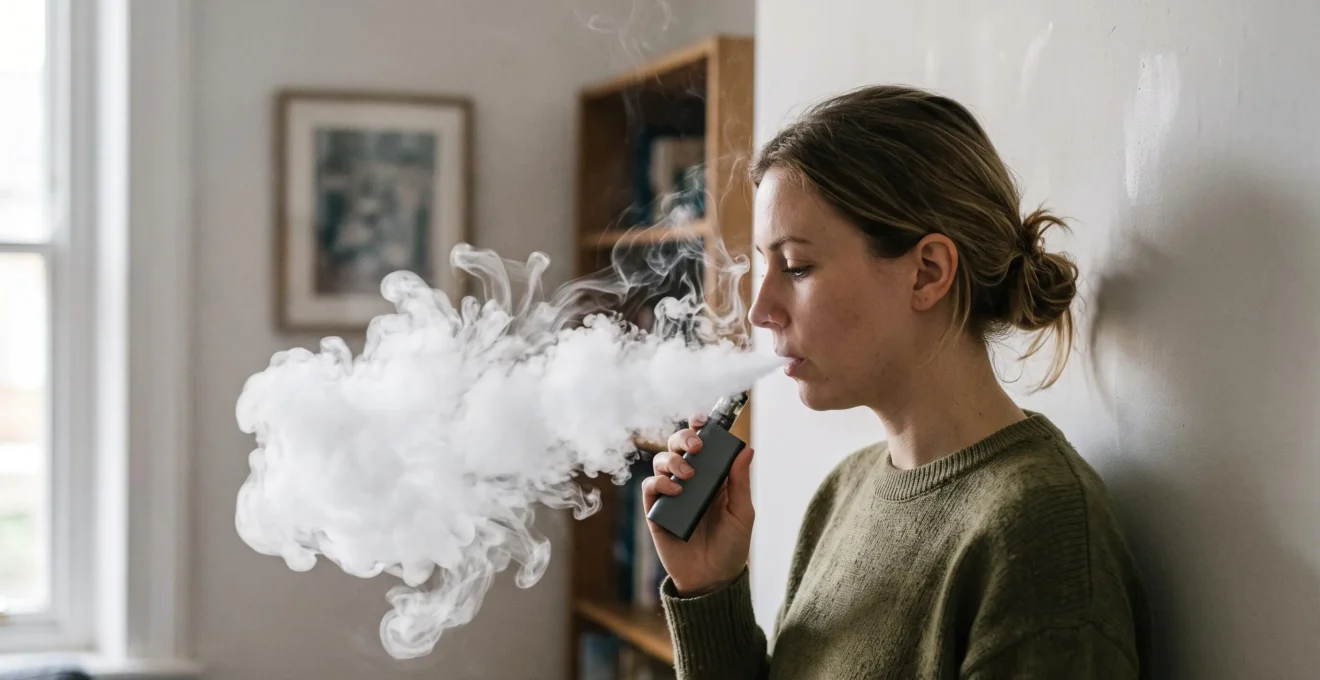
A thick white cloud leaving an e-cigarette can appear substantial, yet become almost invisible within seconds. Another exhale may look faint initially but remain noticeable as it drifts through a quiet room. These differences arise from several interacting physical processes, not simply from the amount of liquid consumed.
Vape aerosol is not just water vapour. It consists of tiny liquid droplets suspended in air, together with gaseous substances. The droplets commonly contain propylene glycol (PG) and vegetable glycerin (VG), while their composition can also reflect nicotine, flavouring ingredients and compounds formed during heating. What becomes visible depends on the droplets’ size, number, composition and interaction with light.
Electrical power and airflow influence aerosol generation inside the device. Once exhaled, temperature, humidity, evaporation and surrounding air movement determine how the plume develops. Crucially, a cloud becoming invisible does not establish that everything it contained has disappeared from the environment.
Vape aerosol visibility: the essential points
- Density: Device power, PG/VG composition, airflow and droplet properties affect how thick an aerosol cloud appears.
- Persistence: Droplets can evaporate, shrink, remain suspended or disperse with moving air, often simultaneously.
- Exposure: Cloud size and visibility cannot reliably reveal nicotine content, chemical composition or health risk.
- Why Do Some Vape Aerosol Clouds Linger in the Air Longer Than Others?
- How Do Airflow and Power Settings Change the Density of Vape Aerosol?
- Warm Room or Cold Outdoors: Where Do Vape Clouds Remain Visible Longer?
- Why Can Judging Vape Aerosol Only by Cloud Size Be Misleading?
- How Can Device Settings Reduce Visible Aerosol Without Causing Poor Wicking?
- Indoor or Outdoor Air: Where Do Vape Plumes Disperse More Quickly?
- Why Does High-Volume Airflow Make Vapour Feel Cooler at the Same Wattage?
- Why Do Vape Vapour Plumes Change Shape and Density After Exhalation?
Why Do Some Vape Aerosol Clouds Linger in the Air Longer Than Others?
Some vape aerosol clouds remain visible longer because their droplets evaporate relatively slowly, stay suspended in the air or encounter little air movement. Droplet size and composition influence how the particles evolve, while ventilation determines how quickly the plume spreads. A cloud that disappears rapidly may have evaporated, dispersed or undergone both processes.
Two processes need to be distinguished: particle suspension and droplet evaporation. Small aerosol droplets generally settle more slowly under gravity than larger ones, although their behaviour also depends on air currents and other physical forces. Remaining airborne, however, does not guarantee that a droplet remains large enough to scatter visible light effectively.
PG and VG influence aerosol formation and evaporation because they have different physical properties. A plume can therefore lose visibility even when air movement is limited. Its droplets may shrink or evaporate into gaseous constituents without being physically transported out of the room.
An experimental study of exhaled e-cigarette aerosol dynamics examined aerosol behaviour in a controlled chamber. Researchers observed particle evaporation or shrinkage within 10 seconds after a puff from the tested electronic cigarette. The experiment involved three volunteers and specific products, so its findings should not be treated as a universal disappearance time.
Within 10 seconds
Particle evaporation or shrinkage was observed after a puff from the electronic cigarette tested in a controlled chamber study. This is not a general measurement of complete cloud disappearance.
Aerosol and Air Quality Research, 2021, experimental investigation of exhaled aerosol dynamics.
Environmental conditions add another layer. In stagnant indoor air, a plume may retain a recognizable shape longer because turbulence and dilution are limited. Near an open doorway, fan or ventilation outlet, a similar plume may stretch into a faint trail almost immediately.
A simple observational comparison can help distinguish these effects. Consider how an exhaled plume behaves in still air, then compare its movement in a space with an existing gentle airflow. Changes in shape and drifting direction suggest air movement is important; fading without much displacement is consistent with evaporation or local dilution. Neither observation identifies the aerosol’s exact chemical composition.
Visibility should also be separated from exposure. A lingering cloud is not automatically more concentrated in nicotine or more harmful than a rapidly fading one. Conversely, a plume that disappears quickly should not be assumed to leave clean air behind.
The next question is what determines the aerosol before it enters the surrounding air: the device’s power, airflow and liquid composition.
How Do Airflow and Power Settings Change the Density of Vape Aerosol?
Higher electrical power generally increases the amount of e-liquid aerosolised per puff, while airflow affects how concentrated and warm the generated aerosol feels and appears. More restricted airflow can produce a denser-looking stream, whereas greater airflow may dilute it. The outcome depends on coil design, liquid composition, puff duration and the device’s operating limits.
Power controls the rate at which electrical energy reaches the heating element. When the wick supplies sufficient liquid, increased heating can produce more aerosol. The relationship is not unlimited: a coil cannot maintain normal aerosol production if liquid replenishment fails to keep pace with evaporation.
Laboratory research on e-cigarette power, liquid composition and aerosol output compared 80% PG/20% VG and 20% PG/80% VG liquids at power settings between 7 and 22 watts. Under the tested conditions, aerosol mass output increased significantly with power, and the higher-VG formulation produced greater aerosol output.
The study also identified changes in aerosol particle-size distribution across operating conditions. These measurements demonstrate that power and formulation influence the aerosol itself, not merely its apparent whiteness. However, the experiments used particular equipment and nicotine-free, flavour-free liquids; they do not establish universal settings for all devices.
Airflow changes the relationship between generated aerosol and incoming air. At a given power, a more open inlet can distribute aerosol through a larger volume of air, often making the draw cooler and less concentrated. Nevertheless, it can also alter coil temperature and the amount of liquid aerosolised, so dilution is not necessarily the only change.
Visible cloud density also depends on VG content. VG-rich formulations can increase aerosol output under certain conditions, but higher VG viscosity may affect how efficiently a particular wick receives liquid. Device compatibility matters more than pursuing a particular ratio in isolation.
These relationships lead to different adjustment priorities depending on the desired effect. The following grid describes physical tendencies, not universal prescriptions or guaranteed outcomes.
| Desired outcome | Main variable | Expected effect and limitation |
|---|---|---|
| Less visible aerosol | Lower power within the supported range | May reduce aerosol output; the coil still needs appropriate operating conditions. |
| Denser-looking plume | Greater aerosol production or more concentrated airflow | Can increase heating demands or make the draw warmer; wicking remains a constraint. |
| Cooler draw | More open airflow | Often reduces perceived warmth and concentration, with device-dependent effects on aerosol generation. |
| Change aerosol characteristics | Compatible PG/VG formulation | May change output, droplet properties and liquid supply to the coil. |
Adjusting every variable simultaneously makes it difficult to identify which change caused an observed difference. It is more informative to compare one setting at a time, without exceeding the manufacturer’s specifications.
Once aerosol leaves the device, its appearance is further altered by the temperature and moisture content of the surrounding environment.
Warm Room or Cold Outdoors: Where Do Vape Clouds Remain Visible Longer?
Cold outdoor air can make an exhaled vape cloud look denser initially because cooling encourages some constituents to condense into light-scattering droplets. However, wind and atmospheric mixing may disperse it quickly. Warm indoor air can produce a less striking initial plume, yet weak air movement may allow visible traces to remain locally for longer.
The apparent paradox comes from confusing initial visual density with visible lifetime. These are different observations, governed by partly different variables.
When warm, moisture-containing exhaled air meets a colder environment, rapid cooling can change the balance between gaseous and condensed material. Water vapour from breath may also contribute to the visible cloud, particularly in sufficiently cold conditions. The visible result is therefore not necessarily composed solely of droplets originating from the e-liquid.
Outdoors, moving air continually stretches and dilutes the plume. A dramatic white cloud can become indistinct quickly even when initial condensation makes it especially visible. Nevertheless, calm outdoor conditions are possible, and cold weather alone does not determine how long every aerosol cloud will remain visible.
In a warm room, condensation may be less conspicuous. Nevertheless, a plume can remain visually recognizable in a sheltered part of the room where local airflow is weak. Warmth does not automatically cause particles to remain suspended longer: temperature also affects evaporation, so some droplets may shrink and fade faster.
Humidity adds another variable. Relatively dry air may favour evaporation of volatile droplet components, while higher humidity can change water exchange between droplets and the surrounding atmosphere. The direction and magnitude of these effects depend on composition and temperature.
Importantly, the controlled chamber research discussed earlier did not identify statistically significant effects of relative humidity on the reported aerosol dynamics under its particular experimental conditions. It would therefore be incorrect to claim that humid air invariably keeps vape clouds visible longer.
A useful field comparison separates two measurements. Observe the initial apparent density of a plume in a warm indoor setting and a colder outdoor setting, then separately estimate how long each remains visibly recognizable. Comparable device settings, puff patterns, lighting and observation positions improve the comparison, although they cannot make the two environments scientifically identical.
Even then, a human observation is only a visual comparison. It does not quantify particle concentration, liquid mass or inhalation exposure.
The distinction matters because apparent cloud size, however dramatic, reveals much less about the aerosol’s actual contents than it might seem.
Why Can Judging Vape Aerosol Only by Cloud Size Be Misleading?
Cloud size is a poor standalone indicator of vape aerosol quantity, nicotine delivery or safety. What looks like a large cloud depends on droplet concentration, size distribution, lighting and the time elapsed after exhalation. A faint plume can still contain aerosol particles and chemical constituents, while an impressive white cloud does not reveal their concentrations.
A visible cloud is an optical phenomenon. Light is scattered by suspended droplets, and the amount of scattering depends on their physical characteristics as well as viewing conditions. Two aerosol plumes containing different amounts of liquid can consequently look similar, while two similar emissions may look different against contrasting backgrounds.
Three quantities are especially easy to confuse:
- Aerosol mass: the amount of particulate liquid present, which cannot be determined accurately by looking at the cloud.
- Droplet size distribution: the range of droplet sizes, which affects light scattering and how particles behave.
- Visible persistence: how long the plume remains recognizable as droplets evaporate, disperse or change size.
PG/VG composition provides a practical illustration. Higher-VG liquids can produce greater aerosol mass under some tested conditions, often contributing to visually substantial clouds. PG-rich formulations may yield a less conspicuous plume, but reduced visibility does not establish that nothing was aerosolised.
Equally important is the distinction between aerosol generated at the coil, material actually inhaled and material subsequently exhaled. These are not interchangeable quantities. Inhalation patterns and deposition within the respiratory tract affect how much of the generated material is retained or exhaled.
According to CDC information on the health effects of vaping, e-cigarette aerosol can contain nicotine, fine particles, heavy metals, volatile organic compounds, flavouring chemicals and other potentially harmful substances. This does not mean every device produces every listed constituent at the same concentration.
The CDC also explains that e-cigarette aerosol generally contains fewer harmful chemicals than cigarette smoke, without implying that vaping is safe. The composition of a particular emission cannot be assessed from its size, brightness or speed of disappearance.
Consider two hypothetical devices producing visually similar clouds. One could generate a different aerosol mass or nicotine concentration from the other. Without appropriate measurements, an observer could not establish which plume contained more nicotine or other constituents simply by comparing their appearance.
The more informative questions are therefore: What substances could this aerosol contain? Which device and environmental conditions are making it appear this way? Those questions separate physical appearance from chemical exposure.
For those interested specifically in reducing visible emissions, this distinction suggests focusing on appropriate device operation rather than treating a smaller cloud as evidence of reduced risk.
How Can Device Settings Reduce Visible Aerosol Without Causing Poor Wicking?
Visible aerosol can sometimes be reduced by lowering power within the coil’s recommended range, changing compatible airflow settings or selecting a suitable liquid with less VG. These adjustments should be made individually because coil heating, liquid viscosity and wick replenishment interact. A smaller cloud is not evidence of safer exposure, and settings should remain within the device manufacturer’s specifications.
Wicking describes how e-liquid moves through an absorbent material toward the heating element. During operation, the coil consumes liquid through heating and aerosol formation. The wick must replenish that liquid sufficiently to prevent exposed or inadequately wetted regions from overheating.
A dry hit can occur when heating demand exceeds liquid supply. Its warning signs may include a harsh, burnt or unusually dry taste. Increasing power beyond the coil’s supported range, using an incompatible liquid or operating with insufficient liquid can all contribute to this mismatch.
Reducing power generally lowers liquid consumption per unit of heating time rather than inherently causing poor wicking. However, operating significantly below a coil’s intended range may produce weak aerosol, inconsistent vaporisation or unwanted condensation. These effects should not be confused with classic dry-wick overheating.
Airflow adjustments require similar care. Opening a compatible airflow control may produce a cooler, less concentrated draw, but actual aerosol output can change in device-specific ways. Gurgling and liquid spit-back can indicate flooding or condensation-related problems rather than inadequate liquid delivery.
PG/VG selection also matters. Formulations with more VG are generally more viscous, which can affect liquid movement through some wicks. A more PG-rich liquid may be easier for certain wick designs to transport, but the device must be intended for that formulation. Altering liquid viscosity is not a universal solution to poor wicking.
Five checks for evaluating a lower-visibility device configuration
- Identify the device limits: Read the manufacturer’s operating instructions and record the supported coil power range and compatible liquid specifications.
- Establish a baseline: Note the current power, airflow position, liquid composition and any abnormal operation in a short settings record.
- Change one permitted variable: Adjust only an available control within the stated operating limits, and record the new position or value.
- Check for operating problems: Observe normal operation and record any dry or burnt taste, gurgling, spit-back or leakage; discontinue use if overheating or abnormal behaviour appears.
- Compare the observations: Note the visible plume and operating consistency under comparable surroundings, then identify whether the adjustment produced a noticeable difference without equipment problems.
These checks are a general observational approach, not a scientifically validated tuning protocol or a guarantee of safe aerosol emissions.
Closed or sealed pod systems offer fewer adjustments than refillable devices with variable power and airflow. With fixed-coil hardware, users should not attempt modifications outside manufacturer instructions. Compatible replacement pods or permitted liquid options may be the only relevant variables.
There is also a practical limit to the objective itself: lowering visible density does not establish that nicotine or other potentially harmful emissions have decreased proportionally.
Device output is only one part of the picture. Whether a released plume spreads through a room or rapidly moves away depends on the surrounding airflow.
Indoor or Outdoor Air: Where Do Vape Plumes Disperse More Quickly?
Vape aerosol plumes often disperse more rapidly outdoors when wind and atmospheric turbulence mix them with surrounding air. Indoors, weak airflow can leave a visible plume concentrated near its release point, while effective ventilation can increase dilution and removal. However, rapid visual fading may also result from droplet evaporation, not just physical dispersal.
Dispersal describes the movement and spreading of material through air. It is different from evaporation, which changes liquid droplets into gaseous constituents. Both processes can reduce the visible concentration of a plume, but their consequences for the surrounding atmosphere are not equivalent.
Outside, wind can move and stretch an exhaled plume, while turbulence mixes it into a larger volume of air. Local conditions matter: an enclosed courtyard or sheltered doorway may experience much less mixing than an exposed open space. It is therefore inaccurate to assume that every outdoor plume disperses faster than every indoor one.
Indoors, air exchange depends on the room’s ventilation system, open windows, air paths and other environmental factors. Stronger effective ventilation may transport or dilute airborne constituents, whereas limited exchange can allow emissions from repeated puffs to contribute to indoor concentrations.
The distinction between visible droplets and other constituents is especially important here. In a controlled chamber investigation comparing exhaled e-cigarette aerosol with conventional cigarette smoke, researchers observed that particle concentrations from the tested e-cigarettes returned rapidly toward background levels. They identified droplet evaporation as an important explanation for the decline, rather than ventilation removal alone.
This means the visible disappearance of a plume must not be interpreted as proof that its constituents have left the room. Some material may have changed phase, and other substances may remain airborne even though the original white cloud is no longer recognizable.
Controlled chamber comparison of exhaled aerosols
In research published in Nicotine & Tobacco Research, volunteers used electronic cigarettes and conventional cigarettes in a room-simulating chamber. Researchers measured particle concentrations and size distributions at a simulated bystander’s position under different ventilation and distance conditions.
For the tested products and measurement conditions, exhaled e-cigarette particle concentrations decreased rapidly, largely through evaporation. Conventional cigarette smoke particles were considerably more persistent in the comparison. These results concern measured particles, not the complete disappearance of all emitted chemical substances.
For indoor air quality, the relevant distinction is between making a plume visually less noticeable and reducing the presence of its constituents. An open window may contribute to air exchange, but an observable change in cloud shape cannot quantify how much material has been removed.
Outdoor dilution also does not mean exposure is necessarily absent, particularly close to a fresh plume. Distance, air movement and emission conditions can affect what another person encounters.
Airflow also operates inside the device, where its interaction with heating affects not only the plume’s appearance but also the temperature and character of the draw.
Why Does High-Volume Airflow Make Vapour Feel Cooler at the Same Wattage?
Higher airflow can make vapour feel cooler at the same wattage because incoming air carries heat away from the coil and mixes with the generated aerosol. The resulting draw may have a lower temperature and a less concentrated sensation. However, airflow can also change coil temperature and aerosol production, so equal electrical power does not guarantee equal vapour output.
Electrical wattage describes the rate at which energy is delivered to the heating system. At a fixed setting, the electrical energy supplied over a given time is approximately fixed, but the way that energy is distributed depends on airflow, liquid supply and heat losses.
When more air passes through the heating region, it can remove thermal energy more quickly. The outgoing mixture may therefore be cooler, provided other conditions remain comparable. Increased convective cooling can also change how effectively the coil vaporises liquid.
The sensation of coolness has an additional perceptual component. A less concentrated aerosol may feel lighter in the mouth and throat, even where its measured temperature difference is modest. Temperature and perceived density are related experiences, but they are not identical physical quantities.
A simple conceptual comparison is useful. Imagine the same adjustable device operating at a fixed supported wattage with two manufacturer-approved airflow positions. A more restricted position may deliver a warmer, more concentrated sensation. A more open position may feel cooler and less intense, although its actual emissions could also differ because the coil is being cooled differently.
Flavour perception may change at the same time. Greater airflow can lower the concentration of flavour-containing aerosol reaching the mouth in a given volume of inhaled air. Nevertheless, the effect is not universal, since coil geometry, airflow direction and liquid chemistry all influence flavour delivery.
At an extreme, excessive airflow relative to heating capacity may cool the coil enough to reduce effective aerosol formation. The result could be a weaker draw instead of a progressively cooler version of the same aerosol output.
Conversely, highly restricted airflow can reduce cooling and alter thermal conditions. This is another reason to follow the manufacturer’s airflow and power specifications rather than assuming either fully open or nearly closed airflow is inherently optimal.
The central trade-off is that airflow influences several outcomes simultaneously: heat transfer, aerosol concentration, perceived warmth and potentially flavour intensity. It cannot be treated as an independent temperature dial.
Once the draw is exhaled, those initial temperature and concentration differences interact with the surrounding air, producing a plume whose appearance continually evolves.
Key takeaways before interpreting an exhaled plume
- Separate the aerosol’s initial properties from the changes that happen after it enters the surrounding atmosphere.
- Observe movement and fading independently: a cloud can lose visibility without being carried away.
- Use cloud appearance to explore physical behaviour, never as a substitute for measuring chemical constituents or exposure.
Why Do Vape Vapour Plumes Change Shape and Density After Exhalation?
Vape plumes change shape and density after exhalation because warm aerosol mixes with surrounding air while its droplets continuously evolve. Buoyancy, turbulence and local air currents stretch or redirect the cloud, while evaporation can shrink its droplets and reduce their visibility. The plume observed a few seconds later is not physically identical to the one first exhaled.
At the moment of exhalation, the aerosol leaves the mouth as a moving stream. Its initial momentum carries it outward, while differences in temperature and density influence how it interacts with nearby air. As it travels, the stream entrains surrounding air and becomes progressively less concentrated.
The visible edges of a plume often soften because the boundary between exhaled air and room air is continuously disturbed. Small turbulent motions fold and stretch that boundary, creating irregular shapes and regions of differing droplet concentration.
Buoyancy may also influence movement when the exhaled mixture differs in temperature or density from the surroundings. However, it is only one factor. Room ventilation, a person’s motion or a nearby draft may dominate the plume’s direction.
Evaporation changes the plume even without significant displacement. As droplets lose volatile material, their size distribution can shift. Smaller droplets may scatter light differently or become less visually detectable. Consequently, a cloud can fade while remaining close to where it was exhaled.
The earlier controlled chamber findings illustrate this process: measurable droplet shrinkage or evaporation can take place within seconds. This helps explain why a cloud’s changing outline cannot always be interpreted as simple mixing with fresh air.
Condensation may also occur under suitable environmental conditions. A cooling exhaled mixture can generate or enlarge droplets, potentially creating regions that temporarily become more visible. The balance between condensation and evaporation depends on the composition and local thermodynamic conditions.
Even repeated exhalations from the same device can look different. Small variations in puff duration, initial aerosol temperature, breathing pattern, airflow direction, humidity and lighting influence the resulting cloud. Reproducing an identical plume visually is therefore difficult outside tightly controlled conditions.
A useful way to interpret what is observed is to distinguish three moments: the dense region immediately after release, the changing plume as it mixes with ambient air, and the later stage when its visible contrast becomes faint. None of these snapshots alone measures the mass or chemical composition of the material emitted.
This is why the expression « vapour cloud » can be misleading when interpreted literally. The white plume principally reveals light-scattering droplets, while gaseous constituents remain largely invisible. The system contains material distributed between liquid and gas phases, and that distribution can change rapidly.
When observing vape aerosol, describe what can actually be seen—initial density, movement, spreading and fading—without inferring nicotine content or safety from appearance. Understanding these limits provides a more accurate picture of the changing aerosol than any single visual snapshot.
Is the white cloud from a vape made entirely of water vapour?
No. Visible vape aerosol contains tiny liquid droplets that commonly include PG and VG, alongside other possible constituents depending on the product. Exhaled moisture may also contribute under certain conditions. Pure gaseous water vapour is invisible; the white appearance comes from light scattered by condensed droplets.
Can vape aerosol become invisible while its chemicals remain in the air?
Yes. Liquid droplets can evaporate or shrink until they no longer scatter enough light to be easily seen. This does not establish that every gaseous constituent has been removed from the surrounding atmosphere. Evaporation, dilution and ventilation are different processes.
Does a high-VG e-liquid always produce more visible aerosol?
Not always. Experimental research has found greater aerosol mass output from higher-VG formulations under particular conditions, but visible density also depends on coil power, airflow, droplet properties and the environment. A relationship observed with one device cannot be assumed to hold identically for every device.
Why can a vape cloud seem denser under bright side lighting?
Visible aerosol droplets scatter light. Changing the direction, intensity or background contrast of illumination can make the same plume easier or harder to see. A brighter-looking cloud under different lighting therefore does not necessarily indicate greater aerosol production.
Does a smaller exhaled cloud mean less nicotine was inhaled?
No reliable conclusion can be drawn from cloud size alone. Nicotine delivery depends on factors including liquid concentration, device operation, puff behaviour and deposition within the respiratory tract. The visible exhaled plume represents neither a direct measurement of the nicotine inhaled nor a dependable indication of health risk.