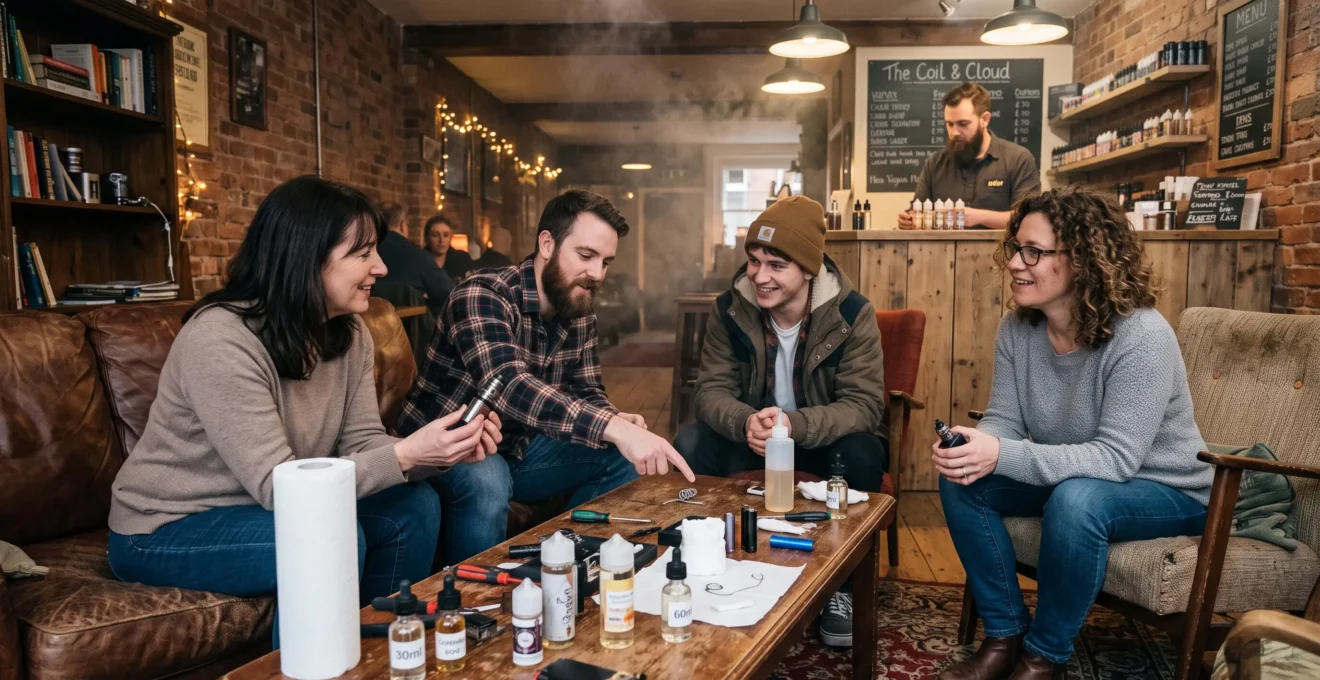
A dedicated vaping lounge serves a different purpose from a conventional retail counter. Rather than organising every interaction around a purchase, it provides a place where adults who already vape can exchange practical knowledge, discuss equipment and spend time with others who share an interest in vaping culture.
These venues can function as informal meeting places, product-demonstration spaces and centres for specialist activities such as coil-building discussions or cloud-chasing events. Their social significance comes less from the equipment itself than from the relationships that develop through repeated visits.
Yet vaping lounges are not interchangeable. Some operate as comfortable seating areas attached to shops; others emphasise organised gatherings or technical demonstrations. Local regulations, house policies and ventilation also affect what visitors can actually do inside.
Understanding these differences helps explain why some venues develop recognisable communities while others remain primarily places to buy products. It also provides a practical framework for deciding whether a lounge suits a particular visit.
Vaping lounges at a glance
- Community: Lounges can encourage lasting relationships through demonstrations, regular gatherings and informal knowledge exchange.
- Etiquette: Visitors should confirm house rules, respect personal space and avoid directing vapour towards other people.
- Practical differences: Lounges prioritise shared time and interaction, while conventional vape shops generally focus on retail services. Neither setting automatically permits indoor vaping.
- Why Did Dedicated Vaping Lounges Become Community Hubs for Enthusiasts?
- How Can a First-Time Visitor Navigate Etiquette in a Vaping Lounge?
- Vaping Lounge or Vape Shop: How Do Their Social Roles Differ?
- Why Should You Check Venue Rules Before Vaping Indoors in the UK?
- When Can a Vaping Lounge Offer More Value as a Social Space Than a Retail Visit?
- Cloud Competition or Casual Meet-Up: How Do These Vaping Events Differ?
- Indoor or Outdoor Air: Where Do Vape Plumes Disperse More Quickly?
- How Did Cloud-Chasing Culture Develop Around High-Output Vaping Setups?
Why Did Dedicated Vaping Lounges Become Community Hubs for Enthusiasts?
Dedicated vaping lounges developed a community role because they offered something that online discussions and ordinary retail transactions could not fully reproduce: face-to-face interaction around shared equipment and experiences. Visitors could observe demonstrations, ask questions in person and develop relationships through repeated visits. The resulting sense of belonging made some specialist venues more than places to purchase vaping products.
Early vaping communities relied heavily on online forums, product reviews and specialist retailers. These channels helped enthusiasts exchange information about device performance, e-liquid characteristics and maintenance. However, written explanations could be difficult to interpret when equipment behaved unexpectedly.
In-person specialist venues provided another form of learning. A visitor could describe a technical problem, show a device to someone familiar with it and observe a demonstration. Where permitted and hygienically managed, product comparisons and sampling could also provide information unavailable through an online description.
These interactions involve two related but distinct functions: practical knowledge exchange and social belonging.
Knowledge exchange might involve discussing coil compatibility, manufacturer-recommended power ranges, maintenance or different flavour profiles. Social belonging develops more gradually, through familiar faces, recurring conversations and a shared understanding of the venue’s informal customs.
Research example: community relationships in English vape shops
A qualitative study of vape-shop customers and community experiences, published in 2019, examined telephone interviews with 22 customers from the East Midlands of England. Interviews took place in April and May 2016.
Participants described practical demonstrations, information from staff and relationships with other customers as important aspects of their experiences. Some associated specialist shops with a sense of community. The research concerned a small group of vape-shop customers rather than dedicated lounges specifically, so it cannot establish how common these experiences are across venues today.
Physical venues and online communities therefore serve complementary purposes. A forum can bring together geographically dispersed users and preserve detailed discussions. A lounge can support immediate conversation and hands-on comparison, but its available expertise depends on the people present.
Community continuity is another consideration. A lounge may become a regular meeting place when visitors recognise each other and have reasons to return. If seating disappears, activities stop or interaction becomes secondary to retail turnover, that social function may weaken. This is a plausible operating risk rather than an established rule about lounge survival.
A venue does not become a community hub simply by providing somewhere to sit. Its character depends on whether people have opportunities to interact, learn from one another and return without every visit needing to involve a purchase.
How Can a First-Time Visitor Navigate Etiquette in a Vaping Lounge?
A first-time visitor can navigate vaping lounge etiquette by checking the house rules before using a device, observing how the space is organised and treating other customers’ equipment and personal boundaries with respect. Asking staff about permitted activities is generally more useful than assuming the venue follows the conventions of a café, bar or ordinary vape shop.
On arrival, identify the reception or retail counter and ask whether vaping is permitted in the seating area. Some venues may designate particular spaces for demonstrations, sampling or higher-output devices. Others may operate as social meeting places while restricting indoor use entirely.
Where sampling is available, establish which products are included, whether outside e-liquids are allowed and what hygiene arrangements apply. Do not assume that a communal testing station permits visitors to share mouthpieces or use devices without appropriate cleaning.
Courtesy extends beyond the posted rules. Another visitor’s device may be expensive, customised or temporarily disassembled. Ask before touching it, photographing it or examining its components. Avoid treating someone’s preferred flavour or setup as a measure of their technical competence.
Conversation also has a rhythm. Waiting for a demonstration to finish before asking questions makes it easier for everyone to follow the explanation. Visitors who are unfamiliar with rebuildable equipment can listen and ask for clarification without pretending to understand every technical term.
Vapour volume matters particularly in shared seating. High-output devices may produce clouds that affect visibility and comfort nearby. Directing exhaled aerosol away from others is a basic courtesy, but it does not eliminate their potential exposure. Reducing output where appropriate and following staff instructions can help avoid unnecessary disruption.
People with less experience need not participate in technical discussions immediately. Observing how staff and regulars communicate can reveal whether the atmosphere is welcoming, instructional, competitive or primarily social. A visitor should feel able to decline equipment demonstrations or sampling without explanation.
Five checks for a first lounge visit
- Confirm indoor-use permission: Ask staff whether vaping is allowed and identify the permitted area before switching on a device.
- Establish sampling conditions: Find out which products may be sampled, how equipment is sanitised and whether personal e-liquids are permitted.
- Identify shared-space expectations: Check whether the venue has separate areas for casual conversation and high-output demonstrations, leaving yourself a clear seating choice.
- Request permission before interacting: Obtain an explicit answer before handling or photographing another visitor’s setup.
- Check the event format: Ask whether a scheduled activity is a casual gathering or organised demonstration, so the expected level of participation is clear.
Good etiquette is not about mastering an insider vocabulary. It is about understanding the setting, respecting other people and recognising that a specialist social space may have expectations different from those of conventional hospitality venues.
Vaping Lounge or Vape Shop: How Do Their Social Roles Differ?
A vape shop primarily provides retail access to devices, e-liquids and related assistance, while a dedicated vaping lounge gives greater importance to time spent socialising, comparing equipment and participating in shared activities. Many businesses combine these roles, so the distinction depends on how the space operates rather than what appears on its sign.
The difference is visible in the layout. A retail-focused shop may prioritise product displays, counter service and a clear route from consultation to purchase. A lounge needs space for conversation, comfortable seating and activities that do not require each visitor to complete a transaction.
Staff responsibilities may also differ. Retail employees often help customers identify compatible products, explain available options and complete purchases efficiently. In a lounge-oriented setting, staff may additionally facilitate group demonstrations, introduce visitors to scheduled activities or maintain shared-space rules.
Neither model automatically provides more accurate technical advice. Staff expertise varies, and recommendations can be influenced by available stock. A welcoming atmosphere should not be confused with verified competence.
The following comparison describes typical functions rather than universal rules. A hybrid venue can offer both experiences, and some dedicated lounges may have limited retail or sampling facilities.
| Criterion | Vape shop | Vaping lounge |
|---|---|---|
| Primary purpose | Product sales and customer assistance | Social interaction and extended visits |
| Typical visit | Often short and purchase-oriented | Potentially longer and activity-oriented |
| Space design | Displays, stock and service counters | Seating, shared areas and possible demonstration space |
| Technical interaction | Advice about available products and compatibility | Potential for demonstrations and peer discussion |
| Events | Optional product-related activities | May include regular gatherings or specialist sessions |
| Indoor vaping | Subject to law and house policy | Subject to law and house policy |
The business model helps explain these differences. A retailer needs sufficient transactions to support stock and staffing. A lounge must also justify the space and staff time associated with customers who remain for longer periods. Some may charge for particular activities, while others connect social use to purchases or events.
Hybrid venues can offer convenience by placing retail products and communal seating together. The trade-off is that inventory and commercial displays may compete with the space needed for gatherings. A useful test is whether visitors can comfortably participate in a planned activity without obstructing ordinary retail service.
For someone collecting a specific replacement product, an efficient shop may be the better choice. For an adult seeking extended conversation or a planned specialist gathering, a lounge may offer a more suitable environment, provided its facilities and rules support that purpose.
Why Should You Check Venue Rules Before Vaping Indoors in the UK?
Visitors should check venue rules before vaping indoors in the UK because permission cannot be inferred from a business being described as a vaping lounge. Smoking restrictions, vaping-specific provisions and individual premises policies are not necessarily identical. A venue may prohibit vaping even where general smoke-free legislation does not directly apply to e-cigarettes.
The distinction is particularly important when interpreting UK smoking laws. Legislation introduced across the UK’s nations at different times restricts smoking in many enclosed workplaces and public places, but those smoking prohibitions should not automatically be treated as identical bans on vaping.
For example, UK government guidance on smoking at work explicitly distinguishes e-cigarettes from products covered by the workplace smoking prohibition described on that page. It also explains that employers can decide whether e-cigarettes may be used on their premises.
That guidance does not establish every rule applicable to every venue throughout England, Scotland, Wales and Northern Ireland. Specific restrictions may depend on the nation, premises type and legislation in force at the time. New legal powers or prospective provisions should not be mistaken for restrictions already operating.
Consequently, there is no safe basis for assuming that one simple indoor-vaping rule applies uniformly to every UK lounge.
House policies add another layer. A proprietor might restrict vaping because of insurance conditions, staff preferences, ventilation limitations, other customers’ comfort or concerns about confusion with cigarette smoking. A policy can be more restrictive than the general legal baseline.
A venue advertising vaping-related products does not necessarily allow their use on site. Similarly, a photograph showing indoor vapour does not reliably establish the current policy. Promotional material may reflect an earlier arrangement or an exceptional event.
The practical verification method is straightforward:
- Review notices displayed at the entrance and inside the venue.
- Ask a member of staff whether vaping is currently permitted in the area you intend to use.
- Confirm any restrictions concerning devices, demonstrations, events or designated spaces.
- Follow the current on-site instructions even if an older website description suggests a different policy.
For unfamiliar premises or cross-border travel, checking current official national and local requirements is also sensible. Staff can explain house policy, but a verbal assurance does not override applicable law.
Failing to confirm permission can interrupt an otherwise straightforward visit. A customer might be asked to stop using a device, move to a designated area or leave. Such friction is avoidable without needing to debate the legal classification of e-cigarette aerosol at the counter.
Permission to vape should always be established before use, not inferred from the venue’s identity. Once the rules are clear, visitors can assess whether the space offers the activities and social experience they came for.
When Can a Vaping Lounge Offer More Value as a Social Space Than a Retail Visit?
A vaping lounge can offer more value than an ordinary retail visit when an adult’s main objective is conversation, practical learning or an extended comparison of equipment rather than a quick purchase. Its advantage depends on what activities are genuinely available, their cost and whether the visitor values the social experience independently of buying products.
For someone with a specific replacement component already identified, a straightforward retail visit may be sufficient. Spending additional time in a lounge would not necessarily improve that outcome.
The calculation changes when the visitor has a question that benefits from direct interaction. For example, comparing the handling of compatible devices or watching an appropriate maintenance demonstration may help clarify an issue that written specifications leave unresolved.
Where lawful and permitted, organised sampling can also support product evaluation. However, visitors should verify hygiene arrangements, product information and any sampling restrictions. Tasting an e-liquid does not establish its long-term safety or guarantee that it will perform identically in a different device.
There is also a financial consideration. Some venues may request an admission payment, charge for an activity or expect purchases connected to sampling. These arrangements are venue-specific, and there is no reason to assume that every lounge charges entry.
A visitor can compare the stated cost against the potential benefit of avoiding an unsuitable purchase, while recognising that demonstrations cannot eliminate purchasing uncertainty.
| Visitor objective | Usually more suitable | What to verify |
|---|---|---|
| Buy a known replacement product quickly | Retail shop | Stock and compatibility |
| Compare how devices feel or operate | Lounge with demonstrations | Available models and demonstration rules |
| Learn about device maintenance | Venue offering suitable technical guidance | Staff competence and equipment restrictions |
| Discuss vaping culture with other adults | Socially oriented lounge | Gathering schedule and atmosphere |
| Attend a specialist event | Event-hosting venue | Admission, format and participation conditions |
Product advice deserves independent scrutiny in either environment. A business may recommend products it stocks, and a visitor’s positive impression of staff does not independently establish the accuracy of technical or health-related claims.
Social value can exist without product discovery. Someone satisfied with an existing setup may visit primarily to meet familiar people, take part in conversation or attend an organised gathering. The benefit then resembles that of other interest-based social spaces rather than a retail service.
The same distinction can help prevent unnecessary purchases. Participating in a community does not require continually upgrading equipment, experimenting with increasingly powerful devices or buying something during every visit.
The strongest reason to visit is therefore tied to a specific purpose: an available activity, a useful conversation or an established social connection. A lounge’s value is not measured simply by how much equipment is displayed or how much vapour its visitors produce.
Cloud Competition or Casual Meet-Up: How Do These Vaping Events Differ?
Cloud competitions and casual vaping meet-ups differ mainly in structure and expectations. Competitions involve organised demonstrations of vapour production under event-specific rules, while casual gatherings prioritise conversation and informal participation. A visitor attending to observe, learn or meet other adults may find either interesting, but the appropriate behaviour depends on the event format.
In a cloud-chasing competition, participants typically demonstrate the production or presentation of visible aerosol clouds. Depending on the organiser, an event may specify equipment conditions, judging criteria, timed attempts or qualifying stages. These arrangements are not universal and should be checked before attending.
The organised format changes how people interact. Competitors may need an uninterrupted demonstration area, while organisers and spectators must respect boundaries and directions. Casual conversation that would be normal during a social gathering may become distracting during an active round.
High-output equipment also introduces practical considerations. Larger plumes can reduce visibility and increase aerosol concentrations in an enclosed environment. Event organisers therefore need to consider ventilation, crowd positioning and the safety of the equipment being used.
A casual meet-up operates differently. Attendees might discuss devices, compare experiences, exchange maintenance knowledge or simply spend time together. Formal performance is not required, and people with less technical familiarity can participate through ordinary conversation.
That openness does not mean equipment can be handled or sampled without permission. Visitors should still ask before touching another person’s device, follow hygiene requirements and respect any restrictions on indoor vaping.
For spectators, a competition can be an observational experience. Watching a demonstration does not require owning high-output equipment or attempting to reproduce what competitors do. In fact, unfamiliar or extreme setups should not be copied without an understanding of their risks.
A casual gathering may be the less demanding introduction for someone interested mainly in the community. Competitions are more specialised and may appeal to observers curious about the history, techniques or public performance aspects of cloud chasing.
Neither event type should be understood as representative of all vaping communities. Many adult vapers have little interest in competitive vapour production and may prefer quieter discussions or entirely different social settings.
Regardless of the format, event rules, equipment safety and consideration for people sharing the air remain more important than the size of a cloud or the level of technical experience in the audience.
Indoor or Outdoor Air: Where Do Vape Plumes Disperse More Quickly?
Vape plumes generally dilute more readily outdoors when moving air carries the aerosol away, whereas indoor dispersal depends strongly on ventilation, room size and the number of people vaping. A visible cloud may disappear relatively quickly without all airborne substances being removed. Consequently, plume visibility alone is not a reliable measure of exposure or air quality.
Exhaled e-cigarette aerosol consists of droplets and substances that can evaporate, spread through the air or settle on surfaces. Its behaviour depends on environmental conditions and the composition of the aerosol.
Outdoors, wind and atmospheric mixing can disperse an exhaled plume away from its initial location. This does not establish a universal disappearance time or mean that someone standing directly in its path avoids exposure.
Indoors, the same aerosol enters a more limited air volume. Without adequate fresh-air exchange or effective removal, repeated use can contribute to accumulated airborne substances. The concentration at any given point depends on emissions, occupancy, ventilation and other conditions.
A small enclosed room with little air exchange is therefore different from a larger venue with effective mechanical ventilation. Open windows may improve airflow, but their actual effect depends on external conditions and the building layout. Room size alone does not guarantee good ventilation.
21 times
In a study of five selected vape shops in New Jersey, measured PM2.5 concentrations during opening hours were 21 times those recorded during closing hours. This was a comparison within the sampled venues, not a universal multiplier for vaping lounges.
Research on indoor air quality and passive aerosol exposure in vape shops, Nicotine & Tobacco Research, published in 2020.
The same research examined other airborne substances, including nicotine and aldehydes, and found elevated concentrations during opening hours in the measured shops. Particle concentrations were associated with the number of active e-cigarette users present.
These observations establish that vaping can influence indoor air conditions. They do not, by themselves, determine the long-term health risk of an individual visitor or establish what concentrations would occur in a differently ventilated lounge.
Comparisons with cigarette smoke also require precision. E-cigarette aerosols and cigarette smoke differ in composition and formation, and vaping generally exposes users to fewer toxicants than smoking combustible cigarettes. That does not mean vaping aerosol is harmless or that bystanders experience no exposure.
Absence of visible vapour is not proof of clean air. A cloud can become visually indistinguishable while some airborne constituents remain present. Likewise, an absence of noticeable smell does not demonstrate that particulate or nicotine concentrations have returned to background levels.
For lounge visitors, practical considerations include the position of ventilation outlets, the density of occupants, the number of devices being used and whether there are areas with less concentrated aerosol. Avoiding direct exhalation towards others remains appropriate even in designated vaping areas.
People who are uncomfortable with shared indoor aerosol exposure can choose a non-vaping area or an alternative venue. A lounge’s social function does not override the importance of informed choices about indoor air.
The relevant question is not simply whether a plume has disappeared. It is whether ventilation and occupancy conditions keep shared-air exposure appropriately controlled, particularly when high-output devices are being used repeatedly.
Key takeaways before exploring cloud-chasing history
- Technology shaped the culture: More powerful devices made large aerosol clouds an increasingly visible activity within parts of vaping culture.
- Events reinforced visibility: Organised demonstrations and online videos helped turn a specialist practice into a recognisable subculture.
- Technical knowledge matters: The electrical and battery risks of high-output equipment cannot be judged from vapour production alone.
How Did Cloud-Chasing Culture Develop Around High-Output Vaping Setups?
Cloud-chasing culture developed as more powerful vaping devices made it possible to produce increasingly large and visually distinctive aerosol clouds. Enthusiasts began comparing techniques and equipment, while videos, specialist gatherings and competitions gave the activity a public identity. The culture became particularly visible during the 2010s, although its popularity and relationship with wider vaping communities have changed over time.
Early devices generally offered less control over vapour production than the more advanced equipment that followed. The development of adjustable-power devices, rebuildable atomisers and other specialised hardware expanded the range of configurations available to experienced users.
Within some enthusiast communities, experimenting with coil configurations, resistance and device output became a technical interest in its own right. Rebuildable equipment and mechanical modifications were associated with aspects of this activity, although they should not be treated as the exclusive origins of cloud chasing.
The social dimension developed alongside the hardware. Enthusiasts could demonstrate clouds in person and share photographs or videos online, making visual performance easier to compare and discuss across geographically separated groups.
According to a scientific commentary on the rise and decline of cloud chasing, the activity expanded alongside increasingly powerful second- and third-generation e-cigarette devices. The authors describe competitions emerging in vape shops during the early 2010s and a particularly visible period around 2015.
The commentary also reports declining attention to competitions and associated social-media activity during 2016–2018. It does not establish that competitions remain widespread in 2026, nor does it determine whether the activity subsequently experienced a resurgence.
Historically, shops and event venues helped transform an individual technical interest into a public performance. A competition created an audience, while online coverage extended that audience beyond the physical venue. This interaction made cloud chasing recognisable even to people who never participated.
However, high-output vaping introduces specific electrical safety concerns. Low-resistance builds and mechanical devices can place substantial demands on batteries. Incorrectly matched components, damaged battery wraps, short circuits or battery misuse can create serious hazards, including overheating and battery failure.
Understanding Ohm’s law, device protections, battery specifications and manufacturer guidance is important when assessing equipment. Watching an experienced participant is not sufficient preparation for reproducing a demanding setup, and a competition demonstration is not evidence that a configuration is safe for another user.
Cloud chasing also affects the character of shared venues. Large plumes may be central to an organised demonstration but intrusive during ordinary conversation. This is one reason a venue accommodating different interests may need explicit rules about demonstrations, seating and ventilation.
Importantly, cloud chasing is one specialist activity, not a definition of vaping culture as a whole. Other adults may be interested in device reliability, product maintenance, discussions about vaping or simply the relationships formed in familiar meeting places.
Anyone considering a visit to a vaping lounge can begin by checking its current rules, event programme and shared-space arrangements. The most useful choice is a venue whose atmosphere suits the intended activity, while recognising that social participation does not require purchasing new hardware or pursuing greater vapour output.
Do you need to own a vape device to visit a vaping lounge?
Not necessarily. Some venues may welcome adults who simply want to attend a discussion or observe an event. Others may reserve certain activities for customers or registered participants. Check the venue’s admission policy and age requirements beforehand. Attending a social gathering does not require starting to vape.
Can visitors bring their own food or drinks into a vaping lounge?
That depends on the premises. Some lounges may offer refreshments or allow outside items, while others may restrict them for operational or hygiene reasons. Ask staff about the specific policy instead of assuming the space operates like a café.
Are vaping lounges always restricted to adults?
Rules concerning age-restricted vaping products, entry and participation vary by jurisdiction and venue. In the UK, sales of nicotine-containing vaping products to under-18s are prohibited, but that sales restriction should not be confused with a universal rule governing admission to every type of premises. Adult visitors should verify local requirements and venue-specific age policies.
Is sharing a vape device at a lounge hygienic?
Sharing mouthpieces can create hygiene concerns because they come into contact with saliva and the mouth. Visitors should avoid casually sharing mouthpieces, follow appropriate cleaning procedures and use individual or hygienically managed sampling equipment where available. A venue permitting sampling does not automatically make every sharing practice hygienic.
Can a vaping community exist without a physical lounge?
Yes. Online forums, discussion groups and other communication channels can support communities without a dedicated meeting place. Physical lounges offer additional possibilities for in-person conversation and demonstrations, but shared interests and repeated interactions can develop entirely online. The two formats may complement one another rather than compete.