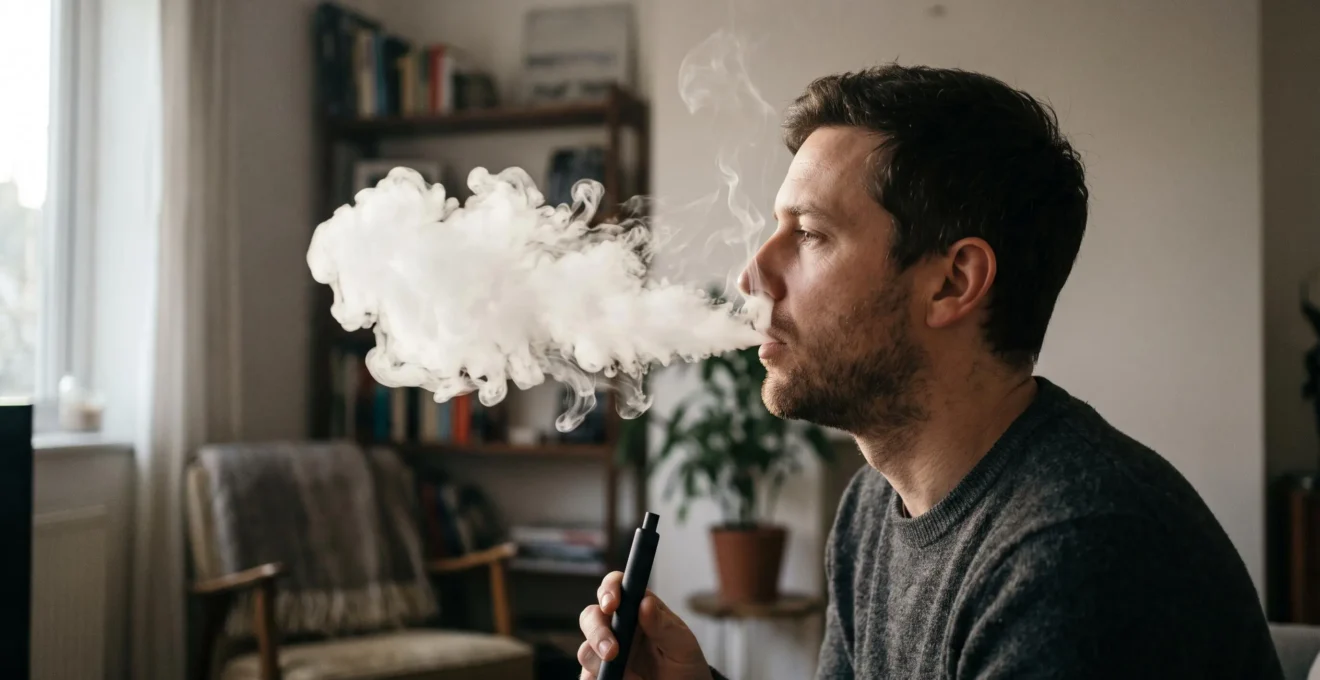
A visible vape plume can emerge as a compact white cloud, stretch into a narrow stream, rise towards the ceiling or disappear almost immediately. These changes are not random. They result from the interaction between aerosol droplets, exhaled air and the surrounding environment.
Electronic cigarettes generate an aerosol containing suspended liquid droplets and gas-phase substances. When exhaled, this aerosol mixes with ambient air. Droplets can evaporate, change size or absorb moisture, while airflow redistributes their concentration. Each process changes how light passes through the plume and therefore how clearly it can be seen.
The appearance of a cloud also depends on how it was produced. Device power, e-liquid composition and inhalation conditions influence the aerosol before exhalation. Exhalation speed, ventilation, humidity and temperature then govern its movement and evolution.
Understanding these separate influences explains why identical puffs can look different, why some clouds remain visible longer and why a plume becoming invisible does not necessarily mean that the surrounding air contains no vaping-related substances.
Vape plume behaviour at a glance
- Initial cloud density depends on aerosol droplet concentration, size distribution, e-liquid composition and device operating conditions.
- Plume shape and dispersal depend on exhalation speed, airflow, turbulent mixing, temperature and humidity.
- Visibility is not an air-quality measurement: droplets can shrink or evaporate while aerosol-derived substances remain in the surrounding air.
- What Makes Vape Aerosol Clouds Dense, Thin or Quick to Disappear?
- Why Does a Vape Plume Disperse Faster in Moving Air?
- How Does Exhalation Speed Change the Shape of a Visible Vape Plume?
- Indoor or Outdoor Air: Where Do Vape Plumes Disperse More Quickly?
- Why Can a Faint Vape Plume Still Contain Aerosol After It Becomes Hard to See?
- When Are Vape Plumes Most Likely to Remain Visible for Longer?
- Why Do Some Vape Aerosol Clouds Linger in the Air Longer Than Others?
- Why Can Large Vapour Clouds Create Problems in Shared Public Spaces?
What Makes Vape Aerosol Clouds Dense, Thin or Quick to Disappear?
Vape aerosol clouds appear dense when numerous liquid droplets scatter enough light to create a visible white mist. Their initial appearance depends on droplet concentration, particle size distribution, e-liquid composition and device operation. After exhalation, temperature, humidity and mixing with surrounding air determine how quickly the cloud becomes thinner or disappears from view.
The device influences how much aerosol is generated and the characteristics of its droplets. Coil temperature and electrical power affect vaporisation, while the proportions of propylene glycol (PG) and vegetable glycerin (VG) influence aerosol formation. Puff volume and inhalation conditions introduce further variation.
PG and VG behave differently because their physical properties, including volatility and hygroscopicity, differ. In experimental measurements, VG-based e-liquids produced larger particles than PG-based liquids under the conditions tested. However, a higher VG proportion is not a guarantee that every device will create a visibly thicker or longer-lasting cloud.
Research published in Chemical Research in Toxicology illustrates why device characteristics matter. In the research on e-cigarette aerosol particle size and device conditions, particle measurements varied with power, e-liquid composition, puff volume and measurement conditions.
145 ± 8 nm vs 182 ± 9 nm
Measured particle count median diameters for PG-based and VG-based e-liquids, respectively, in the 2019 experimental study. These figures describe particular test conditions, not universal plume sizes or visible persistence times.
Son and colleagues, Chemical Research in Toxicology, 2019.
Visible density is also influenced by the concentration of droplets in the exhaled air. A cloud containing more light-scattering material generally appears more opaque, although lighting, background contrast and the size distribution of droplets modify perception.
Temperature adds another layer. Warm exhaled air cools as it encounters its surroundings, potentially changing the balance between evaporation and condensation. Moisture from exhaled breath and ambient air may contribute to droplet growth under suitable conditions. However, atmospheric moisture condensing onto droplets is not the sole reason vape aerosol becomes visible: the e-liquid droplets themselves scatter light.
Vape aerosol is not combustion smoke. Its liquid droplets can evaporate and shrink as the cloud dilutes. A conventional cigarette generates combustion-derived particles with different stability and composition.
The plume often becomes less defined around its edges because those regions are exposed to more surrounding air. Mixing lowers local droplet concentration, while evaporation can reduce light scattering. These mechanisms progressively weaken the visible boundary without requiring every substance to leave the air.
That distinction matters because two clouds starting with similar opacity may evolve differently once airflow begins stretching and diluting them.
Why Does a Vape Plume Disperse Faster in Moving Air?
A vape plume usually loses its visible shape faster in moving air because airflow transports and mixes the aerosol with surrounding air. Turbulent motion stretches the cloud into thinner structures, reducing local droplet concentration. Evaporation can further weaken visibility, although the rate depends on humidity, temperature, droplet composition and the surrounding airflow.
When a plume enters a draught, it rarely moves as a perfectly intact mass. Differences in air velocity pull neighbouring portions in different directions. The cloud bends, stretches and separates into progressively narrower regions of concentrated aerosol.
This process involves turbulent mixing: irregular airflow continuously transfers aerosol between neighbouring volumes of air. As more ambient air enters the plume, the concentration of light-scattering droplets decreases.
Thinner plume structures also bring aerosol-laden air into closer contact with surrounding air. When that air is sufficiently unsaturated with respect to the droplets’ volatile constituents, evaporation can contribute to the loss of visible cloud density.
Two types of air movement help explain different observations:
- Bulk airflow: a ventilation stream, open-window draught or fan produces an overall direction of transport, often carrying the plume visibly across the room.
- Local disturbances: walking people, opening doors and shifting thermal currents produce smaller, less predictable changes that can distort or fragment the cloud.
Even in the same room, a plume exhaled towards an open doorway can behave differently from one released after the door closes. Its movement reflects local airflow at that moment, not simply the nominal ventilation setting.
A fan does more than push vapour somewhere else. Depending on its position and the room geometry, it can also increase mixing. However, redistribution within a closed room is not equivalent to removing aerosol-derived substances from that room. Effective extraction, filtration and fresh-air exchange have different consequences from recirculation alone.
Changes in humidity may also alter droplet size after dilution. An aerosol that has become difficult to see could potentially scatter more light again if sufficiently hygroscopic particles encounter moisture-rich air. This is conditional rather than a predictable reversal for every plume.
The direction of movement can reveal the influence of surrounding air, while the cloud’s shape immediately after leaving the mouth reveals something different: the momentum of exhalation.
How Does Exhalation Speed Change the Shape of a Visible Vape Plume?
Exhalation speed changes vape plume shape by controlling the momentum of the released air. A forceful exhale creates a relatively narrow jet that travels forward and mixes with surrounding air. A gentle exhale produces a broader, slower-moving cloud whose later movement may be governed more strongly by buoyancy and local air currents.
During forceful exhalation, air leaves the mouth with substantial forward velocity. The resulting jet entrains surrounding air as it travels, generating shear and turbulent structures around its boundaries.
Under some conditions, coherent vortices or ring-like structures may form near the leading region of a puff. They are not guaranteed to appear with every exhalation, and ordinary continuous jets may break up without producing a clearly visible vortex ring.
A fast exhale can therefore appear to shoot across a room before rapidly losing definition. This does not automatically mean that its droplets evaporate faster solely because of exhalation speed; stronger entrainment and dilution can account for much of the visible change.
With a slow exhale, the initial momentum is weaker. The aerosol may accumulate close to the face before spreading. If the released air is warmer and less dense than its surroundings, positive buoyancy can contribute to upward motion.
The contrast becomes easier to recognise by watching three features: the distance the cloud travels before changing shape, whether its central region remains compact, and whether its dominant movement is forward or upward.
One especially revealing observation involves techniques sometimes called « ghosting », in which inhaled aerosol is retained before a faint cloud is released. During retention, droplets may deposit within the respiratory tract, evaporate or otherwise change. Consequently, the exhaled aerosol may contain fewer visible droplets.
A faint result does not establish exactly how much aerosol was inhaled or where its constituents went. It demonstrates that the aerosol reaching the surrounding air can differ from what originally entered the mouth or respiratory tract. Deliberately prolonging inhalation is not necessary for observing this principle and should not be treated as a safety technique.
Once the initial momentum weakens, the surrounding environment becomes increasingly important. A slow plume in a ventilated room can disappear faster than a forcefully exhaled cloud in still air.
Indoor or Outdoor Air: Where Do Vape Plumes Disperse More Quickly?
Vape plumes generally disperse more readily outdoors when wind and atmospheric mixing provide rapid dilution. Indoors, walls, limited air exchange and recirculating airflow can allow aerosol-derived substances to remain in shared air. However, a calm outdoor setting may preserve a visible plume longer than a dry, well-ventilated indoor space.
The important distinction is not simply whether a cloud is inside or outside. It is the rate at which aerosol mixes with cleaner air and the extent to which that air is replaced or transported away.
Outdoors, even modest air movement can stretch an exhaled plume into a thin stream. Atmospheric turbulence often disperses it across a much larger volume than would be available in an enclosed room.
Yet windless outdoor conditions can produce a different result. A plume may hang near its point of release, particularly when humidity favours droplet persistence. Its visible behaviour can temporarily resemble that of a plume in an indoor room with little air movement.
Indoor conditions vary just as much. A sealed room with little ventilation is different from one with effective mechanical extraction or appropriately positioned openings that permit air exchange.
Research on indoor aerosol transport demonstrates the importance of these distinctions. An experimental study of e-cigarette aerosol transport between indoor rooms compared ventilation, filtration and room separation under controlled conditions.
How closing a door changed indoor aerosol concentrations
Researchers examined particle concentrations in a vaping room and an adjoining non-vaping room under different ventilation and separation conditions.
Closing the connecting door reduced particle number concentration in the adjoining room by 42%, while increasing concentration in the vaping room by 26%. Enhanced ventilation or air purification reduced concentrations in both rooms. These findings describe the tested configuration, not a universal effect of closing doors in buildings.
This experiment illustrates an important distinction: containing an aerosol within one room can reduce transfer elsewhere while increasing local concentrations. Changing airflow pathways can redistribute exposure rather than eliminate it.
Visible movement towards an open window or extraction point may indicate a local airflow direction. It does not establish an adequate air exchange rate, prove effective filtration or demonstrate that all emitted substances have been removed.
Likewise, a plume disappearing rapidly in a heated, dry room may reflect droplet evaporation as well as ventilation. Appearance alone cannot determine which process dominates.
The distinction becomes particularly important when a cloud looks as though it has vanished: visible disappearance may occur without complete removal of aerosol-derived material.
Why Can a Faint Vape Plume Still Contain Aerosol After It Becomes Hard to See?
A faint or invisible vape plume can still be associated with aerosol particles and gas-phase substances because visibility depends on how effectively suspended droplets scatter light. Dilution and evaporation reduce that scattering, sometimes making a cloud impossible to distinguish by eye before its emitted constituents have been fully removed from the surrounding air.
Human vision cannot directly measure airborne particle concentration. A plume becomes difficult to see when the combined effect of droplet size, number, lighting and background contrast no longer produces sufficient optical contrast.
This is not a single, universal particle-size threshold. Large droplets may scatter light strongly, but many small droplets can also produce visible haze when sufficiently concentrated. Conversely, an optically faint aerosol may contain particles that are too sparse or small to form a recognisable white cloud.
Evaporation and removal are different processes. When a liquid droplet evaporates, its constituents may enter the gas phase. Some less volatile material may remain in particles or on surfaces, depending on the aerosol composition and surrounding conditions.
A controlled experimental comparison published in Nicotine & Tobacco Research examined this distinction. The study comparing exhaled e-cigarette mist and cigarette smoke dispersion found rapid evaporation of exhaled e-cigarette droplets under the tested conditions, unlike the more stable combustion-generated particles from conventional cigarettes.
“Exhaled e-cigarette particles are liquid droplets evaporating rapidly; conventional cigarette smoke particles are far more stable and linger.”
These findings describe the behaviour of selected aerosols in a controlled chamber. They do not establish a universal disappearance time or demonstrate that secondhand exposure becomes harmless when the visible mist has evaporated.
Humidity can also complicate the relationship between visibility and concentration. Hygroscopic aerosol material can absorb water under suitable conditions. Droplets may then grow and scatter more light, making an aerosol region more noticeable after a period of reduced visibility.
Such behaviour depends on local moisture conditions and particle composition. It should not be assumed that every invisible vape plume will become visible again in humid air.
The practical implication is straightforward: neither a clear-looking room nor the disappearance of a particular plume is sufficient evidence of clean indoor air. Proper air-quality evaluation requires appropriate measurements and an understanding of ventilation and emissions.
Understanding this limitation also clarifies why environmental conditions can keep a cloud visible without necessarily determining how long all its constituents remain airborne.
When Are Vape Plumes Most Likely to Remain Visible for Longer?
Vape plumes are more likely to remain visible when airflow is weak, dilution is limited and environmental conditions favour the survival or growth of light-scattering droplets. High humidity, certain e-liquid compositions and low air exchange can contribute. Temperature matters too, but its influence depends on moisture, droplet composition and mixing rather than cold or warmth alone.
Humidity is especially important because PG and VG are hygroscopic: they can interact with surrounding water vapour. In sufficiently moist air, this interaction may help droplets retain or acquire water, whereas drier conditions can favour evaporation of water and other volatile constituents.
However, the direction and magnitude of droplet-size changes depend on the mixture. It is inaccurate to treat relative humidity as a universal control that always produces a thicker vape cloud.
Still air also changes what observers see. Without strong mixing, a concentrated plume may retain its recognisable shape near the point of release. This is different from a situation in which a similar aerosol is quickly diluted across a larger volume of moving air.
The temperature relationship requires additional care. Warm exhaled air entering cooler surroundings may initially be positively buoyant. Cooling can also change the equilibrium between gas-phase moisture and liquid droplets, potentially encouraging condensation under suitable conditions.
Yet temperature does not operate independently of relative humidity. Cold outdoor air can be humid or dry, and the relative humidity of an air parcel can change as it warms or cools. Cold conditions therefore do not guarantee either longer visibility or faster evaporation.
A high-VG e-liquid may produce visually substantial aerosol under particular device conditions, but plume persistence cannot be inferred from VG content alone. Device power, nicotine content, puffing behaviour and the surrounding atmosphere also matter.
For practical comparison, consider the following interacting conditions rather than treating any one of them as decisive:
- Weak air movement: reduces the rate at which the cloud is stretched and diluted.
- High ambient humidity: may slow some evaporative changes or support hygroscopic droplet growth.
- Temperature and moisture differences: affect buoyancy, condensation and evaporation.
- E-liquid and device characteristics: determine the aerosol’s starting properties.
- Limited air exchange: can allow emitted material to remain in an enclosed environment.
The combined effect explains why a plume observed on a calm, humid morning may remain visually coherent while an apparently similar plume fades quickly in a dry room with strong airflow.
Persistence is also not a single measurable outcome. A cloud may stop being visible before all its particles or chemical constituents have left the surrounding air.
Why Do Some Vape Aerosol Clouds Linger in the Air Longer Than Others?
Some vape aerosol clouds remain visible longer because their droplets evaporate or dilute more slowly under the prevailing conditions. Device settings and e-liquid composition determine the initial aerosol, while air movement, humidity, temperature and ventilation influence its subsequent evolution. Importantly, the duration of visible cloudiness is not necessarily the duration of airborne particle or chemical persistence.
Consider two hypothetical observations. In the first, the same device produces a dense plume in a still, humid room and a rapidly fading plume beside an extraction airflow. The difference could arise largely from the environment, even though the aerosol source is unchanged.
In the second, two different devices are used under similar surrounding conditions. Their clouds may begin with different droplet concentrations and size distributions because their heating systems and e-liquid compositions differ.
These scenarios reveal why comparing apparent disappearance times without controlling surrounding conditions is unreliable.
Droplet size distribution is particularly relevant. Larger droplets can contribute strongly to visible light scattering, while sufficiently small particles can remain suspended and move with ambient airflow. Larger droplets also generally have greater gravitational settling velocities, all else being equal.
However, vape aerosol droplets are dynamic. A larger liquid droplet may shrink through evaporation before settling, while a smaller hygroscopic particle may absorb water under different conditions. It is therefore too simplistic to say that larger vape droplets always linger visibly longer or that smaller ones always remain airborne longer in every environment.
Visible persistence and airborne residence are separate properties. The first concerns optical appearance; the second concerns the evolving distribution of particles and substances over time.
A 2020 study in Aerosol Science and Technology supports this distinction. University of California research on e-cigarette aerosol dynamics investigated different PG/VG mixtures and aerosol concentration decay in a controlled chamber.
The researchers found that greater PG content was associated with lower PM2.5 emission factors. For nicotine-free mixtures, higher PG/VG ratios were associated with increased measured particle loss rates, but this pattern did not hold when nicotine was present. The findings show why e-liquid composition cannot be reduced to one universal prediction of aerosol persistence.
Observing how a plume behaves can nevertheless provide useful qualitative clues. Its direction, spreading pattern and fading behaviour may indicate the influence of nearby air currents, but they cannot independently determine humidity, particle concentration or ventilation effectiveness.
Five observations for interpreting plume behaviour
- Record the setting: note whether the observation takes place indoors or outdoors and whether windows, doors or ventilation equipment are operating. The result is a short description of the airflow setting.
- Observe the initial shape: classify an ordinarily exhaled plume as a narrow forward-moving jet or a broad, slowly spreading cloud. Record the visible shape without changing inhalation behaviour to produce a specific result.
- Identify its direction: note whether the cloud drifts sideways, moves forward, rises or remains near its release point. Record the dominant direction as a clue to local airflow.
- Describe its fading: note whether the plume stretches into filaments, gradually loses contrast or disappears relatively uniformly. Write down the visible pattern rather than assuming a measured evaporation rate.
- Compare the observations: make a two-column note of environmental differences and plume differences. Identify possible explanations while explicitly recording that visual observation cannot establish air cleanliness.
This observational method is intended for interpreting plume physics, not for testing whether a location is safe for vaping or whether bystanders are protected from secondhand emissions.
The distinction becomes especially relevant wherever other people share the same air. A large visible plume can create immediate disruption, while less visible emissions may still raise exposure concerns.
Key takeaways for shared environments
- A cloud’s visible size and disappearance rate cannot establish whether other occupants are exposed to aerosol-derived substances.
- Ventilation, room configuration and the presence of other people matter more than simply observing where a plume drifts.
- Respecting venue rules and avoiding emissions into shared air are more reliable responses than trying to make a plume disappear quickly.
Why Can Large Vapour Clouds Create Problems in Shared Public Spaces?
Large vape clouds can create problems in shared spaces because they reduce visibility, cause nuisance and introduce aerosol-derived substances into air occupied by other people. Their movement depends on ventilation and airflow, while their disappearance from view does not guarantee that exposure has ended. These concerns are particularly relevant in crowded or poorly ventilated environments.
Visible clouds can cross personal space, obscure sightlines or remain noticeable in confined areas. Their presence may also lead bystanders to question whether they are being exposed to unwanted airborne substances.
The concern is not merely a misunderstanding between vapour and cigarette smoke. E-cigarette aerosol and combustion smoke differ physically and chemically, but both can introduce substances into shared air. A scientifically meaningful assessment should acknowledge those differences without treating vape aerosol as harmless water vapour.
Even people familiar with vaping cannot determine an aerosol’s composition by looking at it. A dense cloud may appear especially intrusive, but a faint cloud is not automatically free of exposure implications.
Indoor ventilation adds another complication. A fan may carry a plume away from one person while directing some of its contents towards another area. Recirculation can change visible cloud shape without providing sufficient removal of airborne constituents.
Effective ventilation or filtration may reduce particle concentrations, as demonstrated by controlled indoor experiments. However, performance depends on the actual system, airflow pathways and substances involved. Visible dispersal is not a substitute for assessing these factors.
Rules governing vaping also vary among countries, regions, venues and transport operators. A location where vaping is not explicitly prohibited should not automatically be interpreted as an appropriate place to release aerosol into air shared with others.
Practical considerations include room occupancy, proximity to bystanders, applicable restrictions and whether the space is enclosed. In a crowded environment, the most dependable way to avoid exposing others to a vape plume is not to generate one in the shared air.
Outdoors, airflow can substantially dilute an exhaled plume, but close proximity to another person may still create direct contact with freshly exhaled aerosol before substantial mixing occurs.
Cloud size therefore matters socially because it affects visibility and nuisance, while the broader air-quality question concerns substances that may remain after the cloud fades. The two issues overlap but are not interchangeable.
When assessing a shared space, consider occupancy, airflow and applicable venue rules, and avoid vaping where emissions could affect others. For understanding a plume already observed, distinguish what its visible movement reveals from what only aerosol and ventilation measurements can establish.
Is the white cloud from a vape made entirely of water vapour?
No. The visible cloud is an aerosol containing liquid droplets formed from e-liquid constituents, commonly including propylene glycol and vegetable glycerin, together with water and potentially other ingredients or substances. It also contains gas-phase components. Pure water vapour is invisible; the white appearance comes from light scattering by suspended droplets.
Does a vape plume disappearing mean its droplets have settled on the floor?
No. A cloud can become invisible through dilution and droplet evaporation, without requiring droplets to settle. Deposition on surfaces and gravitational settling can occur, but the balance among these mechanisms depends on particle size, composition, airflow and environmental conditions. Evaporated material may remain in the gas phase.
Can lighting make the same vape cloud appear thicker or thinner?
Yes. The visibility of suspended droplets depends partly on how light illuminates them and on contrast with the background. Side lighting or backlighting can make a plume’s boundaries easier to distinguish against a darker surface. This can change perceived density without changing the amount of aerosol present.
Can a fan make a vape plume disappear without removing its contents from the room?
Yes. A fan can stretch, transport and dilute a plume until it becomes difficult to see, even if the air is only being recirculated. Exhaust ventilation and effective filtration can remove some airborne material, but a circulating fan alone does not establish that pollutants have been extracted.
Is the direction a vape plume travels a reliable way to measure ventilation?
No. Plume direction provides a qualitative indication of local air movement, but it cannot establish air exchange rates, filtration effectiveness or overall air quality. Temperature-driven currents, nearby people and obstacles can alter the path. Ventilation performance requires appropriate measurement or system assessment.