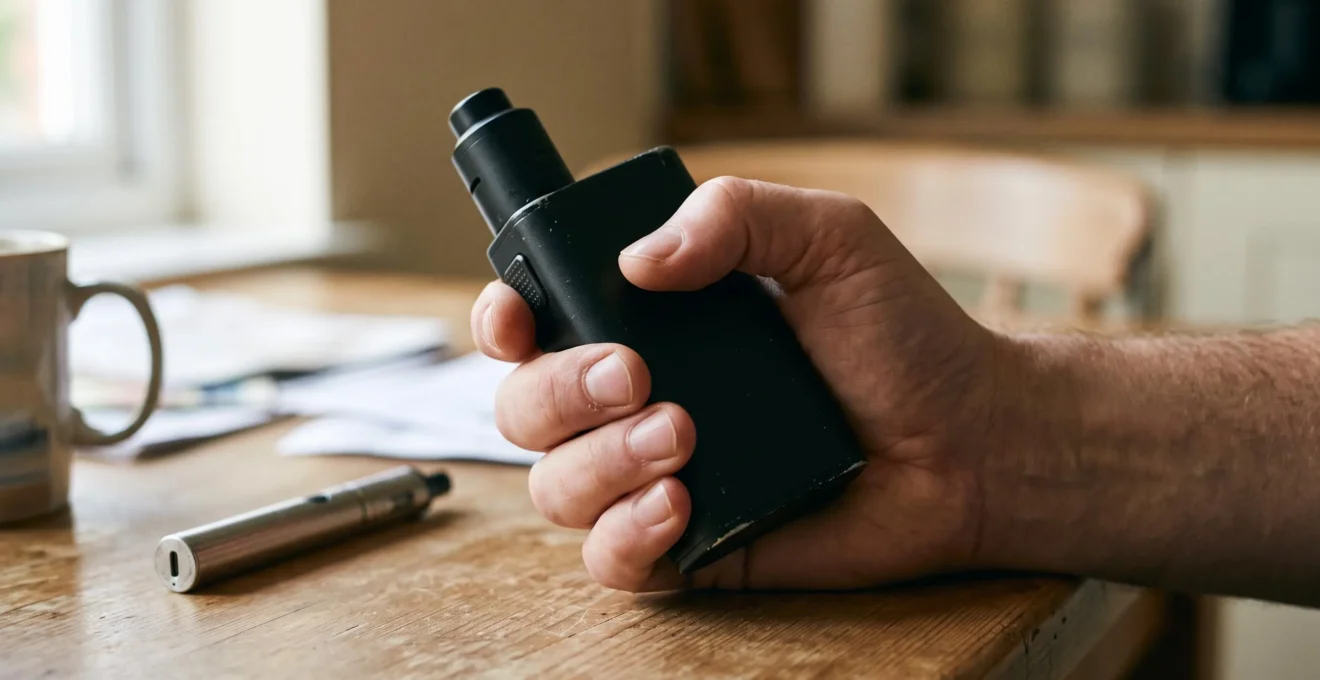
A box-shaped vape changes how an adult user holds, operates and carries the device. Its wider rectangular body can provide a larger gripping surface than a cylindrical pen, create additional room for controls and accommodate different battery configurations. These advantages depend on the relationship between device dimensions, hand size, weight distribution and everyday usage conditions.
A larger body is not automatically more comfortable. A box that fills one person’s palm naturally may force another person to stretch their fingers or adjust their grip to reach the firing button. Similarly, additional internal space can accommodate a larger battery, but longer operating time depends on electrical specifications and power consumption, not external dimensions alone.
For adults comparing existing vaping hardware, the most useful approach is to assess grip geometry, control accessibility, carrying requirements and charging opportunities together. This is an assessment of hardware handling, not evidence that one vaping format is healthier or safer than another. E-cigarette aerosol can contain nicotine and other harmful substances regardless of device shape.
Box Vape Ergonomics at a Glance
- Grip: A wider, flatter body may support more palm contact, but excessive thickness can make a device harder to hold comfortably.
- Controls: Fire-button position, screen visibility and airflow orientation should work with the user’s natural hand position.
- Battery and portability: Larger devices can accommodate greater battery capacity, although actual runtime depends on power demand and usage conditions.
- Why Can a Box-Shaped Vape Feel More Stable in the Hand Than a Slim Pen?
- How Can You Check Whether a Box Vape’s Controls Suit Your Grip?
- Compact or Large Box Vape: Which Better Balances Portability and Runtime?
- Which Ergonomic Problems Make a Box Vape Uncomfortable During Daily Use?
- How Can You Match Box Vape Size to Commuting, Home Use or Longer Trips?
- Vape Pen or Pod System: Which Is Easier for a Compact Daily Setup?
- Higher Capacity or Smaller Battery: Which Better Fits a Portable Vape?
- How Can You Build a Vaping Setup That Matches Your Power and Portability Needs?
Why Can a Box-Shaped Vape Feel More Stable in the Hand Than a Slim Pen?
A box-shaped vape can feel more stable because its wider, flatter surfaces allow the fingers and palm to contact more of the device at once. A slim cylindrical pen is often held with a narrower pinch grip. Neither arrangement is inherently superior: comfort depends on how well the device’s width, thickness, surface finish and weight match the user’s hand.
A rectangular body creates relatively broad contact surfaces. When those surfaces fit the hand, the user may be able to maintain a relaxed hold without relying as heavily on fingertip pressure. A pen-style device instead encourages a grip involving the thumb and one or more fingers around a narrow cylinder.
The important distinction is contact distribution rather than shape alone. A NIOSH-hosted study on hand-handle contact pressure investigated how handle dimensions and applied forces influence pressure across the hand. Researchers examined three cylindrical handle diameters—30 mm, 40 mm and 48 mm—with 10 adult male participants.
The study found that peak contact pressures depended on handle size and gripping forces. However, it did not test vaping devices or compare rectangular bodies against pens. Its findings support assessing individual grip dimensions, not claiming that box vapes universally reduce fatigue.
A wider body only helps when the hand can wrap around it naturally. As a practical fit test, the thumb should be able to reach its intended resting position while the fingers maintain contact without uncomfortable stretching. This is an individual assessment rather than a scientifically established size threshold.
Box devices also offer a separate everyday advantage: many have flat bases that allow them to stand upright on a suitable level surface. Cylindrical pens may roll when placed horizontally unless their design includes a stabilizing feature. The actual stability of either device depends on its base, proportions and center of gravity.
Users accustomed to narrow pens may initially find a rectangular grip unfamiliar. They may need to change which fingers support the device or where the thumb rests. That adjustment does not necessarily indicate poor ergonomics, but persistent pressure or repeated hand repositioning does.
Once a device feels secure in the hand, the next question is whether its controls can be operated without losing that comfortable grip.
How Can You Check Whether a Box Vape’s Controls Suit Your Grip?
A box vape’s controls suit your grip when the firing mechanism, airflow position and visual indicators can be accessed without awkward finger stretching or repeated hand rotation. Hold the device in your normal operating position, check which finger naturally reaches the main control and confirm that the remaining fingers support its weight comfortably. Repeat the assessment with either hand if needed.
Button location determines how much the user must adapt their grip. A front-facing button may suit a thumb-operated hold, while a side-edge button may be more accessible to an index finger. Top-corner buttons can work with certain hand positions but feel inconvenient with others. These are layout possibilities, not universal rules.
The relationship between controls is equally important. A firing button may be easy to reach, yet the screen could require rotating the device to read it. Adjustment buttons may sit where the supporting fingers press unintentionally. The mouthpiece and airflow layout should also allow the device to reach the mouth without wrist contortion or obstruction of intended airflow openings.
Left-handed users and people who alternate hands should examine control symmetry carefully. A button positioned for comfortable right-thumb operation may be difficult to access with the opposite hand. Symmetrical body geometry and centrally accessible controls can be useful, although accessibility still depends on the complete design.
When comparing devices online, published dimensions can provide a useful first approximation. A folded paper mock-up or accurately sized 3D-printed model can help reveal whether a body appears too broad, tall or thick. However, such models cannot reproduce the device’s actual weight distribution, button resistance or surface texture.
Five Practical Checks Before Choosing a Box Vape
- Record the dimensions. Write down the device’s stated height, width and thickness, producing a basic size reference.
- Make a physical outline. Fold paper or prepare a simple model matching those measurements, producing a tangible grip mock-up.
- Mark the controls. Add the advertised firing-button and adjustment-button positions, producing a control-location diagram.
- Test both hand positions. Hold the mock-up as naturally as possible and record any finger stretching, wrist rotation or required grip changes.
- Check carrying space. Compare the mock-up with the intended pocket or bag compartment and record whether it fits without forcing.
These checks do not replace handling the actual device when possible. They help identify obvious dimensional mismatches before purchase and make product specifications more meaningful.
After establishing a suitable control layout, device size can be evaluated against the practical compromise between battery runtime and portability.
Compact or Large Box Vape: Which Better Balances Portability and Runtime?
A compact box vape generally favors pocketability and lower carrying bulk, while a larger body may accommodate more battery capacity and provide a fuller gripping surface. Neither size guarantees superior daily performance. The better fit depends on typical power demand, charging availability, hand dimensions and whether the device is carried frequently or used mainly in one location.
Battery capacity often influences the space a manufacturer allocates inside a device. A larger enclosure may accommodate a larger integrated battery or a different removable-cell configuration. However, external volume also depends on circuit boards, screens, structural components and reservoir design. Two similarly sized devices can therefore have different battery specifications.
For portability, thickness and weight matter alongside height. A compact device may fit comfortably in a pocket yet feel too narrow for an adult with larger hands. Conversely, a large box can offer a substantial gripping surface but become inconvenient when carried through a busy day.
The following comparison summarizes typical design trade-offs rather than measured performance differences between specific products.
| Criterion | Compact box | Large box |
|---|---|---|
| Grip | Potentially easier to enclose with smaller hands | Potentially more palm contact for larger hands |
| Pocket portability | Usually less bulky | May require more carrying space |
| Battery accommodation | More limited internal space | Potentially more room for cells |
| Controls and screen | Less surface area for separation | Potentially more room for accessible layouts |
| Charging routine | May require more frequent charging | May support longer intervals at comparable power demand |
Battery capacity must be considered alongside output power. A high-capacity device operated at substantially higher power can have a shorter interval between charges than a smaller device used at lower power. Advertised milliampere-hour ratings cannot establish practical runtime without further electrical and usage information.
A simple decision method is to assess whether the device can cover an ordinary day’s existing use without inconvenient charging. Consider how frequently the device is operated, whether charging is available during the day and how much carrying space is acceptable.
For example, in a hypothetical comparison, an office-based user with regular charging access may find a compact device sufficient. Another adult spending long periods away from charging facilities may give more weight to battery accommodation. These are scenarios illustrating the decision process, not measured results.
Size alone does not determine comfort, however. Surface design, balance and repeated movements can create problems even when a device appears to fit the hand.
Which Ergonomic Problems Make a Box Vape Uncomfortable During Daily Use?
A box vape can become uncomfortable when its edges concentrate pressure against the palm, its thickness forces a stretched grip, or its weight makes repeated handling awkward. Slippery finishes, poorly positioned buttons and uneven weight distribution can add to the problem. A device that feels acceptable briefly may still be inconvenient during repeated use throughout an ordinary day.
Sharp corners are one common source of localized discomfort. Rounded edges can reduce the prominence of contact points, although the benefit depends on how the user holds the device. A rectangular body with broad faces is not necessarily comfortable if the gripping surfaces are poorly matched to the hand.
Weight distribution matters separately from total weight. A device that feels top-heavy may require more active finger control to maintain its orientation. If the user repeatedly adjusts the wrist or thumb to compensate, the interaction can become cumbersome.
Surface texture introduces another trade-off. A smooth finish may be easy to clean but become slippery in some handling conditions. A textured surface may improve perceived grip security, yet overly abrasive material can be unpleasant against the fingers. Neither finish should be assumed superior without considering the complete device.
Several observable signs suggest that the device and hand do not work well together:
- The grip must be changed whenever the firing button is pressed.
- The thumb or fingers cannot comfortably reach the intended controls.
- Edges leave noticeable pressure marks after handling.
- The device feels likely to slip unless held tightly.
- Supporting the device requires an awkward wrist position.
These observations identify possible ergonomic mismatches rather than diagnose an injury. Persistent discomfort should not be treated as a normal adjustment requirement.
Other practical issues arise during carrying and repeated operation. Squared corners may rub against pockets or bag linings. Exposed buttons may be pressed unintentionally unless the device includes an effective lock or protective arrangement. During extended operation, noticeable heat around the gripping surface is also a reason to stop using the device and consult its manufacturer guidance, rather than simply change hand position.
Comfort is a combined result of dimensions, balance, texture and control access. No single specification reliably captures all four.
These handling characteristics become especially relevant when the device moves between different daily environments, each with its own space and carrying constraints.
How Can You Match Box Vape Size to Commuting, Home Use or Longer Trips?
Match box vape size to the places where the device is normally carried, the amount of available storage space and the opportunities to charge it. Compact models may be easier to transport during commuting, while larger devices can be less inconvenient when mostly kept at home. Longer journeys require additional attention to battery carriage rules, accidental activation and destination restrictions.
Commuting places a premium on carrying practicality. Pocket depth, clothing, bag compartments and the presence of other objects can matter more than small differences in published dimensions. A device that is comfortable in the hand but difficult to store may be unsuitable for a frequently mobile routine.
Carrying a device alongside keys or other hard objects may expose its screen and finish to scratching. A dedicated compartment or appropriate protective case can reduce incidental contact, although that accessory adds its own bulk.
Home-based handling involves a different balance. Where portability is less important, a larger device may be easier to accommodate on a desk or table. The user’s charging arrangement and preference for a particular grip remain relevant, but pocket fit may no longer be the primary constraint.
For longer journeys, charging opportunities and transport rules become more important. A larger battery may be useful when access to charging is limited, but battery capacity does not override airline restrictions.
Under US aviation requirements, the FAA PackSafe rules for vaping devices require electronic smoking devices to be carried on the passenger or in carry-on baggage, not checked baggage. Measures must be taken to prevent accidental activation, and spare lithium batteries require protection against short circuits. The FAA also prohibits charging vaping devices and their batteries aboard aircraft.
These requirements apply to the relevant US aviation framework. Other English-speaking countries, airlines and destinations may have additional or different rules, including restrictions on possession or use. Travelers should verify current requirements before departure rather than assume international uniformity.
A useful matching exercise is to note the locations in a typical week, then record how the device would be stored and where charging would be possible. This reveals whether a compact form covers the majority of situations or whether a larger device would create fewer practical inconveniences. Maintaining two devices is an option some users consider, but it also adds equipment, charging and storage responsibilities.
For adults who prioritize minimal bulk, comparing box devices with alternative pen and pod configurations can clarify whether the rectangular format is necessary at all.
Vape Pen or Pod System: Which Is Easier for a Compact Daily Setup?
A vape pen may suit a compact setup when its narrow cylindrical body and straightforward operating requirements match the user’s preferences. A pod system may offer comparable simplicity while using replaceable cartridges and a rechargeable base. The easier option depends on the particular product’s activation method, maintenance needs and carried components—not simply whether it is called a pen or a pod.
These categories are not mutually exclusive. A pod system can have a pen-like shape, and a box-shaped device can incorporate a pod or cartridge arrangement. Product terminology therefore provides only a starting point for examining physical dimensions and operating requirements.
The CDC overview of e-cigarette types and components describes disposable, refillable and prefilled-cartridge configurations, noting that e-cigarettes come in different shapes and sizes. These classifications describe hardware characteristics; they do not establish that a particular body shape must use a specific activation mechanism.
When comparing portability, consider the complete set of items carried during an ordinary day. A rechargeable pen with an integrated liquid reservoir may require little additional equipment for a given routine. A pod system could make cartridge replacement more convenient but involve carrying spare pods. A refillable configuration may involve different maintenance materials.
| Consideration | Pen-style device | Pod system |
|---|---|---|
| Body shape | Typically narrow and cylindrical | Varies from slim to box-like |
| Activation | Button or draw activation, depending on model | Button or draw activation, depending on model |
| Liquid arrangement | Integrated, refillable or other model-specific design | Usually cartridge or pod-based |
| Daily accessories | Depends on charging and reservoir requirements | May include spare cartridges |
| Control access | Limited surface area for controls | Depends on shape and interface design |
One misleading assumption is that pen devices are always simpler because they look less complex. A draw-activated pod configuration can remove the need to operate a firing button, while a pen with several adjustable functions may require more interaction.
For the smallest practical setup, compare activation method, maintenance burden and total carried equipment. If two products offer similar functionality, the one that fits the hand and storage conditions more naturally may be the more convenient choice.
Whichever format is selected, battery specifications still need separate evaluation because small size and long runtime are competing design priorities.
Higher Capacity or Smaller Battery: Which Better Fits a Portable Vape?
A higher-capacity battery may reduce charging frequency, while a smaller battery can make a portable vape lighter or less bulky when the surrounding design also supports compactness. The choice depends on required operating time, power settings and charging access. Capacity figures expressed in milliampere-hours are useful specifications, but they cannot independently predict how long a complete device will operate.
Lithium-ion battery capacity and energy storage depend on cell design. Adding battery capacity within a product family can require more internal volume, but external device dimensions are also shaped by electronics, structural materials and other components. Greater capacity is therefore not a guaranteed consequence of a larger enclosure.
Battery performance is also sensitive to load. Higher power demand can reduce the amount of usable energy available under certain conditions, making nominal ratings an incomplete basis for comparing devices.
Battery University‘s technical discussion of lithium-ion discharge characteristics provides an illustrative example. A specified Panasonic cell rated at 3.2 Ah delivered approximately 2.3 Ah under the article’s particular 2C discharge condition and 3.0 V cutoff. This is a result for that cell and test configuration, not a prediction for vape batteries generally.
Actual runtime depends on both stored energy and consumption. A more useful comparison considers battery energy, the device’s typical operating power, activation duration, standby demand and charging opportunities.
A simplified electrical estimate can illustrate the relationship:
Nominal battery energy (Wh) ≈ rated capacity (Ah) × nominal voltage (V).
Dividing this nominal energy by a representative power draw gives an idealized estimate of cumulative operating time at that draw—not elapsed hours or days between charges. Conversion losses, battery protection limits, standby consumption, temperature and actual usage patterns affect the result. A complete-device estimate therefore requires more information than a battery’s advertised mAh value.
Manufacturer puff-count claims should also be interpreted cautiously because operating duration and power conditions may differ between devices.
Battery construction introduces another portability consideration. An integrated non-removable battery keeps the device’s power source within the main body. A replaceable-cell design may allow separate spare cells, but those cells require appropriate protective cases, compatible charging arrangements and careful handling according to manufacturer instructions. Loose lithium-ion cells should not be carried unprotected with metal objects.
Long-term capacity decline matters as well. Lithium-ion batteries gradually lose usable capacity with aging and charge cycles. A device that barely meets current runtime requirements may become less convenient over time. Modest capacity headroom can accommodate some deterioration, although its practical value depends on usage and battery conditions.
A complete hardware assessment should combine these electrical considerations with grip, controls, storage and the everyday charging routine.
Key Takeaways Before Choosing a Setup
- Start with the routine: Identify where the device is handled, stored and charged before treating battery size as the primary requirement.
- Evaluate the full device: A comfortable body needs accessible controls, manageable weight and a practical carrying arrangement.
- Check the operating conditions: Battery ratings, power settings, accessories and aging all influence long-term convenience.
How Can You Build a Vaping Setup That Matches Your Power and Portability Needs?
A practical vaping hardware setup starts with the user’s existing usage conditions, then matches device dimensions, control placement and battery characteristics to those requirements. Identify where and how often the device is handled, assess how its shape fits the hand and determine whether charging access supports the desired portability. Higher power and larger capacity should not be treated as automatic improvements.
Begin with a realistic account of current device use rather than a specification sheet. Consider how frequently charging becomes inconvenient, where the device is usually carried and whether operating the controls requires grip adjustments.
The next consideration is physical compatibility. Compare the device’s dimensions with the hand and intended storage space. A compact body that creates an uncomfortable grip may not be preferable to a slightly larger one. Equally, a wide device offering comfortable palm contact may be impractical when it must fit into a small pocket.
Power requirements should be evaluated without assuming that maximum output is desirable. Higher output settings generally increase energy consumption during operation and may shorten the interval between charges. The appropriate electrical configuration depends on the device’s intended operating range and manufacturer guidance, not a universal target wattage.
Accessories complete the assessment. A protective case, charging cable or compatible replacement components may make a setup more convenient in certain circumstances, but they also increase the amount of equipment carried. Removable lithium-ion batteries introduce additional compatibility, storage and handling considerations.
A straightforward way to evaluate the trade-offs is to compare the proposed configuration against an actual week of current use:
- Document the routine. Note where the device is handled, carried and stored, together with the charging opportunities available.
- Check physical fit. Compare dimensions, grip width, button reach and pocket clearance using available product measurements or direct handling.
- Assess battery requirements. Review capacity together with power demand and determine whether the charging arrangement is practical.
- Include accessories. Account for the space and safe storage needed for cables, protective cases or compatible replacement components.
- Review real-world performance. After purchase, compare the device’s actual handling and charging behavior with the original requirements, without assuming that manufacturer estimates will exactly match everyday conditions.
These steps make trade-offs visible without relying on arbitrary size or capacity thresholds. They also help separate genuine ergonomic advantages from features that add complexity without addressing a practical need.
No particular box shape eliminates the health risks associated with e-cigarette aerosol, and hardware comfort should not be confused with product safety. The purpose of the assessment is to understand how an existing or contemplated device fits an adult user’s physical handling and transport requirements.
Use the recorded dimensions, control-access observations and charging requirements as a final pre-purchase comparison. Choose only after checking that the complete device—not merely its advertised battery capacity or external shape—meets the practical conditions identified.
Does a heavier box vape always feel more stable?
No. Greater weight can change the sensation of solidity, but it can also increase the effort needed to lift and position a device. Weight distribution, gripping surface and hand size are important. A lighter model with suitable dimensions may be easier to handle than a heavier model that requires repeated grip adjustments.
Are rounded corners more comfortable than sharp box edges?
Rounded corners may reduce concentrated contact pressure where the device meets the palm or fingers. However, overall comfort still depends on dimensions, grip force, material texture and individual anatomy. Corner shape alone cannot establish ergonomic superiority.
Can an adult with small hands comfortably hold a box-shaped vape?
Yes, depending on the device. Compact rectangular bodies may fit smaller hands comfortably, particularly when controls are accessible without stretching the thumb or changing grip. Published width and thickness measurements, combined with a physical sizing check, are more informative than the box-shaped classification itself.
Does a box-shaped design prevent accidental button activation?
No. Accidental activation depends on button exposure, locking mechanisms and carrying conditions rather than rectangular geometry. For transport, use the manufacturer’s recommended locking or protective measures. Aviation requirements may impose additional precautions to prevent unintended heating-element activation.
Is battery capacity or physical thickness more important when comparing portable devices?
Neither specification is universally more important. Thickness affects pocket fit and grip, while capacity contributes to potential runtime. The appropriate balance depends on typical power consumption, charging access and the user’s physical handling requirements. Both should be evaluated together rather than treated as independent purchasing criteria.