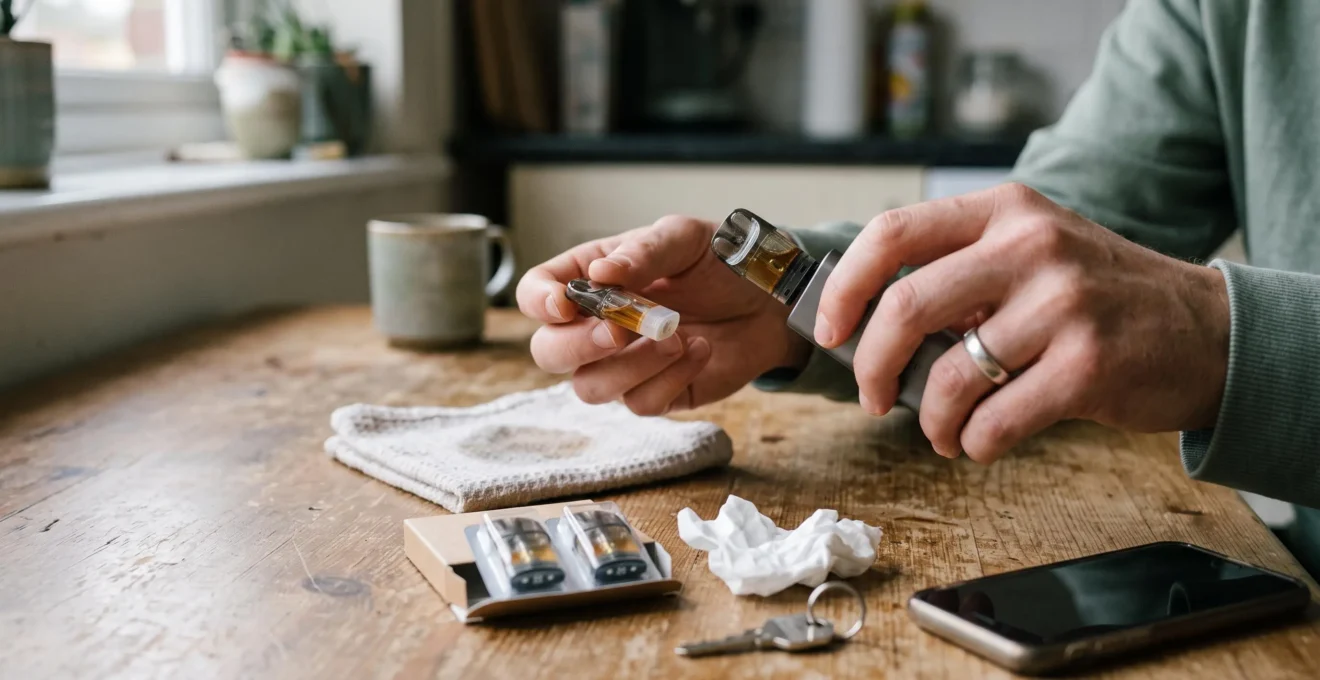
Sealed pod cartridges change vape maintenance by moving most liquid-handling tasks into a replaceable component. Instead of opening a reservoir, adding e-liquid, monitoring refill seals and cleaning a reusable tank, an adult user removes the spent cartridge and installs a compatible replacement. The device body remains in service, while the liquid-containing pod is exchanged.
That arrangement can make everyday maintenance simpler, but it does not eliminate it. Electrical contacts still collect condensation, connection points can become contaminated, and cartridges may leak or lose performance. Proper installation and timely replacement remain important to prevent avoidable device problems.
The practical difference also depends on the hardware. Some pod systems use magnetic connections, others use friction-fit cartridges, and certain designs combine replaceable pods with refillable components. Understanding these distinctions helps separate genuinely reduced maintenance from tasks that have merely shifted elsewhere.
For adults comparing prefilled sealed cartridges with refillable systems, the central questions are straightforward: what needs cleaning, what can be replaced, how can failures be recognized, and what does the simpler routine cost over time?
Sealed pod maintenance at a glance
- Sealed cartridges eliminate routine e-liquid refilling and most internal cartridge cleaning, but device contacts and the pod socket still require inspection.
- Correct alignment, compatible connectors and clean, dry electrical contacts help prevent installation damage and detection errors.
- Replacement should follow cartridge condition, leakage and performance changes rather than an assumed universal lifespan.
- Why Sealed Vape Pods Need Less Routine Cleaning Than Refillable Cartridges
- How to Fit a Sealed Pod Cartridge Without Damaging Its Contacts or Seal
- Sealed or Refillable Pod: Which Better Fits a Low-Maintenance Routine?
- Which Signs Mean a Sealed Vape Pod Should Be Replaced Immediately?
- When to Replace a Sealed Pod Cartridge Before Performance Deteriorates Further
- Vape Pen or Pod System: Which Is Easier for a Compact Daily Setup?
- How to Check a Replacement Vape Component Before Installing It
- When a Cylindrical Vape Pen Suits Everyday Vaping Better Than a Larger Device
Why Sealed Vape Pods Need Less Routine Cleaning Than Refillable Cartridges
Sealed vape pods generally need less routine cleaning because the e-liquid reservoir and its internal heating assembly are replaced together rather than repeatedly opened for refilling. Liquid handling, internal residue and worn cartridge components are largely dealt with through replacement. However, condensation, connector contamination and debris can still accumulate inside the reusable device.
In a refillable system, users must handle the reservoir whenever adding liquid. Depending on the design, maintenance can also involve inspecting fill-port plugs, cleaning residue around the opening, and managing replaceable coils or tank components. Those tasks do not normally apply to a factory-sealed, non-refillable cartridge.
The mechanical distinction is particularly noticeable when cartridges are changed. A sealed pod is removed as a complete assembly, while a conventional tank may need to be emptied, disassembled and cleaned before being used again. Not every refillable pod requires a deep clean at each refill, so the actual difference depends on the specific hardware and liquid used.
The electrical connection still needs attention. Condensation can appear around the underside of either cartridge type, while leaked liquid or pocket debris may interfere with contact between the pod and battery.
In its Innokin EQ FLTR support and maintenance instructions, the manufacturer recommends inspecting magnetic connectors for e-liquid, debris and condensation. These instructions concern a particular refillable pod device, but they illustrate why maintaining the pod bay matters even when the liquid container is replaced.
A practical cartridge-change routine is to power off the device where supported, remove the pod, check the socket and gently wipe accessible contacts with a clean, dry, lint-free material. If the manufacturer permits additional cleaning, follow its instructions and let every component dry completely before use.
Moisture near the mouthpiece may also cause gurgling or an inconsistent draw. Inspecting the mouthpiece and exterior airflow openings can help identify visible condensation, but a dry puff test is not a validated universal diagnostic for sealed cartridges. Persistent gurgling after permitted external cleaning may indicate an internal pod problem.
The maintenance saving is therefore better understood in terms of tasks eliminated rather than minutes guaranteed. A refillable system requires periodic liquid handling and sometimes more extensive cleaning; a sealed system concentrates attention on cartridge replacement and accessible connection points. Neither category has a universally established cleaning schedule.
This simpler arrangement works best when each new cartridge is fitted correctly. Poor alignment or contaminated contacts can cancel some of the convenience gained from avoiding refills.
How to Fit a Sealed Pod Cartridge Without Damaging Its Contacts or Seal
Fit a sealed pod cartridge by confirming model compatibility, removing only the protective pieces identified in its instructions, aligning the cartridge with the device socket and applying gentle, straight pressure until it seats. Magnetic pods usually settle into position with magnetic resistance or a slight click; friction-fit pods require an even push without forcing the connection.
Before insertion, examine the cartridge’s contact surface and any visible silicone sealing components. A pod with distorted contacts, damaged seals or liquid already escaping from its base should not be installed.
For magnetic systems, position the pod in the orientation specified by the manufacturer and let the magnets guide the final movement. With friction-fit designs, hold the pod square to the opening and press evenly. Some products provide an audible click, while others indicate seating through their physical fit. Neither sound nor resistance is a universal requirement.
A partially seated cartridge may sit higher than normal, rock in its socket, leave an unexpected gap or produce an intermittent connection. Remove it and inspect the fit rather than pushing harder.
Misalignment creates avoidable mechanical risks. Forcing a pod at an angle can damage connector pins, deform the cartridge housing or displace an exposed gasket. Liquid across electrical contacts can also prevent normal detection, even when the pod appears correctly installed.
Priming requires particular care because sealed and refillable cartridges are not interchangeable in this respect. For a refillable coil with accessible wick ports, the manufacturer may instruct users to saturate the wick before use. A factory-sealed prefilled cartridge must not be opened or injected with additional liquid. Follow its first-use instructions, including any specified waiting period after removing protective seals.
If a newly installed cartridge is not detected, use a controlled troubleshooting sequence:
- Stop using the device and remove the cartridge.
- Inspect both sets of accessible contacts for liquid, debris or damage.
- Clean only as the manufacturer allows and ensure all contact surfaces are dry.
- Reinsert the cartridge in its correct orientation.
- If the error persists, test another confirmed-compatible cartridge where safe and available, then seek manufacturer support if the problem remains.
A failure limited to one cartridge suggests a cartridge-specific issue. Failure across multiple compatible cartridges may point toward the device or connector, although neither observation alone proves the cause.
Once fitting is reliable, choosing between sealed and refillable formats becomes less about the connection itself and more about ongoing effort, ownership cost and liquid flexibility.
Sealed or Refillable Pod: Which Better Fits a Low-Maintenance Routine?
A sealed pod generally suits an adult who wants to avoid handling bottled e-liquid and cleaning reusable liquid chambers. A refillable pod suits someone willing to manage filling, seals and coil maintenance in exchange for broader liquid choice and potentially lower ongoing costs. Neither format is automatically cheaper, cleaner or more reliable across every device.
The useful comparison is not simply how often a cartridge gets replaced. It is the complete set of tasks required to keep the device operating normally, including inspections, refills, cleaning, replacement purchases and troubleshooting.
| Comparison criterion | Sealed prefilled pod | Refillable pod |
|---|---|---|
| Routine weekly actions | Inspect contacts, monitor pod condition and replace cartridges when necessary | Refill liquid, inspect fill seals, check contacts and maintain or replace the coil or pod as required |
| Initial purchase | Can have a relatively inexpensive starter device; model and market matter | Starter prices vary with battery, tank and adjustment features |
| Running expenses | Recurring purchases of compatible proprietary cartridges | Bottled liquid plus replacement pods, coils or other consumables |
| Flavor consistency | Can change as the integrated coil and wick age; replace the entire pod | Depends on liquid condition, refill practices and coil maintenance |
| E-liquid flexibility | Limited to the manufacturer’s available formulations and strengths | Broader selection, within the device’s specified liquid compatibility |
| Leak-related work | Less manual filling, but cartridge seals can still fail | Fill-port handling and seal wear introduce additional possible leak points |
| Component replacement | Usually replaces the liquid chamber and integrated coil together | May replace only a coil, a pod, or both, depending on design |
A UK government consultation included historical illustrative average kit prices of £12 for reusable prefilled-pod kits and £40 for kits with refillable cartridges. These were historical entry-price figures, not verified current retail prices or a long-term ownership comparison. The distinction appears in the UK government consultation on vaping products and their costs.
The main hidden trade-off is cartridge dependency. A sealed system generally ties replacement availability, e-liquid formulations and nicotine options to the manufacturer’s product range. A refillable model provides more choice but introduces maintenance requirements around its refill port, seals and heating element.
For someone who uses a small amount of liquid and strongly dislikes refilling, the reduced handling may justify buying prefilled cartridges. A more frequent user with varied liquid preferences may find the recurring cost or restricted selection less attractive. A refillable device kept as a backup is another possibility, although maintaining two systems adds its own responsibilities.
To compare costs, calculate the expected expense over the same period:
- Sealed system: starter-device cost plus the expected number of replacement cartridge packs multiplied by their actual purchase price.
- Refillable system: starter-device cost plus bottled liquid, replacement coils or pods and any required maintenance consumables.
Use the same expected liquid consumption and time horizon in both calculations. If one format has a higher initial price but lower projected running costs, divide the initial price difference by the estimated periodic savings to estimate a break-even period. The result is only as dependable as the personal consumption and price assumptions.
Whichever system fits the routine, users still need to distinguish normal cartridge aging from failures that make immediate removal necessary.
Which Signs Mean a Sealed Vape Pod Should Be Replaced Immediately?
A sealed vape pod should be removed from use when it leaks from a damaged seal, has visible cracks, shows abnormal heating or produces a persistent burnt taste. A sharp, unexplained reduction in vapor or repeated gurgling can also justify stopping use and inspecting the cartridge. Gradual flavor fading alone is a less urgent replacement signal.
The first distinction is between a cartridge that is wearing out and one that may threaten the reusable device. Reduced flavor intensity or an increasingly weak draw can indicate developing performance problems, but external liquid escaping from the base presents an additional risk of contaminating the connector.
Inspect the following signs in order of practical urgency:
- External leakage or damaged housing: remove the pod, inspect the device socket and do not reuse a visibly damaged cartridge.
- Persistent burnt taste: stop using the pod. A dry or damaged wick may be involved, but the precise cause cannot be diagnosed from taste alone.
- Unusual heat or abnormal electrical behavior: stop using the device and follow manufacturer safety guidance.
- Sharp vapor reduction: check battery charge and connector cleanliness before concluding that the cartridge has failed.
- Darkened liquid or visible deposits: consider these alongside flavor, age and other signs rather than treating color alone as proof of exhaustion.
- Persistent gurgling: inspect the exterior airflow pathway and mouthpiece, and replace the cartridge if symptoms continue despite permitted cleaning.
Flavor muting is particularly ambiguous. It can reflect changes in the cartridge, the liquid formulation or the user’s perception. Comparing a used cartridge with a new compatible cartridge of the same formulation may help identify a difference, but the comparison should not override obvious signs of damage or leakage.
Leaks appearing after travel require additional judgment. Pressure changes during a flight, unusual storage positions or compression inside a bag may coincide with liquid escaping. However, a leak occurring after transport does not prove that the cartridge seal remains intact.
Remove the cartridge and inspect it in a clean, stable environment. If liquid continues to escape under normal conditions, the cartridge should not be reused. A cracked casing, distorted base or visibly displaced seal is sufficient reason to reject it without further testing.
The Innokin device troubleshooting instructions identify several possible contributors to burnt taste, including insufficient wick saturation, unsuitable operating settings, frequent puffing and coil defects. They also discuss checking seals and connections when addressing leaks or vapor-production failures. Much of this advice concerns refillable devices, so sealed-pod owners must follow their own product’s instructions rather than attempt invasive coil repairs.
Immediate removal is appropriate when physical integrity or safe operation is in doubt. For normal aging, the more useful question is how to anticipate replacement before performance becomes noticeably unpleasant.
When to Replace a Sealed Pod Cartridge Before Performance Deteriorates Further
Replace a sealed pod when a consistent decline in flavor, vapor output or draw quality appears after basic battery and contact checks. There is no universal cartridge lifespan: performance depends on the pod design, liquid composition, power delivery and individual usage patterns. Tracking when deterioration starts is more useful than relying on a fixed number of days.
A cartridge used frequently with longer puffs may experience different heating and liquid-consumption conditions from one used occasionally. Liquid formulations can also affect coil deposits and wick behavior, although these effects vary by product and cannot be converted into a reliable universal replacement interval.
Some early symptoms are subtle. Flavor may become less distinct, draw resistance may change, or residue may become more visible through a transparent cartridge wall. Each observation is a prompt to inspect the system, not conclusive proof that the pod has reached a predetermined age.
A simple tracking method is to record the cartridge installation date in a phone note and note the first sustained performance change. After several cartridges of the same model and formulation, the record may reveal a personal usage pattern.
Do not extend cartridge life by ignoring burnt taste. Continued heating with inadequate wick saturation may worsen deposits or wick damage. External leakage can also transfer residue to the device contacts, making the next cartridge installation less straightforward. There is no established basis for claiming that residue inside one cartridge directly changes the flavor of a new, independently sealed cartridge.
Keeping one or two confirmed-compatible spare cartridges may reduce the temptation to continue using an exhausted pod. Check the exact product generation and connection design before buying replacements, since similar-looking products are not necessarily interchangeable.
In the United Kingdom, UK government guidance on reusable and single-use vapes distinguishes reusable devices that accept replacement prefilled cartridges from devices refilled manually. The UK prohibition on selling or supplying single-use vapes took effect on 1 June 2025. This classification does not establish a pod lifespan, and legal requirements differ between English-speaking countries.
Replacement habits are only part of a practical daily setup. The device’s shape, activation system and carrying requirements also influence how convenient that routine feels.
Vape Pen or Pod System: Which Is Easier for a Compact Daily Setup?
A compact sealed-pod system may be easier to manage daily than a traditional refillable vape pen because cartridge replacement involves fewer liquid-handling tasks. However, shape alone does not determine convenience. Some cylindrical pens accept sealed cartridges, while some rectangular pod devices require manual refilling and regular coil maintenance.
The comparison should start with the actual device construction rather than its marketing category. A cylindrical pen can contain a fixed tank, removable refillable tank or proprietary pod. A compact pod system can be draw-activated, button-operated or equipped with additional power controls.
For daily carrying, consider four practical characteristics:
- Pocket resilience: whether the mouthpiece, controls and cartridge connection are protected against dirt and pressure.
- Leak resistance: how the liquid chamber seals and whether the manufacturer recommends a particular storage orientation.
- Activation method: whether the device uses inhalation activation, a physical button or both, and how accidental activation is prevented.
- Partially used storage: whether the cartridge can remain installed safely between sessions and what storage conditions are specified.
Battery capacity introduces another trade-off. A smaller body may be easier to carry, but it does not automatically offer the same endurance as a larger device. Charging-port placement also matters: a port at the bottom may prevent the device from standing upright while charging, although charging should always follow the manufacturer’s surface, cable and supervision instructions.
Hybrid products complicate easy categories. A slim, pen-shaped device with magnetic sealed pods may provide the liquid-handling routine of a pod system in a cylindrical body. Conversely, a compact device with a refillable pod may still require frequent filling.
The simplest decision is therefore based on actual maintenance steps, carrying conditions and battery needs. A device that looks smaller is not necessarily easier to maintain if its seals, controls or cartridge fittings are inconvenient.
Once a suitable form factor is identified, attention should shift to replacement-component quality. A convenient device still depends on cartridges that are intact, compatible and properly stored.
How to Check a Replacement Vape Component Before Installing It
Before installing a sealed replacement pod, verify its exact model compatibility, inspect the cartridge housing and seals, and check that the contacts are clean and undamaged. Confirm that the packaging and liquid condition show no obvious abnormality. A cartridge with cracks, leakage or damaged electrical connections should be rejected rather than tested in the device.
Start with the product reference. Cartridge appearance is not reliable proof of compatibility, especially when a manufacturer sells multiple generations with similar dimensions. Compare the printed model information with the device manufacturer’s specifications.
Next, inspect the cartridge under good lighting. Look for housing damage, displaced sealing material, bent contact elements and liquid on the outside of the pod. For transparent models, examine the liquid chamber for unexpected material or obvious inconsistencies. Liquid color alone cannot reliably establish authenticity, freshness or safety because formulations differ.
Packaging also deserves attention. Unidentified products, damaged seals, inconsistent product markings or missing traceability information can justify checking authenticity with the manufacturer or authorized seller. A normal-looking package, however, is not proof that a product is genuine.
Storage conditions matter because cartridges contain liquid and sealing components. Prolonged heat exposure or inappropriate storage may affect product condition. Follow the stated storage instructions and any expiry or batch information where supplied.
Five checks before installing a replacement pod
- Match the model reference: identify the device model and the cartridge’s stated compatibility, producing a confirmed model match.
- Inspect the housing: examine the casing and visible seams under good lighting, confirming that no cracks or distortion are present.
- Check seals and liquid: look for escaped liquid, displaced gaskets or abnormal visible contents, confirming that no obvious defect is present.
- Inspect electrical contacts: verify that accessible contact surfaces are clean, dry and undamaged, documenting any defect before rejecting the cartridge.
- Validate first installation: follow the manufacturer’s first-use instructions, verify that the device recognizes the cartridge and confirm normal operation without persistent errors or leakage.
A brand-new cartridge and a previously used cartridge stored between sessions require different judgments. A new sealed unit should retain its intended packaging and factory-sealed condition. A previously used pod may show condensation, contact wear or storage-related residue that was absent initially.
For a previously used cartridge, inspect accessible surfaces and confirm that continued storage and reuse are permitted for that product. Do not open a factory-sealed cartridge, attempt to repair its internal seal or use an apparently damaged pod merely because it previously worked.
On first use, follow any manufacturer-specified initialization or saturation procedure. Gentle initial use may be appropriate when instructed, but repeated dry firing, opening the pod or applying liquid directly to an inaccessible wick are not general-purpose checks for prefilled sealed systems.
After the cartridge and connection have been verified, the remaining form-factor decision concerns how much device size, power adjustment and carrying convenience matter in everyday use.
Key takeaways for choosing your everyday device
- Evaluate the liquid system separately from the device’s external shape: a pen-shaped device can also use replaceable pods.
- Match battery endurance and controls to actual usage instead of assuming that either smaller or larger hardware is universally better.
- Favor a maintenance routine that can be performed consistently, including cartridge inspection, safe storage and contact cleaning.
When a Cylindrical Vape Pen Suits Everyday Vaping Better Than a Larger Device
A cylindrical vape pen can suit everyday use better than a larger device when compact carrying, simple controls and occasional short sessions matter more than extensive power adjustment or battery capacity. The advantage depends on its actual construction. A slim pen with replaceable cartridges may require little liquid handling, while one with a refillable tank needs more routine attention.
The narrow shape can be convenient in a jacket pocket or compartmentalized bag, particularly when the device has a protected mouthpiece and a secure cartridge connection. Some pens have only one operating button, while others are draw-activated. Fewer available settings can reduce the chance of accidental adjustment, although a simple interface is not the same as guaranteed protection against activation in a pocket.
For adults who prefer mouth-to-lung airflow, some compact pens offer suitable draw characteristics without extensive adjustment. Those characteristics must be verified for each device; cylindrical shape does not itself determine airflow resistance or inhalation style.
A larger device may be more appropriate when the user needs greater battery capacity, adjustable power or airflow options not offered by a particular pen. More powerful hardware can also involve additional settings and maintenance considerations. Neither size category automatically produces a better result for every liquid or usage pattern.
The most important secondary question is how the liquid-containing component is managed. A cylindrical pen accepting factory-sealed pods can combine a narrow body with a cartridge-swap routine. A cylindrical pen using a refillable tank still involves filling, inspecting seals and maintaining its heating component.
Device simplicity and cartridge simplicity are separate characteristics. A low-maintenance setup combines manageable controls, compatible replaceable components and straightforward access to the connection points that may need cleaning.
For a sealed-pod design, the routine can often be summarized as three recurring actions: swap a worn cartridge, wipe accessible contacts when needed, and charge the reusable battery according to its instructions. Inspection, safe storage and correct disposal remain necessary alongside those actions.
Before choosing a device, compare its cartridge availability, compatibility requirements, connector access and charging instructions. The most useful next step is to check the actual product manual and estimate recurring consumable costs using personal usage rather than choosing by shape alone.
Can a factory-sealed pod cartridge be refilled?
A factory-sealed, non-refillable cartridge is intended to be replaced rather than opened and filled again. Attempting to pry it apart may damage its housing, sealing components or electrical assembly. Refillable cartridges are a different product category and should be used according to their stated design.
Should the device be cleaned every time a sealed pod is changed?
Every cartridge change is a useful opportunity to inspect the socket and electrical contacts for condensation, residue and debris. Clean accessible areas when necessary, following the manufacturer’s instructions. A complete internal cleaning is not automatically required at every replacement, and cleaning intervals differ by model.
Can an unused sealed pod deteriorate during storage?
Storage conditions and elapsed time can affect the condition of cartridge components and e-liquid. Keep unopened products under the manufacturer’s recommended conditions, check any stated expiry information and reject cartridges showing leakage, damaged packaging or obvious physical defects. Visual inspection cannot detect every possible problem.
Why does a compatible sealed pod sometimes produce a connection error?
A cartridge can fail to connect because it is not fully seated, its contacts are contaminated or a component is damaged. Remove it, inspect the connection surfaces, clean and dry them only as instructed, and reinstall correctly. If the issue persists with another confirmed-compatible cartridge, consult the device manufacturer’s troubleshooting guidance.
How should used sealed pod cartridges be disposed of?
Follow the manufacturer’s disposal instructions and the applicable local waste rules. Used cartridges may retain e-liquid and contain electrical or heating components, so they should not automatically be treated as ordinary recyclable plastic. Keep used cartridges away from children and pets, and never discard the rechargeable device battery in an unsuitable waste stream.