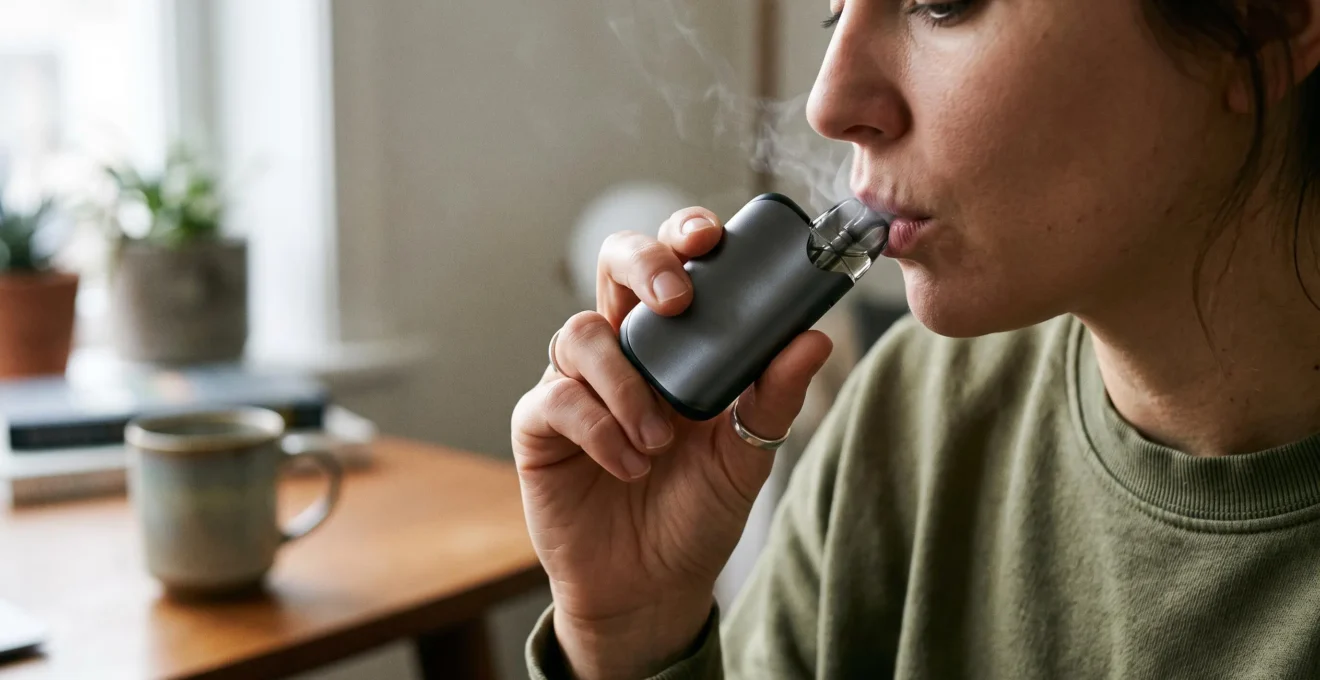
A draw-activated vape starts heating when a sensor detects the airflow or pressure change caused by inhalation. Instead of pressing a firing button, the user draws through the mouthpiece. The sensor produces an electrical signal, the control circuit evaluates it, and the battery supplies power to the heating coil when the required conditions are met.
This apparently simple interaction depends on several components working together. The air intake must remain unobstructed, the sensor must recognize a sufficiently strong puff, and the electronics must permit heating. A problem anywhere in that sequence can make a functioning device seem unresponsive.
Understanding the mechanism also explains why some devices activate with a light inhale while others require a firmer draw, why condensation can interfere with automatic firing, and how electronic protections interrupt heating when necessary. These principles are useful for interpreting everyday device behavior without assuming every activation problem is a defective sensor.
Draw-Activated Vape Mechanisms: Key Points
- Inhalation changes pressure or airflow inside the device, allowing a sensor to detect the puff without a manual button.
- The control circuit interprets the sensor signal, checks operating conditions, and delivers electrical power to the heating coil.
- Weak activation can result from insufficient suction, obstructed airflow, contaminated contacts, or electrical problems—not necessarily a failed sensor.
- Why Does Inhaling Activate Some Vape Devices Without Pressing a Button?
- How Can You Keep a Draw-Activated Vape Sensor Working Reliably?
- Draw-Activated or Button-Fired Vape: Which Control Style Fits Your Routine?
- Which Problems Can Make a Draw-Activated Vape Fire Inconsistently?
- When Should You Clean a Draw Sensor Before Suspecting Device Failure?
- How Does a Vape Circuit Board Process a Puff From Button Press to Heating?
- Why Are Vape Pens Usually Simpler Than Larger Box-Shaped Devices?
- When Does a Cylindrical Vape Pen Suit Everyday Vaping Better Than a Larger Device?
Why Does Inhaling Activate Some Vape Devices Without Pressing a Button?
Inhaling activates a draw-activated vape because suction changes the airflow or pressure inside its air channel. A sensor detects that physical change and generates a signal for the electronic controller. If the signal meets the device’s activation requirements, the controller powers the heating coil, allowing the e-liquid to form an inhalable aerosol without a button press.
The mechanism begins when air enters through the device’s intake openings and moves toward the mouthpiece. This movement produces a pressure difference between parts of the airflow system. Depending on the design, the device may detect the pressure change itself or measure air moving through the channel.
Pressure-based sensing responds to a pressure differential generated by suction. Some sensing designs use a deformable membrane or diaphragm, while others rely on electronic pressure-sensing components. The specific construction depends on the device and cannot be assumed from its external appearance.
Airflow-based sensing detects air movement or a related flow characteristic. The European patent on electronic cigarettes with mass airflow sensors describes electronic-cigarette configurations in which airflow sensing communicates a detected puff to control electronics that activate an atomizer. It also distinguishes airflow measurement from pressure-based detection.
Although these methods measure different physical properties, their electronic purpose is similar. The sensor identifies a puff, and the controller determines whether heating should begin. Neither sensing approach is inherently guaranteed to prevent accidental activation; susceptibility depends on the complete sensor and control design.
The activation sequence can be summarized as follows:
- The user inhales, creating airflow and a pressure difference inside the device.
- The sensor detects a sufficient change in its monitored physical property.
- The sensor communicates an electrical activation signal to the control circuit.
- The controller evaluates the signal and relevant safety conditions.
- An electronic switching component permits battery power to reach the coil, which heats the e-liquid held by the wick.
A minimum detection threshold is important. A very gentle inhale may create too little pressure change or airflow for the controller to recognize it as an intended puff. This does not necessarily indicate a malfunction.
For example, Innokin’s EQ FLTR support instructions advise users to inhale slightly more forcefully if the device does not activate. This is a model-specific recommendation, but it illustrates why draw strength belongs in the initial troubleshooting process.
Once the sensor has been identified as the starting point, its exposure to airflow and everyday contamination becomes the next consideration for reliable operation.
How Can You Keep a Draw-Activated Vape Sensor Working Reliably?
Keeping a draw-activated vape responsive involves maintaining clear airflow openings, checking accessible contacts for residue, and following the manufacturer’s cleaning instructions. Condensation, e-liquid, lint, and poorly seated components can interfere with activation. Routine visual inspection is useful, but the internal sensor should not be exposed to liquids or mechanical cleaning unless the device manufacturer explicitly permits it.
Automatic activation depends on the airflow system remaining sufficiently clear for the sensor to detect the intended change. Vapor condensation and e-liquid residue may collect around the pod cavity, air inlets, or electrical contacts. Depending on the construction, contamination can restrict airflow, interfere with connections, or affect the sensing path.
These effects need not develop uniformly. A device may sometimes respond normally and sometimes require a stronger draw. However, gradual deterioration alone does not prove that residue is coating a sensor membrane; battery performance, pod seating, and coil condition can produce overlapping symptoms.
A practical inspection starts with externally accessible parts:
- Examine the air intake holes for pocket lint, dust, or visible residue.
- Inspect the mouthpiece for obstruction or accumulated liquid.
- Remove a detachable pod only as instructed and check its seating surfaces.
- Look for visible condensation or e-liquid around accessible connectors.
- Check whether the pod, coil, and airflow adjustment are correctly positioned.
Manufacturer documentation matters because cleaning recommendations differ between components. Innokin‘s official device troubleshooting page describes procedures for cleaning accessible pod connectors and addressing inconsistent activation on particular devices. Its instructions allow carefully controlled use of isopropyl alcohol on specified contacts, followed by drying. That does not authorize applying alcohol inside an internal airflow sensor.
For an accessible surface that the manufacturer permits users to clean, a dry, soft cotton swab may remove visible residue without introducing liquid. Avoid pushing the swab into a narrow sensor channel or touching a delicate membrane. Do not direct pressurized air into a sealed sensor assembly unless the manufacturer specifies that procedure; excessive pressure can damage sensitive parts or drive contaminants further inside.
Storage also influences reliability. Keeping a device away from loose debris, excessive heat, direct sunlight, and extreme cold helps protect its battery and airflow openings. Cold conditions may additionally change e-liquid viscosity, affecting how the device operates even when its electronics remain functional.
Good maintenance reduces avoidable activation problems, but it does not eliminate the differences between automatic and manually controlled devices.
Draw-Activated or Button-Fired Vape: Which Control Style Fits Your Routine?
Draw-activated vapes suit users who prefer inhalation to initiate heating without an extra control step. Button-fired devices offer deliberate activation and may provide access to additional adjustments, depending on the model. Neither method automatically determines vapor output, coil compatibility, or inhalation style. The better fit depends on the device’s features, handling requirements, and the user’s preferred level of control.
The most visible difference is the firing action. With draw activation, the device interprets inhalation as a request to heat. With button firing, the user operates a physical switch that sends an activation request to the electronics.
Button-controlled devices may offer wattage adjustment, preheating functions, display menus, or configurable operating modes. However, these features are not inherent to the presence of a button. Similarly, compact draw-activated devices can offer adjustable airflow or other controls.
For mouth-to-lung (MTL) inhalation, a restricted draw may resemble the airflow pattern some users associate with conventional cigarettes. Direct-lung (DL) inhalation generally involves greater airflow. Both styles depend on the particular device’s airflow design, coil, and power capabilities rather than the firing method alone.
The following comparison separates activation convenience from broader hardware features.
| Criterion | Draw-activated device | Button-fired device |
|---|---|---|
| Heating trigger | Detected inhale | Manual button input |
| Everyday operation | No firing button press required | Requires deliberate activation |
| Activation sensitivity | Depends on sensor and airflow conditions | Depends on switch and electronic controls |
| Power customization | Available on selected models | Common on adjustable devices |
| Potential unintended activation | Can occur through abnormal pressure or airflow conditions on susceptible designs | Can occur if an unlocked button is pressed accidentally |
| Troubleshooting focus | Air path, sensor response, contacts, and power | Button condition, contacts, and power |
Hybrid systems provide a third possibility. The Aspire Flexus Q specifications and safety features identify a compact device supporting both automatic draw and button-triggered activation, together with adjustable airflow.
A hybrid design can also help distinguish an activation problem from a general heating problem. If a device heats through its button but not through inhalation, that observation may help narrow the investigation toward its automatic activation path. It does not, by itself, prove the sensor is defective.
Regardless of control style, a device should be locked or powered off during transport when the manufacturer provides that capability. Unintended heating can create a safety risk, particularly if the device is obstructed or enclosed.
When a draw-activated device behaves unpredictably, its response pattern provides a more useful starting point than its control style alone.
Which Problems Can Make a Draw-Activated Vape Fire Inconsistently?
A draw-activated vape can fire inconsistently because of obstructed airflow, insufficient inhalation strength, poor electrical connections, low battery charge, or pod and coil problems. Sensor malfunction is another possibility, but it should not be the first assumption. Checking these causes in a consistent order helps distinguish a detection problem from an interruption in electrical power or aerosol production.
Three groups of faults explain many intermittent activation complaints: restrictions in the air path, problems around the sensor or its sensing conditions, and electrical or atomizer-related faults.
Airflow restrictions may originate at intake holes, the mouthpiece, or an adjustable airflow mechanism. Lint, debris, and accumulated liquid can alter the airflow conditions that the device relies on. In some designs, a poorly positioned pod or overly restricted airflow setting can also affect activation.
Sensor-related problems include contamination of accessible sensing openings or faults within the sensing electronics. Whether a particular residue changes sensitivity depends on the design. A delayed response should therefore be treated as a diagnostic clue, not proof of a worn membrane.
Electrical and atomizer problems include insufficient battery charge, contaminated connectors, and an improperly installed coil or pod. A device can detect a puff correctly yet fail to heat because another part of its control sequence prevents power delivery.
For example, manufacturer troubleshooting documentation for certain Innokin devices identifies loose coil installation and airflow settings as possible contributors to intermittent automatic firing. These observations demonstrate why replacing a sensor without checking the rest of the system may not solve the problem.
The appearance of symptoms helps organize the investigation:
| Symptom | Possible explanation | First check |
|---|---|---|
| Only stronger draws activate the device | Activation threshold or restricted airflow | Normal versus slightly firmer draw; visible air inlets |
| Intermittent activation | Pod seating, contacts, airflow, or sensing fault | Pod installation and accessible connectors |
| Indicator responds but little aerosol appears | Coil, liquid supply, or power-delivery problem | Liquid level, coil installation, and device instructions |
| Gurgling accompanies inconsistent operation | Possible excess e-liquid in the airflow path | Pod and mouthpiece for visible liquid |
| Heating stops during a long draw | Safety cutoff or another electronic interruption | Manufacturer’s puff-duration and warning guidance |
| Device activates with no intentional inhale | Possible unwanted triggering or control failure | Stop using the device and follow safety instructions |
Gurgling deserves particular attention. Excess liquid within the airflow path can affect the passage of air and may interfere with normal operation. However, the combination of gurgling and inconsistent heating is not sufficient to identify flooding as the sole cause.
Similarly, a noticeable firing delay or an unexpected cutoff can originate from more than one component. No universal diagnostic rule establishes that a half-second delay indicates sensor fatigue rather than battery or control-circuit behavior.
A structured inspection reduces unnecessary part replacement. The following checklist applies to devices that remain safe to inspect and operate. If a device self-fires, overheats, leaks into its electronics, or shows battery damage, stop using it rather than continuing activation tests.
Five Checks for Inconsistent Draw Activation
- Compare normal and slightly firmer inhalation: On an otherwise safe device, observe whether one activates it consistently. Record the response difference rather than repeatedly taking unusually long or forceful draws.
- Check the power indication: Read the battery indicator or device warning signal according to the manual. Establish whether low charge is a plausible cause.
- Inspect the airflow path: Examine accessible intake holes and the mouthpiece for debris or liquid. Identify any visible obstruction without inserting tools into internal channels.
- Verify pod and coil seating: Confirm that removable components are installed as specified. Note any improvement after correctly reseating compatible parts.
- Repeat a controlled functional check: After permitted maintenance and complete drying, compare activation with the original symptom. Record whether the issue has resolved, changed, or persisted.
If simple checks do not resolve the problem, the next decision is whether cleaning is appropriate or whether the device should be taken out of service.
When Should You Clean a Draw Sensor Before Suspecting Device Failure?
Cleaning is worth considering when a draw-activated vape responds intermittently and visible residue affects an accessible, manufacturer-approved cleaning area. Begin with airflow openings and external contacts rather than the internal sensor. If the device never responds, activates by itself, or continues heating without inhalation, cleaning should not substitute for proper fault assessment and safety precautions.
A gradual change in activation behavior may suggest contamination, but it is not a reliable diagnosis on its own. The same symptoms can arise from weakening battery performance, poor connections, a damaged pod, or an electronic fault.
Cleaning should therefore target an observed condition rather than an assumed internal cause. A visible film on an accessible connector is different from an inaccessible sensor membrane, which may be integrated into a sealed housing.
The safest progression is to turn off the device when possible, remove detachable parts according to the instructions, inspect accessible surfaces, and clean only those areas for which a suitable procedure is documented. Ensure every cleaned component is fully dry before reassembly.
Do not rinse a powered or battery-containing device under water, pour alcohol into an airflow channel, or insert a pointed tool through a sensor opening. Likewise, blowing forcefully into an internal channel can produce an unintended pressure event or move contaminants toward sensitive electronics. Manufacturer-approved cleaning practices take precedence over generic advice.
After permitted cleaning, a functional check can establish whether normal draw activation has returned. On devices where the manual permits it, compare an ordinary inhale with a slightly firmer one and observe the device’s indicator or normal response. A clicking sound is not a dependable universal test because many sensors and electronic switches operate without an audible click.
A response to a stronger draw but not a normal one suggests that the activation conditions differ between the two attempts. It does not conclusively identify a partially obstructed sensor.
There is also no established universal requirement to repeat cleaning twice before declaring sensor failure. One appropriate cleaning and inspection cycle may be sufficient; repeating it is justified only when remaining accessible contamination and manufacturer instructions support doing so.
Many sealed pod systems do not provide user-serviceable sensors. If the device remains unresponsive after the recommended checks, the appropriate next step is usually manufacturer support or replacement of the affected non-serviceable component or device.
This distinction becomes clearer when examining the circuit board, which determines whether a detected puff actually leads to heating.
How Does a Vape Circuit Board Process a Puff From Button Press to Heating?
A vape circuit board processes an activation request from either a draw sensor or a firing button. The controller recognizes the input, evaluates applicable operating and protection conditions, and controls electrical power to the heating coil. The coil then heats e-liquid supplied by the wick. Electronic timing and safety functions can interrupt heating even when the activation input remains present.
The sensor and button provide different input methods, but both ultimately depend on the device’s power-control architecture.
In a draw-activated system, the sensor converts a physical airflow or pressure event into an electrical signal. The electronic controller interprets that signal and determines whether the conditions for activation have been satisfied.
In a button-operated system, pressing the button changes the state of a physical electrical switch. In modern electronically controlled devices, that switch commonly supplies an input to the controller rather than directly carrying the full coil current. The controller then enables power delivery through the appropriate electronic switching circuitry.
The distinction matters because detecting a puff and powering a coil are separate operations. A sensor signal by itself does not deliver the heating energy required by the atomizer.
Once activation is accepted, the controller may evaluate several conditions, depending on the device:
- Whether the battery voltage is within the permitted operating range.
- Whether the connected atomizer presents an acceptable electrical load.
- Whether a short-circuit or other electrical fault has been detected.
- Whether relevant temperature or overheating protection conditions have been triggered.
- Whether the requested activation exceeds the permitted puff duration.
If the checks allow operation, the power-control circuitry energizes the heating coil. Depending on the design, it may deliver a regulated output or use controlled switching to manage electrical power.
The heated coil transfers thermal energy to the nearby e-liquid held within or supplied to its wick. This produces an aerosol rather than the device directly turning air into vapor. The aerosol is then carried by the inhaled airflow.
A puff-duration cutoff limits how long heating may continue during one activation. This protects against certain prolonged-heating conditions and explains why some devices stop firing during an extended inhale even while airflow continues.
For a documented example, Aspire lists vaping-over-time, short-circuit, overheating, and low-voltage protections among the Flexus Q‘s electronic functions. Such features illustrate typical control responsibilities, but their presence and performance cannot be assumed for every device.
Integrating these functions into a compact circuit board helps explain why many vape pens can operate with relatively few external controls.
Why Are Vape Pens Usually Simpler Than Larger Box-Shaped Devices?
Vape pens are often simpler because their compact designs combine the battery, atomizer connection, activation input, and control electronics into a small housing. Many prioritize straightforward operation over extensive user adjustments. Larger box-shaped devices commonly allocate more room for displays, buttons, replaceable batteries, and adjustable power systems, although these differences are design tendencies rather than universal rules.
The defining difference is not necessarily the number of electronic components. Even a simple-looking pen can contain a controller, switching elements, battery-management circuitry, and protection functions. Much of that complexity remains hidden from the user.
A compact device may be configured around a relatively limited set of operating parameters, reducing the need for external controls. In this arrangement, automatic activation works well as an interface choice: the user provides an inhale, and the electronics apply the device’s predetermined heating behavior.
Larger box-shaped devices often provide more extensive adjustment options. Depending on the model, these can include selectable output power, coil-related settings, different operating modes, and visible status information.
However, shape does not determine activation technology. A slim pen can include a firing button and adjustable settings, while a compact pod device may offer both automatic and manual activation. The capabilities must be checked in the model specifications rather than inferred from appearance.
Simplicity also has a maintenance consequence. A sealed, integrated construction may reduce the number of external connections and user-adjustable parts, but that does not automatically make the device more reliable. A failure in an inaccessible component can make repair impractical.
In modular systems, replaceable batteries, tanks, coils, and other accessible components may simplify certain repairs or replacements. Even so, circuit-board failures are not necessarily user-serviceable in a box mod, and battery or electronics repairs require appropriate expertise.
For everyday use, the practical trade-off is between fewer routine decisions and greater control over device behavior. A fixed-output pen can reduce the possibility of incorrect setting adjustments, whereas an adjustable device can better accommodate compatible configurations and preferences.
These architectural differences become especially relevant when choosing a device for repeated use throughout an ordinary day.
Key Takeaways for Everyday Use
- Choose based on actual handling and airflow requirements rather than assuming every pen is automatically activated or every box mod needs manual firing.
- Check which components are replaceable, since a compact sealed device can be convenient but difficult to service.
- Consider charging needs, pod or coil replacement, and transport safety alongside device size and activation style.
When Does a Cylindrical Vape Pen Suit Everyday Vaping Better Than a Larger Device?
A cylindrical vape pen may suit everyday use better when compact size, simple operation, and minimal adjustment are the main priorities. A larger device may be more appropriate when the user needs greater battery capacity, broader compatible coil options, or more extensive output control. The practical choice depends on verified device specifications and the user’s actual handling and maintenance requirements.
Portability is an obvious distinction. A narrow pen-shaped device generally occupies less space than a larger box-shaped setup, making it easier to carry in an appropriate protective case. Compactness is useful when storage space matters, although it does not eliminate the need to prevent unintended activation or damage.
Draw activation can also reduce interaction steps. Where supported, heating begins through an inhale without locating or pressing a fire button. This may be convenient for one-handed handling, but it should not be treated as a reason to use a vape while driving or during other attention-critical activities.
Airflow characteristics can be equally important. Certain compact devices are designed for restricted, mouth-to-lung draws, while larger adjustable systems may support a wider range of airflow configurations and compatible atomizers. These are product-specific capabilities, not fixed properties of a cylindrical or box-shaped enclosure.
Battery requirements depend on power consumption, battery capacity, usage patterns, and charging arrangements. A compact device with a small battery may require more frequent recharging, but physical dimensions alone cannot establish how long a particular model will operate between charges.
A useful comparison can be made using two explicitly hypothetical situations.
Practical Example: Two Different Device Requirements
Scenario A: An adult user wants a compact device with straightforward controls, a predictable airflow setting, and a replaceable pod. A small draw-activated pen could meet those preferences if its battery endurance and maintenance requirements are suitable.
Scenario B: Another adult user frequently changes compatible atomizers and wants direct control over output settings. A regulated device with a larger interface and suitable battery system may offer more relevant features.
These examples illustrate selection criteria rather than measured product performance or evidence that either device category is inherently superior.
The cost of ongoing replacement also deserves attention. A rechargeable pen with replaceable pods or coils distributes hardware costs differently from a sealed device that must be replaced as a complete unit. Actual cost per use depends on purchase price, component lifespan, e-liquid consumption, and replacement frequency; there is no reliable universal cost advantage without those inputs.
Maintenance and disposal matter as well. Devices that require full replacement when an integrated component fails can create more electronic waste than systems where compatible consumable components can be replaced independently. Battery-containing devices should be handled through appropriate collection and recycling arrangements rather than ordinary household disposal.
Ultimately, a vape pen’s strongest practical feature may be its uncomplicated interface, not its shape. A device that consistently detects intended draws, allows safe transport, and supports manageable maintenance can satisfy the goal of straightforward operation without extensive settings.
For an existing device, the most useful next step is to consult its specific manual and verify the activation mode, accessible cleaning points, electronic protections, and replacement-part options. If activation remains unreliable after manufacturer-approved checks, stop using the faulty device and seek qualified support rather than modifying its sensor or circuitry.
Does a draw-activated vape constantly use battery power to detect inhalation?
A draw-activated device needs an electronic system capable of detecting an activation event while it is available for use. Depending on the design, sensing and control functions may consume a small amount of standby power. The amount and operating strategy depend on the particular sensor and circuit; continuous full-power coil heating is not required for puff detection.
Can a draw sensor work when the heating coil is defective?
Yes. The sensor and heating coil perform different functions, so the detection circuit may still recognize an inhale when the coil is damaged, disconnected, or otherwise unable to heat. An indicator light or other device response may help distinguish activation detection from aerosol production, but the precise diagnostic meaning depends on the manufacturer’s instructions.
Why does covering an airflow hole sometimes change automatic activation?
Restricting an intake changes the airflow and pressure conditions within the device. Because automatic activation depends on one of these properties, an obstruction may affect sensor response. The effect varies with channel geometry and sensor design. Deliberately blocking an intake is not a recommended troubleshooting method, since it can interfere with cooling and normal operation.
Does a blinking LED mean the draw sensor has failed?
Not necessarily. LED signals may indicate battery conditions, charging states, activation attempts, protection events, or faults, depending on the device. There is no universal blinking pattern that proves sensor failure. The model-specific manual is the appropriate reference for interpreting the signal.
Can the draw-activation threshold be adjusted?
Some devices offer user-adjustable airflow, but this is not the same as directly adjusting the sensor’s electronic detection threshold. In many compact pod systems, that threshold is established by the hardware or firmware and is not user-configurable. Any available sensitivity or activation setting should be confirmed in the specific model’s documentation.