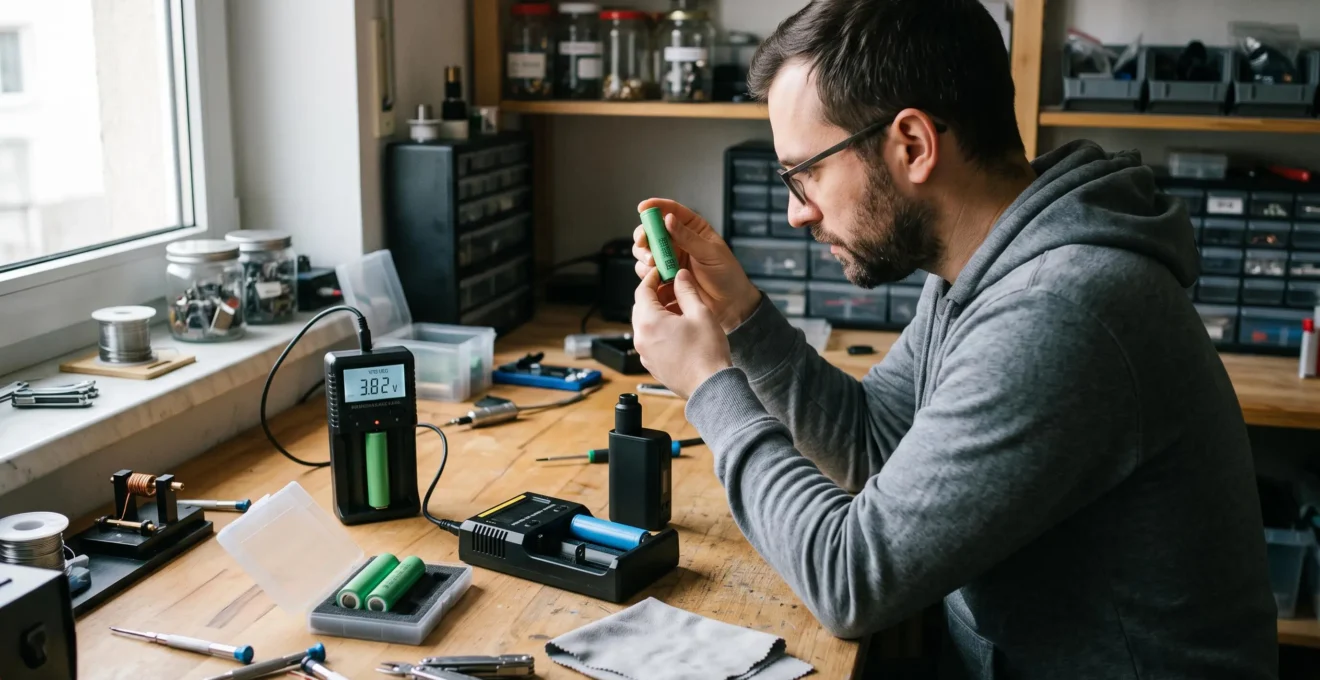
A lithium-ion battery influences far more than how long a vape lasts between charges. Its capacity determines how much energy it can store, its continuous discharge rating limits the current it can safely supply, and its internal resistance affects voltage stability and heat generation during use.
These characteristics become particularly important in rechargeable vape devices that use removable 18650, 20700 or 21700 cells. Two batteries with similar advertised capacities may behave differently at the same power setting, especially after months of charging, storage and repeated high-current operation.
For UK vapers, choosing a suitable cell means understanding the relationship between battery specifications, device requirements and everyday handling. A high capacity figure cannot compensate for an inadequate discharge rating, while a previously reliable cell may become unsuitable as it ages or suffers damage.
The practical priority is to use a genuine, compatible cell within its verified operating limits, recognise deterioration early and follow charging, storage and inspection procedures appropriate to the device.
Vape lithium-ion battery essentials
- Capacity affects runtime; discharge capability limits safe output. Both specifications matter, but neither should be assessed without the device’s power requirements.
- Heat, ageing and charging habits affect performance. Higher internal resistance can reduce usable runtime and increase heating even when a cell still accepts a charge.
- Cell condition and compatibility come first. Damaged batteries, unsuitable discharge ratings and mismatched cells in dual-battery devices create avoidable risks.
- Why Does a Vape Lithium-Ion Battery Hold Less Charge After Months of Use?
- How Should You Store Vape Lithium-Ion Batteries During Several Weeks of Non-Use?
- Capacity or Discharge Rating: Which Matters More for Your Vape Battery?
- Which Lithium-Ion Battery Damage Means a Vape Cell Should Be Taken Out of Service?
- How Can Everyday Charging Habits Help Preserve Vape Battery Lifespan?
- Matched Battery Pair or Mixed Cells: Which Is Appropriate for a Dual-Battery Vape?
- Why Is Battery Capacity Alone Not Enough to Choose a Vape Cell?
- What Should You Check Before Using External Vape Batteries in a Device?
Why Does a Vape Lithium-Ion Battery Hold Less Charge After Months of Use?
A vape lithium-ion battery loses usable runtime because its internal chemistry changes with time and repeated charging. Calendar ageing occurs even while the battery sits unused, whereas cycle ageing develops through charging and discharging. Both can reduce stored energy and increase internal resistance, particularly when the cell experiences elevated temperatures or demanding operating conditions.
Calendar ageing explains why a battery can deteriorate while stored in a drawer. Chemical reactions continue inside the cell even when it is disconnected from a device. Cycle ageing adds degradation associated with repeated use, including the stresses created by charging, discharging and temperature changes.
An experimental study of lithium-ion calendar and cycle aging published in the Journal of Power Sources identified temperature, elapsed time and state of charge as important factors affecting cell performance. The research also examined increasing impedance and declining power capability.
These mechanisms interact. A heavily used cell can deteriorate through cycling, while a rarely used cell stored fully charged in a warm environment can undergo substantial calendar ageing. Neither pattern establishes a universal replacement interval, and storage for several months does not necessarily cause as much damage as intensive vaping.
Capacity loss and increased internal resistance are different problems. Capacity loss reduces the energy a cell can deliver. Higher resistance produces greater voltage sag when current flows, meaning the battery’s terminal voltage temporarily drops under load.
To distinguish them, compare performance under consistent conditions:
- Genuine capacity fade: a previously reliable cell delivers progressively less usable energy across comparable charge and discharge conditions.
- Increased resistance: the device reports a low-battery warning earlier at the same wattage, particularly during demanding puffs, even though the cell’s resting voltage may recover afterwards.
- Possible equipment-related changes: different coils, power settings, contact resistance or temperature conditions can also alter perceived runtime.
Voltage sag is a useful warning sign, not a definitive capacity test. A suitable battery analyser can help assess capacity and resistance, but comparisons require consistent equipment and test conditions. Untrained users should not improvise high-current discharge tests.
As resistance increases, more energy is converted into heat within the cell during operation. Unusual heating, rapid deterioration or repeated premature cut-offs warrant investigation rather than continued use at increasingly demanding settings.
Ageing cannot be prevented entirely, but storage conditions strongly influence how quickly it progresses. Managing charge level and temperature during periods of non-use is therefore an important part of battery care.
How Should You Store Vape Lithium-Ion Batteries During Several Weeks of Non-Use?
Store removable vape lithium-ion batteries partially charged, in individual protective cases, in a cool, dry environment away from metal objects and direct heat. Remove them from the device when the manufacturer permits it, and check their condition periodically. Avoid storing cells fully charged or nearly empty for extended periods because both extremes can create undesirable conditions.
For longer storage, a charge level around 40% is a useful general guideline. Battery University‘s battery storage recommendations explain that lithium-ion cells experience less storage-related stress at a partial state of charge than when kept fully charged, particularly at elevated temperatures.
The guidance associates approximately 40% charge with an open-circuit voltage near 3.82 V for many lithium-ion systems at room temperature. However, voltage does not translate into an identical charge percentage for every chemistry, cell or temperature. A compatible analyser or charger’s storage function is preferable to treating a single voltage reading as an exact measurement.
A practical storage routine involves the following actions:
- Use a compatible charger or reliable charge indicator to bring the cell to a moderate, partial charge.
- Power down the vape and remove removable batteries when the device instructions allow.
- Inspect the wrapper, insulating ring and metal casing before putting each cell into its own protective case or isolated compartment.
- Store the case somewhere dry and temperature-stable, away from radiators, sunlight, keys and loose metal objects.
- Check the cells periodically for unusual voltage loss, physical deterioration or other changes before returning them to service.
Leaving cells inside an unused mod can introduce parasitic drain. Some electronics continue drawing a small amount of power when the device appears switched off. Over a sufficiently long period, this can discharge a battery beyond its intended operating range.
For a break of a few weeks, suitable initial charge and secure storage may require little intervention. For storage extending over several months, periodic checks become more important. There is no universal inspection interval that applies to every device and cell.
Do not attempt to revive a deeply discharged cell using improvised methods or repeatedly override a charger’s refusal to charge. If its history or voltage condition makes safe recovery uncertain, obtain qualified advice or retire it.
Once the battery returns to regular use, storage condition is only one consideration. Its ability to deliver the current demanded by the mod becomes equally important.
Capacity or Discharge Rating: Which Matters More for Your Vape Battery?
The continuous discharge rating matters most for determining whether a lithium-ion cell can safely meet a vape device’s power demand. Capacity, measured in milliamp-hours (mAh), influences runtime, while the continuous discharge rating (CDR), measured in amperes, describes sustained current capability under specified conditions. A suitable cell must satisfy the discharge requirement before capacity becomes the deciding factor.
Battery selection therefore involves a trade-off. Among cells of the same physical format and broadly comparable design, models optimised for higher energy capacity often provide less continuous discharge capability than high-power alternatives.
The distinction becomes clearer when comparing the specifications:
| Characteristic | Capacity (mAh) | Continuous discharge rating (A) |
|---|---|---|
| What it describes | Stored electrical charge | Rated sustained discharge current |
| Main practical relevance | Potential runtime between charges | Suitability for the required current |
| Common misunderstanding | Higher capacity always means a better vape battery | Advertised pulse current is equivalent to continuous current |
| Selection priority | Compare after safety and compatibility requirements are met | Verify against the device’s maximum possible battery demand |
For a regulated mod, estimating battery current requires the device’s output power, operating voltage range, efficiency and battery arrangement. Coil resistance alone is insufficient because the regulator converts battery power into the required output.
In simplified terms, battery input current increases as requested power rises or available battery voltage falls. A conservative assessment therefore considers the highest intended wattage and the lower part of the permitted operating-voltage range, rather than calculating demand only from a freshly charged cell.
For an unregulated device, the relationship between battery voltage, coil resistance and current is more direct. However, coil resistance and battery specifications must be assessed with appropriate measurement equipment, including relevant safety margins. Such devices require substantially more electrical knowledge and offer fewer electronic protections.
Pulse discharge ratings should never substitute for a verified CDR. Pulse figures may be based on different testing methods, temperatures or durations, making them unsuitable as universal indicators of sustained vaping capability.
For lower-power regulated devices, a compatible higher-capacity cell may provide useful runtime. At demanding power settings, verified current capability takes priority, even if that means accepting less capacity.
The device manufacturer’s compatibility instructions and reliable manufacturer specifications should determine the final choice. If the current requirement cannot be established confidently, do not assume that a prominent amperage claim on a battery wrapper provides sufficient assurance.
Even a correctly specified battery can become unsafe after physical damage or substantial deterioration. Battery selection must therefore be followed by routine inspection throughout the cell’s working life.
Which Lithium-Ion Battery Damage Means a Vape Cell Should Be Taken Out of Service?
A vape lithium-ion cell should be taken out of service if it is swollen, deformed, punctured, significantly dented, leaking, unusually hot at rest or showing signs of venting. Damaged insulating wraps or positive-terminal rings also make a cell unsafe to use until corrected. Cosmetic insulation defects may be repairable, but damage to the underlying metal cell requires a more cautious decision.
The distinction matters because a cylindrical lithium-ion cell is not electrically insulated by its metal casing. Much of the exposed can forms part of the negative terminal, so the plastic wrapper and insulating components help prevent accidental contact with positive connections or surrounding conductive surfaces.
A tear near the positive end is particularly concerning because conductive surfaces sit close together. A damaged wrap can allow an unintended short circuit inside a metal-bodied mod or during handling.
Battery defects can be grouped into different responses:
| Observed condition | Recommended response | Reason |
|---|---|---|
| Dented, swollen or deformed casing | Retire the cell | Possible internal mechanical damage |
| Hissing, venting, leakage or abnormal heat at rest | Stop use and follow appropriate battery emergency precautions | Potential internal failure or thermal runaway |
| Torn wrapper with undamaged metal can | Do not use until properly re-wrapped and inspected | Exposed conductive casing can short against surrounding metal |
| Damaged or displaced positive insulating ring | Do not use until correctly assessed and repaired where appropriate | Reduced separation between conductive surfaces |
| Rust, corrosion, residue or abnormal electrical behaviour | Remove from service pending professional assessment or retirement | Possible moisture exposure, contact deterioration or internal damage |
A minor wrapper defect on an otherwise sound cell may be corrected with a replacement sleeve specifically intended for the battery format. The positive insulating ring must remain correctly positioned, and the repair must not conceal casing damage. Anyone uncertain about the procedure should use a competent battery specialist rather than attempting an improvised repair.
Electrical behaviour can reveal damage that external inspection misses. A battery that rapidly loses charge while disconnected, exhibits unusually severe voltage sag under an otherwise ordinary load or behaves inconsistently after charging may have developed increased resistance or another internal fault.
These symptoms justify removing the cell from use. A normal resting-voltage reading does not prove that a battery is healthy, and voltage testing must never involve deliberately shorting the terminals.
Retired lithium-ion batteries must not enter household rubbish or ordinary mixed recycling. The EPA guidance on used lithium-ion battery recycling recommends insulating terminals or individually separating used cells to reduce short-circuit risks before appropriate collection.
In the UK, suitable disposal routes include designated battery collection facilities and local household waste recycling centres that accept the relevant battery type. A damaged, leaking or swollen cell may require specialist handling, so confirm the collection site’s instructions before transporting it. Keep unstable or overheating cells away from combustible materials where safe to do so, avoid handling them unnecessarily and contact emergency services if there is an immediate fire risk.
Physical condition provides only part of the picture. Charging practices also affect battery temperature, chemical deterioration and the likelihood that a serviceable cell will remain reliable.
How Can Everyday Charging Habits Help Preserve Vape Battery Lifespan?
Vape lithium-ion batteries generally last longer when charged with compatible equipment, kept away from excessive heat and not repeatedly subjected to unnecessary charge extremes. Avoiding prolonged periods at full charge and preventing deep discharge can reduce chemical stress. The aim is consistent, controlled charging rather than following a rigid percentage rule or attempting to eliminate normal battery ageing.
High states of charge can accelerate certain degradation reactions, especially when combined with heat. Very low charge levels create a different problem: the cell may approach its minimum operating voltage, particularly if stored or left connected to electronics that continue drawing power.
For everyday use, it is reasonable to recharge before the battery becomes excessively depleted and to disconnect it when charging is complete. An occasional full charge for normal use is not inherently a problem, and the exact benefit of partial charging varies by cell chemistry and operating conditions.
Charging method also matters. A well-designed regulated mod may support safe USB charging when used exactly as directed by its manufacturer. A suitable external charger can nevertheless provide practical advantages for removable cells, including individual charging channels, clearer cell monitoring and the ability to inspect batteries before reinsertion.
For dual-battery devices, the distinction is especially important. Different cells may not reach identical states of charge, and the quality of the device’s balancing or monitoring system depends on its design. An external charger with suitable independent channels can make individual cell behaviour easier to observe, but it is not automatically safer than every properly engineered internal charging system.
Charging environment is another major consideration. A cell that is already warm from demanding use should be allowed to return to an appropriate temperature before charging. Avoid soft furnishings, hot vehicles, direct sunlight and locations where heat cannot escape.
Official FDA recommendations for preventing vape battery fires advise using manufacturer-recommended batteries and charging on a clean, flat surface away from combustible materials and extreme temperatures.
The idea that lithium-ion cells require routine full discharge to preserve their capacity is incorrect. Unlike some older rechargeable battery technologies, lithium-ion cells do not benefit from deliberate deep-discharge conditioning. Leaving a vape charging unattended overnight also adds unnecessary exposure to faults or charging problems, even when the equipment includes protective circuitry.
A reliable daily routine therefore combines appropriate equipment, visual inspection, sensible charge levels and charging while present and able to respond to a problem.
Charging practices become more demanding when a device uses two removable cells, because their electrical characteristics and ageing histories must be considered together.
Matched Battery Pair or Mixed Cells: Which Is Appropriate for a Dual-Battery Vape?
A dual-battery vape should use a matched pair of compatible lithium-ion cells rather than mixing batteries of different ages, brands, capacities or conditions. Cells purchased together, charged appropriately and used as a dedicated pair are less likely to develop significant differences in performance. Mixing cells can produce unequal discharge behaviour and increase stress on the weaker battery.
A matched pair should consist of genuine cells of the same model, specification and comparable usage history. Ideally, both are purchased together from a reputable supplier and remain assigned to the same device.
The reason becomes clearer when considering battery resistance and capacity. As batteries age, they do not necessarily deteriorate at identical rates. A cell with less usable capacity or increased internal resistance may behave differently from its partner even though both fit the device and appear externally undamaged.
The effect depends partly on the battery configuration:
- Series configuration: the same current passes through both cells. A weaker cell may experience a greater voltage drop and reach a critical discharge condition earlier than its partner if the device does not adequately monitor individual cell voltages.
- Parallel configuration: the cells share the electrical load, but current distribution depends on their relative voltages, resistance and circuit design. Mismatched characteristics can create unequal loading or unwanted current redistribution.
A regulated device may incorporate protective monitoring, but those protections should not be treated as permission to mix incompatible batteries. The manufacturer determines which cell configurations are supported and what installation procedures apply.
A simple way to manage battery pairing is to identify the cells as a dedicated set, keep them together throughout their service life and avoid substituting one cell from another device. Both cells should be individually checked for physical damage and unusual charging behaviour.
Where the manufacturer permits, alternating their positions between uses may help distribute position-related differences. However, position rotation is not a substitute for matching cells, and no universal rotation schedule is established for all mods.
If one battery becomes damaged or shows significant deterioration, remove the pair from that dual-battery application. Replacing only the defective cell with a fresh battery creates a mixed-age pair, so the safer routine is to obtain a new matched set. The remaining sound cell should not automatically be classified as damaged, but it should not be paired with the new one in the same device.
Never compensate for a weak cell by mixing charge levels, installing a higher-rated battery alongside it or increasing the device’s power setting.
Even a correctly paired set must be evaluated against the device’s actual power requirements. Capacity figures alone cannot establish whether either cell is suitable.
Why Is Battery Capacity Alone Not Enough to Choose a Vape Cell?
Battery capacity alone is insufficient because it measures stored charge rather than the current a cell can safely deliver. Two lithium-ion batteries with identical mAh ratings may have different continuous discharge limits, resistance characteristics and operating capabilities. A high-capacity cell can therefore be unsuitable for a powerful vape mod even when it physically fits the battery compartment.
Capacity is particularly attractive because it is easy to compare on packaging. A larger mAh figure suggests longer use between charges, but that expectation assumes the device can operate the cell within its permitted voltage and current limits.
At higher output settings, an unsuitable battery may experience excessive voltage sag, increased heating or premature low-battery cut-offs. These effects can reduce practical runtime despite the cell’s apparently generous capacity.
Reading a battery specification requires more than one headline number:
- Cell format: confirm the required dimensions and terminal arrangement, such as 18650 or 21700, without assuming that physically similar cells are interchangeable.
- Continuous discharge rating: establish the verified sustained current capability and compare it with the device’s potential demand.
- Nominal capacity: use mAh to compare runtime potential only after confirming electrical suitability.
- Internal resistance and operating limits: consider published performance characteristics where reliable technical information is available.
- Cycle-life information: treat test results as conditional on temperature, charging parameters and discharge conditions, rather than as a guaranteed number of months.
Authenticity is another essential factor. Some cells are sold under misleading wrappers with exaggerated capacity or current claims. A re-wrapped battery is not necessarily defective, but its external label may not establish which original cell is underneath or whether its advertised specifications are independently supported.
Capacity claims that appear inconsistent with credible manufacturer information for the same format deserve particular scrutiny. Reputable battery vendors, traceable product identification and manufacturer documentation offer stronger evidence than marketplace descriptions or unusually ambitious headline ratings.
There is no single ideal capacity for every vape. Someone using a modest power setting may benefit from prioritising runtime after meeting discharge requirements. A user operating near a device’s higher supported wattage settings should pay particular attention to current capability and voltage behaviour.
Higher capacity is therefore valuable only within the cell’s safe operating envelope. Choosing a battery that cannot support the requested power is not simply an inefficient purchase; it can place additional electrical and thermal stress on the cell.
Once the appropriate model has been identified, its condition, installation and transport still need checking before the device is powered on.
Key takeaways before installing a vape battery
- Confirm the exact cell model and specification required by the mod; physical fit is not enough to establish compatibility.
- Treat wrapper integrity, the positive insulating ring and undamaged terminals as essential electrical safeguards.
- Keep cells individually protected during transport and verify their condition again after storage or charging.
What Should You Check Before Using External Vape Batteries in a Device?
Before installing an external lithium-ion vape battery, inspect its wrapper, positive-terminal insulator, casing and contacts, then verify the correct cell format, chemistry, polarity and continuous discharge capability. The battery must be physically undamaged and compatible with the device manufacturer’s requirements. If its identity, condition or electrical suitability is uncertain, do not use it.
A pre-use check should take place before inserting the cell into the mod, not only when the battery was originally purchased. Damage can occur during transport, charging, storage or removal from a tight battery compartment.
Start with the insulating wrapper. Look for cuts, tears, holes, peeling edges or exposed metal, especially around the positive terminal. Examine the insulating ring and confirm that it is present, correctly positioned and intact.
Next, inspect the metal casing for dents, deformation, punctures, rust or unusual residue. Check for previous overheating or leakage. Any significant mechanical damage is sufficient reason to retire the cell rather than attempting to determine its internal condition through ordinary use.
Finally, confirm that the device accepts the precise cell type and that its discharge capability meets the expected load. Follow the polarity symbols marked inside the battery compartment, and never force a cell into a bay that does not accommodate it correctly.
Five checks before installing a removable vape battery
- Inspect the wrapper: turn the cell carefully and confirm that no tear, hole or exposed section of metal is present. Result: a visibly intact insulating sleeve.
- Examine the positive end: verify that the terminal area and insulating ring are clean, correctly positioned and undamaged. Result: an intact terminal assembly.
- Check the casing: look for dents, distortion, corrosion, leakage or other abnormal marks. Result: no visible reason to retire or isolate the battery.
- Confirm compatibility: compare the cell’s identifiable model, format and verified discharge rating against the mod manufacturer’s requirements. Result: a cell whose suitability can be established.
- Verify installation and carrying arrangements: follow the device’s polarity markings, and keep spare cells in protective cases away from conductive objects. Result: correct installation or safely isolated transport.
The final check concerns batteries that are not currently installed. Loose cells should never share a pocket or bag compartment with coins, keys or other conductive objects. Contact across the terminals can create a short circuit, leading to rapid heating and possible venting or fire.
A purpose-made, non-conductive battery case prevents incidental contact and helps protect the wrapper during transport. For dual-battery devices, a case that keeps both members of a matched pair together also reduces the chance of accidentally mixing cells.
Never assume that a cell is safe merely because it still powers the mod. Battery protection begins with external inspection, but it also depends on choosing the right specifications and responding appropriately when electrical performance changes.
Before the next charging or vaping session, verify the battery’s physical condition, confirm compatibility with the device and remove any questionable cell from service. Where uncertainty remains, consult the device manufacturer or a competent battery specialist rather than testing the limits through continued use.
Can a vape battery show a normal voltage and still be unsafe?
Yes. Resting voltage provides only limited information about a lithium-ion cell’s condition. A battery may show an apparently normal voltage while having increased internal resistance, reduced capacity or physical damage. Wrapper integrity, casing condition, usage history and behaviour under appropriate operating conditions must also be considered.
Does using a lower wattage make every lithium-ion battery safe for vaping?
No. Lower wattage generally reduces current demand in a regulated device, but it does not make an incompatible, damaged, counterfeit or unidentified cell safe. The battery must still meet the manufacturer’s specifications, and the device must provide suitable operating and protection features.
Should a newly purchased vape battery be fully discharged before its first charge?
No. Lithium-ion batteries do not require deliberate full-discharge conditioning before normal use. A new cell should be inspected, verified as suitable for the device and charged with compatible equipment according to the manufacturer’s instructions. Intentionally discharging it to an extreme low voltage offers no routine maintenance benefit.
Can an external charger accurately measure a vape battery’s remaining lifespan?
Not precisely. Some compatible chargers or battery analysers can measure indicators such as delivered capacity and estimated internal resistance. These results can help identify deterioration when compared under consistent conditions, but they do not provide a guaranteed remaining lifespan or prove the absence of internal defects.
Are removable vape batteries interchangeable with lithium-ion cells used in other equipment?
Not necessarily. Cells of the same size may differ in chemistry, terminal design, continuous discharge capability, protection configuration and manufacturer-approved applications. A battery intended for another device should only be considered if its identity and specifications are verified and it meets the vape manufacturer’s requirements. Physical compatibility alone is not sufficient.