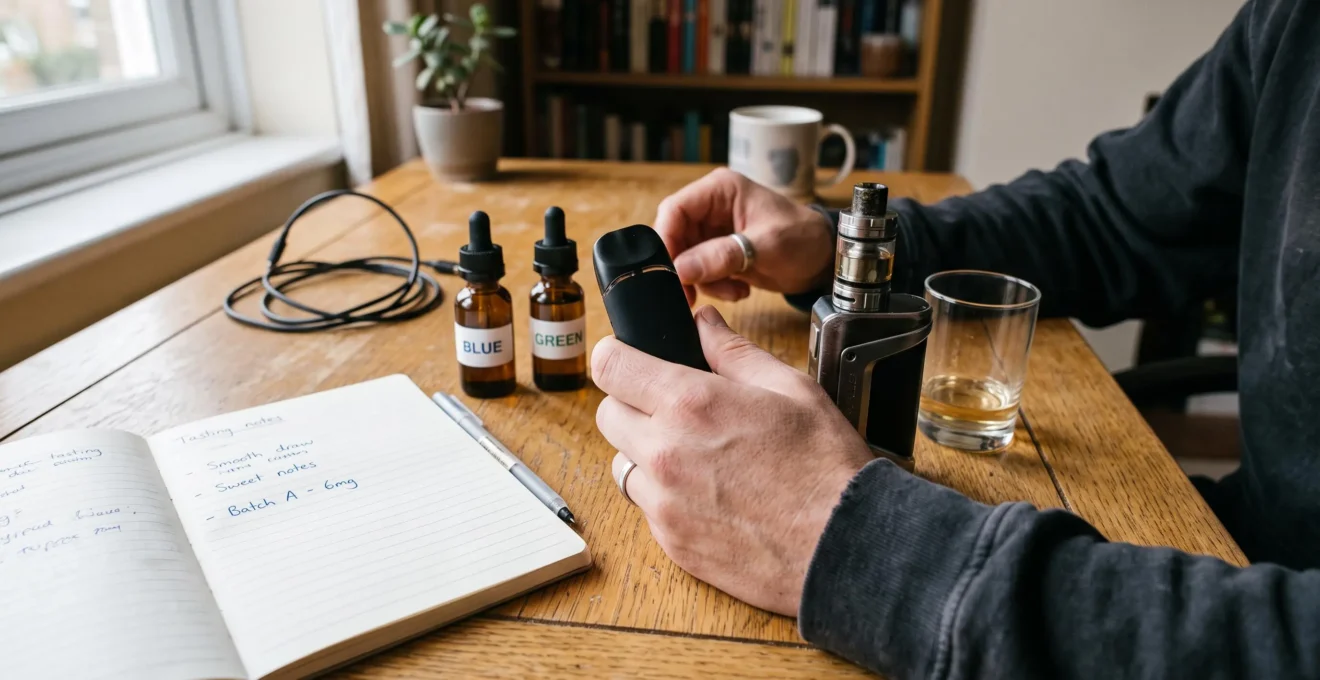
An e-liquid that tastes bright and sharply defined in a compact pod may seem rounder, sweeter or less distinctive in a larger tank. The flavour concentrate has not necessarily changed. Instead, the device alters how the liquid is heated, how its aromatic compounds enter the aerosol and how that aerosol reaches the mouth and nose.
Flavour perception also depends on the formulation itself. Propylene glycol (PG), vegetable glycerin (VG), sweeteners and combinations of aromatic compounds contribute to the experience, while coil condition, airflow and storage introduce further variability. A powerful initial aroma does not automatically mean that a liquid has greater flavour complexity, better balance or superior overall performance.
For adult vapers comparing setups, the useful question is not simply which device produces the strongest flavour. It is which conditions make a particular blend’s character easiest to distinguish consistently. Separating the liquid’s composition from the device’s delivery characteristics makes those comparisons more meaningful, although perceived flavour cannot establish aerosol safety.
E-Liquid Flavour: The Essential Differences
- Device settings change flavour delivery: heating, aerosol production and airflow can alter which aromatic notes are most noticeable.
- Concentration is not the same as complexity: a strong, sweet opening may conceal quieter ingredients or produce a less distinctive finish.
- Controlled comparisons matter: consistent coil condition, liquid age and testing conditions help distinguish formulation differences from equipment effects.
- Why Can the Same E-Liquid Flavour Taste Different in Two Vape Devices?
- How Can You Tune Power and Airflow to Get a Clearer E-Liquid Flavour?
- Single-Note or Layered E-Liquid Flavouring: Which Suits Your Taste Better?
- Which E-Liquid Flavour Profiles Tend to Leave More Coil Residue?
- How Can You Compare Two E-Liquid Flavours Without Your Previous Liquid Distorting the Result?
- Freshly Mixed or Steeped E-Liquid: Which Better Suits Complex Flavour Blends?
- Why Can Too Many Dessert and Fruit Notes Make an E-Liquid Taste Less Distinct?
- How Do Aromatic Flavour Profiles Develop From First Puff to Aftertaste?
Why Can the Same E-Liquid Flavour Taste Different in Two Vape Devices?
The same e-liquid can taste different in two devices because each atomizer produces and delivers aerosol under different thermal and airflow conditions. Coil construction, liquid supply, power and chamber geometry can influence the transfer and presentation of aromatic compounds. Consequently, one setup may emphasise a sharp opening while another produces a fuller but less defined impression.
An e-liquid is a mixture of substances with different physical and chemical properties. Its composition in the bottle is not necessarily identical to the composition of the resulting aerosol. Experimental research on flavour chemical transfer from e-liquids to aerosols found that transfer efficiencies varied according to the flavour chemical, device power and puffing conditions.
The researchers examined two refill liquids and used 40 W and 80 W operating conditions during machine-generated aerosol testing. These were experimental settings, not recommended operating levels. The study measured chemical transfer rather than the subjective quality of flavour, but it helps explain why concentration in the liquid alone cannot predict the inhaled aromatic mixture.
Three variables are particularly important to distinguish:
- Heating conditions: power, coil design and liquid supply influence aerosol generation and the possibility of thermal degradation. Electrical power alone does not determine actual coil temperature.
- Aerosol density: the amount and concentration of aerosol reaching the user can influence perceived intensity without necessarily preserving every ingredient’s relative prominence.
- Airflow and mixing: incoming air changes aerosol cooling, dilution and movement through the device, potentially changing its sensory presentation.
As a sensory illustration, a hypothetical citrus-and-cream blend might present a sharper citrus impression in one device and a rounder creamy impression in another. Citrus is often described as a bright top note and cream as a base note, but no universal device rule guarantees that either will dominate. Menthol intensity can also involve cooling sensations rather than aroma alone.
A useful diagnosis begins with the simplest observable differences. If device A produces a sharper but thinner impression while device B seems softer and fuller, record their coil types, airflow arrangements and manufacturer-specified operating ranges. Where compatible adjustments are available, compare one variable at a time rather than changing everything simultaneously.
Coil material, wick saturation and chamber dimensions are plausible contributors, but their individual sensory effects cannot be established from the cited chemical-transfer study. Nor is there evidence that every commercial flavour concentrate is developed around a standard reference device. Manufacturers may use their own testing arrangements, while consumers encounter substantially different hardware.
A disappointing taste is therefore not sufficient evidence that an e-liquid is counterfeit or defective. Authenticity concerns require independent checks such as packaging, traceability and supplier information.
Once those differences are identified, power and airflow become variables to evaluate systematically rather than settings to maximise indiscriminately.
How Can You Tune Power and Airflow to Get a Clearer E-Liquid Flavour?
Power and airflow adjustments can change perceived flavour clarity, but neither has a universally optimal setting. A controlled comparison involves keeping the liquid and coil condition constant, changing one permitted setting at a time and recording whether identifiable notes become clearer or more obscured. Any adjustment must remain within the device and coil manufacturer’s specified operating limits.
Power affects heating conditions, but increasing wattage is not simply a way to extract more flavour. Liquid supply, coil geometry and thermal behaviour determine whether a device can operate as intended. Excessive heating or inadequate wicking can promote degradation and produce unpleasant or irritating aerosol.
Airflow introduces a different trade-off. A more open setting may cool and dilute the aerosol, making some sensations less intense. A restricted setting may create a more concentrated impression, but it can also make sweetness, bitterness or irritation more prominent. The direction and magnitude of these effects depend on the device and formulation.
For a device with manufacturer-approved adjustable settings, the following is a practical comparison exercise rather than a scientifically validated optimisation protocol.
Five Steps to Document Flavour Clarity
- Record the baseline: write down the liquid, coil type, coil age, permitted operating setting and airflow position. Deliverable: one complete baseline entry.
- Describe the initial profile: note identifiable aromas, sweetness, cooling sensations and aftertaste without assigning a quality score solely to vapour volume. Deliverable: a short baseline sensory description.
- Compare power settings where supported: change only within the manufacturer’s permitted range, stopping if overheating, irritation or dry-wick symptoms occur. Deliverable: a record of the setting and observed difference.
- Evaluate airflow separately: restore the baseline power setting and compare permitted airflow positions without changing the liquid or coil. Deliverable: an airflow comparison note.
- Summarise the result: identify the condition that produced the most distinguishable notes, or record that no useful improvement occurred. Deliverable: a reproducible comparison sheet.
Keeping notes is useful because sensory preferences are subjective. A fuller, warmer impression may appeal to one person, while another may find the same result overwhelming. Neither reaction establishes that the aerosol is chemically safer or that the flavouring itself has changed.
There is also a limit to hardware adjustment. A liquid dominated by overlapping sweet or creamy ingredients may remain difficult to distinguish regardless of the setting. Similarly, a weakly defined formulation will not necessarily gain complexity through heating changes.
When device adjustments provide little additional clarity, the structure of the flavouring becomes the more useful factor to examine.
Single-Note or Layered E-Liquid Flavouring: Which Suits Your Taste Better?
Single-note flavouring is generally easier to recognise and compare consistently, while a layered blend aims to create a more varied sensory profile. Neither structure guarantees stronger or better flavour. The appropriate choice depends on whether the priority is a clearly identifiable dominant note or an evolving combination whose components may become noticeable at different stages.
A single-note profile is organised around one recognisable character, such as mint, strawberry or vanilla. It may contain several aromatic chemicals, so the term describes the intended sensory impression rather than a formulation made from one molecule.
A layered blend combines identifiable elements, potentially including a bright opening, a supporting middle and a longer-lasting base impression. For example, a hypothetical fruit-and-custard composition could be designed around an initial fruit character followed by creamy and vanilla-like sensations.
This complexity can create interest, but it also makes device-related changes harder to interpret. If one note becomes less apparent, the reason could involve aerosol delivery, masking by other ingredients, sensory adaptation or the condition of the atomizer.
The following comparison clarifies the practical distinction.
| Comparison criterion | Single-note profile | Layered blend |
|---|---|---|
| Primary sensory character | One dominant recognisable impression | Several intended impressions |
| Ease of comparison | Often simpler to describe across devices | Requires attention to individual components |
| Perceived development | Typically less varied by design | May change from opening to aftertaste |
| Response to device changes | Differences may be easier to identify | Relative prominence of notes may change |
| Most useful evaluation goal | Consistency and recognisability | Balance, contrast and progression |
These are structural tendencies, not experimentally established rankings of performance. A thoughtfully formulated single-note liquid can be sophisticated, while a layered blend can be confusing or repetitive.
For someone comparing two unfamiliar devices, a simple, identifiable profile can provide a useful sensory baseline. Once the difference between devices is documented, a more complex blend can be assessed without assuming that every variation comes from its recipe.
A particularly important distinction is that more ingredients do not necessarily produce more identifiable flavours. Ingredients can reinforce each other, compete for attention or become difficult to separate.
Even a well-structured flavour can become less recognisable as the atomizer ages, introducing another variable that has little to do with the intended recipe.
Which E-Liquid Flavour Profiles Tend to Leave More Coil Residue?
Rich dessert, custard and dark tobacco profiles are often suspected of contributing to coil deposits, particularly when formulations contain certain sweeteners or thermally reactive ingredients. However, flavour category and liquid colour alone cannot reliably predict residue. Atomizer design, heating conditions, wick saturation and the actual chemical composition of the liquid also influence deposit formation.
It is useful to distinguish a sweet flavour perception from the presence of a particular sweetening substance. A formulation can taste sweet because of its aromatic ingredients without necessarily containing sucralose or another added sweetener.
Laboratory research on sucralose-related chemical degradation during vaping found that sucralose could degrade when heated in PG/VG formulations and enhance solvent degradation under the tested conditions. This is evidence about chemical reactions, not proof that all sweet liquids accumulate residue at the same rate.
Similarly, experimental assessments of atomizers have documented dark deposits and wick damage under particular operating conditions. Those observations demonstrate that atomizer condition can change during use, but they do not establish a universal ranking of dessert, fruit or tobacco liquids by coil lifespan.
From a maintenance perspective, several observations warrant attention: reduced flavour definition, an unfamiliar burnt or bitter undertone, visible darkening of accessible coil material or difficulty maintaining normal liquid delivery. These are useful warning signs, although none independently proves that residue is the cause.
In particular, a burnt taste may indicate overheating or inadequate wick saturation rather than gradual flavour masking. Continuing to use a coil that appears damaged, overheats or produces burnt sensations is not an appropriate way to evaluate its remaining flavour performance.
Where the hardware supports safe replacement, comparing the same liquid before and after installing a compatible fresh coil can help determine whether ageing equipment contributed to a perceived change. Keep the other comparison conditions consistent and follow the manufacturer’s maintenance instructions.
For an adult user who values a rich dessert profile, the practical trade-off may involve flavour preference alongside maintenance demands. But without formulation-specific evidence, it would be misleading to promise that a particular flavour family will always shorten coil life.
Because both old residue and lingering aromas can distort a comparison, the next consideration is how to establish a reasonably neutral starting point when changing liquids.
How Can You Compare Two E-Liquid Flavours Without Your Previous Liquid Distorting the Result?
Comparing two e-liquids is more meaningful when residual liquid, coil age and sensory adaptation are controlled as far as practical. Aromas from the previous formulation can remain in the wick, tank or mouth, while repeated exposure may temporarily reduce sensitivity to familiar notes. A consistent comparison therefore requires attention to both equipment and perception.
Flavour carryover is especially noticeable when the previous liquid has a persistent character. Mint, menthol, intense spice or strong creamy notes may interfere with the next impression, although the degree of interference depends on formulation, equipment and individual sensitivity.
For example, moving immediately from a menthol profile to a delicate dessert profile may make the latter seem unexpectedly cool or less distinct. That does not mean the dessert formulation contains mint; remaining compounds or sensory adaptation may be contributing.
Similar profiles can introduce subtler bias. Two vanilla liquids may appear almost identical when residual material from the first remains in the wick, making it harder to distinguish their differences in sweetness, spice or creaminess.
For an informal comparison, use compatible clean components or separate equivalent setups where practical. Follow the manufacturer’s cleaning and replacement instructions, and avoid exposing electronics or non-washable components to cleaning liquids.
Allow lingering flavours to fade before recording the next impression. Plain water and a pause can be practical palate-reset measures, although neither guarantees complete elimination of adaptation or carryover.
The variables worth keeping consistent include:
- Equivalent coil specifications and similar coil condition.
- The same permitted device settings and airflow position.
- Comparable liquid storage histories and formulation ages.
- A consistent method for recording opening notes, dominant character and aftertaste.
- Sufficient separation between strongly contrasting flavour categories.
If possible, document the first comparison without immediately deciding which liquid is preferable. Describe what is identifiable rather than relying only on a score such as “stronger” or “better”. A repeat assessment under comparable conditions can reveal whether the original difference was stable.
This remains a practical tasting method rather than a validated sensory trial. It cannot eliminate every source of variability, and deliberate additional exposure to vaping aerosol is not necessary to understand a product’s ingredients or safety.
Once carryover and equipment condition have been considered, the liquid’s own age becomes another possible explanation for changes in perceived flavour.
Freshly Mixed or Steeped E-Liquid: Which Better Suits Complex Flavour Blends?
Freshly mixed and rested e-liquids can differ because flavouring chemicals may dissolve, react or change concentration over time. A complex blend might seem more integrated after resting, but this is not a guaranteed improvement. The outcome depends on the individual ingredients, formulation and storage conditions, and there is no scientifically established steeping duration that suits every flavour category.
Steeping generally refers to allowing a mixed e-liquid to rest before use. It is often described as a way for layered flavour notes to settle into a more coherent profile, particularly in recipes involving creams, desserts or several contrasting aromatic ingredients.
This explanation should be treated carefully. Dissolution, physical mixing and chemical ageing are different processes. A change in aroma after storage does not automatically establish that the blend has become more balanced or chemically safer.
A freshly mixed formulation may be perceived as bright but disjointed, particularly if its ingredients have not yet reached a uniform distribution. However, a liquid that is already thoroughly mixed does not necessarily need additional ageing to become usable or sensorially consistent.
A 24-month study of flavouring chemical stability in e-liquids provides an important perspective on storage-related changes.
55%
Eleven of the twenty flavouring chemicals examined showed losses of at least 50% after six months under ambient-temperature, light-exposed storage conditions. This measures chemical stability, not perceived flavour quality, and the storage period is much longer than ordinary short-term steeping.
Page et al., ACS Omega, 2025; longitudinal laboratory stability study.
The researchers assessed twenty commonly used flavouring chemicals and fourteen commercial e-liquids under different storage conditions. Light exposure and ambient storage were associated with substantial losses for several compounds, while cold and dark conditions delayed degradation for some ingredients.
These results challenge the assumption that more time necessarily improves a formulation. Some ingredients are less stable than others, and prolonged storage can reduce their concentrations or produce chemical changes rather than improve the intended flavour.
For a simple single-note profile, there may be little perceived benefit from resting once the formulation is uniformly mixed. For a layered profile, any improvement remains formulation-specific and should not be presumed simply because the recipe contains several components.
Device conditions can complicate these observations further. If a liquid is assessed on an aged coil before storage and on a fresh coil afterwards, the change in perceived flavour cannot confidently be attributed to steeping.
Nor can steeping reliably correct an inherently unbalanced formulation. Excessive sweetness, weak contrast or competing aroma families may remain problematic irrespective of storage time.
If a complex blend remains indistinct under comparable conditions, the next question is whether its ingredients are masking one another rather than simply needing more time.
Why Can Too Many Dessert and Fruit Notes Make an E-Liquid Taste Less Distinct?
Combining numerous dessert and fruit notes can make an e-liquid less distinct when their sensory characteristics overlap or stronger ingredients mask weaker ones. The result may be an intense impression of sweetness without clearly recognisable components. Adding more flavour concentrate does not necessarily solve the problem, because intensity and the ability to distinguish individual notes are different properties.
Layered flavouring depends on contrast as well as concentration. A blend built around several creamy, vanilla-like and sugary elements may produce a relatively uniform sensory impression rather than revealing each component separately.
Fruit combinations can present a similar challenge when several ingredients contribute overlapping sweet or ripe impressions. An identifiable strawberry or peach character may become less obvious when competing aromas dominate the overall mixture.
This is a sensory interpretation rather than a universal chemical law. Ingredient interactions can vary, and some blends intentionally aim for a unified flavour instead of clearly separated notes. A smooth, integrated result is not necessarily a formulation defect.
For illustration, consider two hypothetical recipes:
- Blend A: vanilla custard, sweet cream, caramel and additional vanilla-like flavouring. Its dominant impression might be creamy sweetness, with individual notes difficult to distinguish.
- Blend B: a creamy base paired with a clearly contrasting tart fruit character. The contrast could make the fruit easier to recognise, depending on ingredient selection and relative proportions.
Neither example implies that one recipe is objectively better or safer. They demonstrate how the intended structure of a blend affects what a person may be able to identify.
For a mixer evaluating an existing formulation, the useful conceptual test is whether each ingredient contributes a recognisable role. If removing an overlapping component in a properly controlled formulation comparison leaves the perceived character largely unchanged, that component may not be adding meaningful distinction.
Such comparisons should not be treated as instructions to increase flavour chemical exposure. Flavouring ingredients suitable for food are not automatically established as safe for inhalation, and changing concentrations can alter aerosol chemistry as well as taste.
Complexity is therefore better understood as the relationship between notes rather than their sheer number. A few clearly differentiated elements can create an evolving profile, while many overlapping elements may produce a strong but relatively uniform sensation.
The final distinction is temporal: even a well-balanced blend may not reveal all its intended characteristics at the first moment of perception.
Key Takeaways Before Evaluating the Full Flavour Profile
- Separate initial intensity from the number of distinct aromatic characteristics that remain recognisable.
- Consider device condition and liquid storage history before attributing changes to recipe quality.
- Evaluate the opening, middle and finish as related perceptions rather than treating the first impression as the entire blend.
How Do Aromatic Flavour Profiles Develop From First Puff to Aftertaste?
An aromatic flavour profile can develop from an immediate opening impression through a broader middle character to a lingering aftertaste. These stages reflect differences in aroma perception, taste, cooling or irritation sensations and the persistence of individual compounds. The sequence varies between formulations and users, so a strong first note should not be mistaken for a complete assessment of the blend.
Flavour is a multisensory experience. Taste receptors contribute sensations such as sweetness and bitterness, while aroma perception depends substantially on volatile compounds reaching the olfactory system, including through the retronasal route. Cooling or irritating ingredients can add further sensations that are not themselves basic tastes.
The familiar terms top notes, middle notes and base notes offer a practical descriptive framework. They are not strict chemical categories, and their sequence is not fixed for every inhalation or device.
At the opening, relatively immediate sensations may dominate. These could include a bright fruit impression, a cooling sensation or an easily recognisable aromatic accent. Their prominence makes them memorable, but it does not establish how much of each ingredient is present in the aerosol.
The middle impression is the perceived body of the blend. This is where supporting notes may become clearer, although strong sweetness, cooling or other sensations can conceal subtler elements.
The finish includes sensations that persist after aerosol exposure ends. A creamy, spicy, bitter or cooling aftertaste can be more noticeable than it was during the opening impression. Persistence, however, should not automatically be interpreted as evidence of better formulation quality.
To illustrate the distinction, consider a hypothetical berry-and-vanilla blend. Its opening might be described as berry-forward, its middle as smoother and sweeter, and its finish as predominantly vanilla-like. Another device could change the relative prominence of those impressions without requiring a different recipe.
There is also a difference between changes occurring within a puff and changes noticed over a longer session. Coil saturation, device heating, residue accumulation and sensory adaptation may alter the experience over time. These processes should not all be attributed to the intended aromatic structure.
A descriptive evaluation can therefore distinguish three observation points: the initial impression, the dominant character once the flavour is established, and the lingering aftertaste. If observations are made at different stages of device use, coil condition and operating settings should be documented alongside them.
The methods discussed earlier serve a common purpose. Controlled power and airflow comparisons help isolate delivery conditions; consistent equipment reduces carryover and residue-related uncertainty; storage awareness distinguishes ageing effects from immediate perceptions; and an understanding of flavour layering prevents intensity from being confused with complexity.
Importantly, sensory evaluation cannot determine the toxicological safety of an aerosol. A pleasant, smooth or clearly defined flavour does not demonstrate that the liquid produces fewer harmful degradation products.
The most useful next step is to describe the same familiar formulation under consistent, manufacturer-approved conditions, noting which aromatic characteristics remain identifiable from the opening through the finish. That produces a more informative comparison than judging liquids or devices by flavour strength alone.
Does a stronger e-liquid flavour mean it contains more flavour concentrate?
Not necessarily. Perceived flavour strength depends on the properties and relative concentrations of aromatic ingredients, interactions within the formulation and the device’s aerosol delivery. A highly noticeable compound can dominate perception even when its concentration is not the highest. Sensory intensity alone cannot establish the total amount of flavouring in a liquid.
Does a higher VG ratio always produce less flavour than a higher PG ratio?
No universal relationship can be assumed. PG and VG differ in physical properties and can influence aerosol generation, viscosity and delivery conditions. The sensory result also depends on flavour composition, coil design, liquid supply and operating conditions. Comparing PG/VG ratios without controlling these other variables cannot isolate the effect of the solvent ratio.
Can a clear e-liquid still contain ingredients that degrade during heating?
Yes. Appearance alone does not establish chemical stability. Research involving sucralose-containing formulations has demonstrated heating-related degradation, while other studies have documented changes in flavouring chemicals during storage. Neither clarity nor darkness is a reliable standalone measure of aerosol composition or safety.
Can nicotine change how an e-liquid’s flavour is perceived?
Nicotine can contribute sensory sensations, including irritation or bitterness, that may influence the overall experience. However, the relative importance of these effects depends on formulation, concentration, delivery conditions and individual perception. A comparison involving different nicotine strengths does not isolate flavouring differences.
Does a pleasant or smooth flavour indicate that vaping is safer?
No. Pleasant taste, low irritation and aromatic clarity are sensory characteristics, not measures of toxicological risk. Aerosol composition depends on ingredients and operating conditions, and flavouring substances can undergo chemical changes during heating. Flavour quality should therefore be evaluated separately from health and safety considerations.