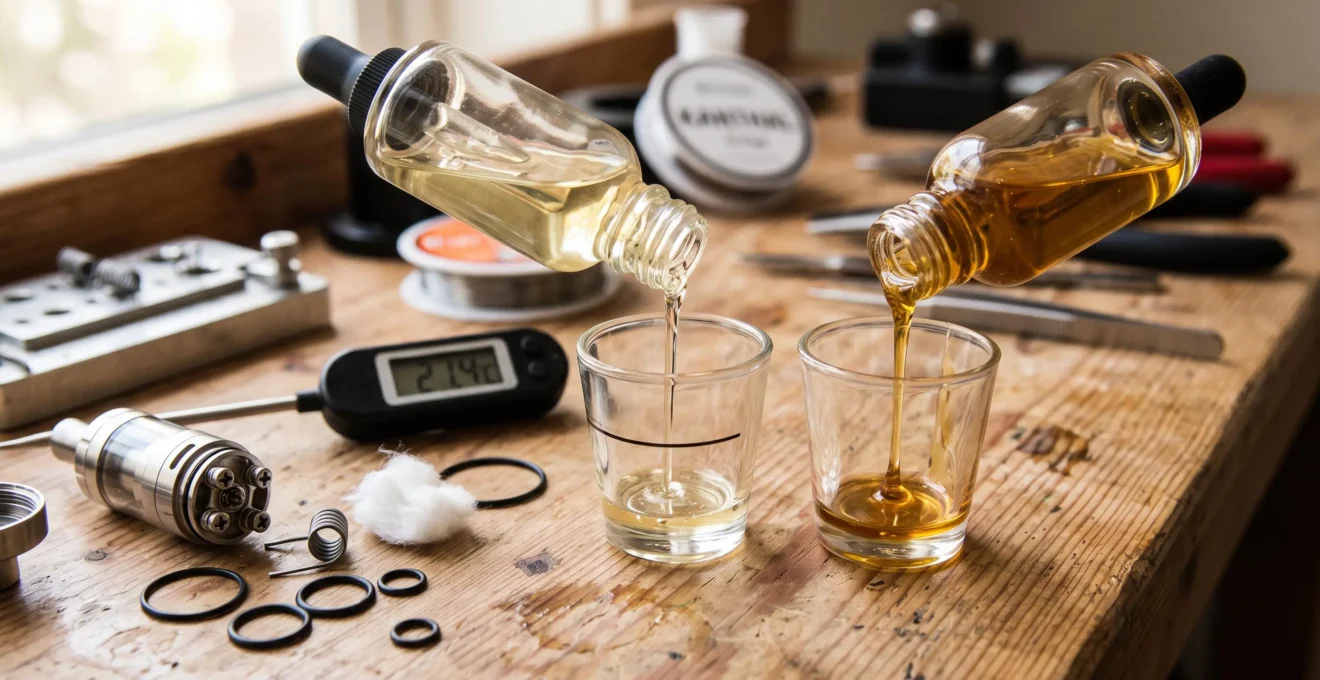
E-liquid viscosity determines how readily liquid travels from a pod or tank reservoir into the coil’s absorbent wick. When the liquid flows too slowly for the amount being vaporised, the wick can become insufficiently saturated and produce a dry hit. When liquid enters the coil chamber faster than it can be vaporised or contained, flooding, gurgling and leakage may follow.
The relationship is not as simple as choosing a thin liquid for every small device or a thick liquid for every powerful tank. Vegetable glycerin (VG), propylene glycol (PG), temperature, wick structure, power settings and the way the device is used all influence liquid delivery. Even two coils installed in the same tank may behave differently with an identical VG/PG blend.
Understanding these interactions makes troubleshooting more systematic. Instead of replacing a cartridge whenever flavour deteriorates or liquid escapes, it becomes possible to distinguish a viscosity mismatch from insufficient priming, damaged seals or unsuitable operating settings.
E-liquid viscosity: essential compatibility rules
- Higher-VG liquids are generally thicker and may replenish small wicks more slowly, particularly when cold.
- Thin liquids can contribute to flooding or leakage in unsuitable hardware, but installation, seals and power settings also matter.
- Choose the VG/PG ratio recommended for the actual coil or cartridge, then use flavour, gurgling and dry-hit symptoms to assess performance.
- Why Does E-Liquid Flow More Slowly in Colder Conditions?
- How Can You Match E-Liquid Viscosity to Small or Large Wicking Ports?
- Thin or Thick E-Liquid: Which Better Suits a Small Pod Cartridge?
- Which Viscosity Mismatches Cause Flooding or Dry Hits in a Vape Tank?
- How Can You Adjust for E-Liquid Viscosity Changes During Cold Weather?
- Which E-Liquid Mismatches Can Cause Leaking, Flooding or Dry Hits?
- How Does Vegetable Glycerin Change E-Liquid Thickness and Vapour Density?
- How Can You Maintain Proper Wick Saturation Without Flooding the Coil?
Why Does E-Liquid Flow More Slowly in Colder Conditions?
E-liquid flows more slowly in cold conditions because its viscosity increases as temperature decreases. VG-rich mixtures are particularly susceptible to noticeable thickening, while PG-rich liquids generally remain more fluid. As a result, a coil that receives enough liquid indoors may struggle to replenish its wick after exposure to cold weather, even when the reservoir is full.
Viscosity describes a liquid’s resistance to flowing. Honey offers a familiar comparison: chilled honey pours sluggishly, whereas the same honey moves more easily after returning to room temperature. E-liquid behaves according to a similar temperature-dependent principle, although its composition differs.
The scientific basis is established by research on e-liquid viscosity and temperature published in Industrial & Engineering Chemistry Research. The researchers studied mixtures of PG, glycerol and water, identifying composition and temperature as important viscosity variables. Their reported model covers 20–80°C, however, so it should not be treated as direct experimental verification of particular vaping outcomes at freezing temperatures.
Consider a hypothetical user who fills a tank with 70VG/30PG e-liquid indoors and then carries it through cold outdoor conditions. The liquid may become noticeably thicker. If the wick cannot transport it quickly enough to replace what each puff vaporises, the coil may overheat locally and produce a burnt sensation.
A full reservoir does not guarantee a saturated wick. The relevant factor is the rate at which liquid reaches the heated surface, not simply the amount remaining in the tank.
Temperature-related thickening is generally reversible. Bringing the device and bottle back towards normal room temperature can restore easier flow without changing the liquid’s formulation. This is different from claiming that every change in appearance or flavour is harmless: unusual contamination, separation or deterioration should be assessed independently.
Avoid direct flames, microwaves, radiators or other aggressive heating methods. Gentle warming through ordinary indoor conditions is preferable, especially because overheating can affect the formulation and damage containers.
Temperature is only one part of the equation. The dimensions and structure of the device’s liquid-feed openings determine whether a thicker mixture can reach the coil consistently.
How Can You Match E-Liquid Viscosity to Small or Large Wicking Ports?
Match viscosity to wicking ports by checking the actual coil or cartridge design and its manufacturer’s recommended VG/PG range. Small, restrictive liquid-feed channels generally favour more fluid mixtures, while larger openings may accommodate thicker high-VG liquids. Port size alone is insufficient, however: wick material, coil design, power requirements and liquid consumption must also be considered.
Wicking ports connect the surrounding liquid reservoir to the absorbent material near the heating element. They act as one of the restrictions controlling how quickly fresh liquid can enter the wick.
In a compact mouth-to-lung (MTL) cartridge, the available liquid-feed openings may be relatively small. A viscous mixture can move through these channels too slowly to maintain saturation during repeated puffs. By contrast, many sub-ohm tanks use larger feed openings and wicking arrangements intended for substantial liquid consumption.
Scientific modelling reinforces the importance of looking beyond the bottle. A Scientific Reports study of capillary transport in e-cigarette wicks examined how PG/VG composition, electrical power and wick porosity interact during vaporisation. The findings concern the studied low-power configuration and do not establish universal compatibility limits for commercial cartridges.
A practical compatibility assessment begins with the hardware:
- Compact MTL pods: examine the manufacturer-approved ratios, with 50VG/50PG often serving as a practical starting point where supported.
- High-output sub-ohm tanks: check whether their coils are designed for more viscous, VG-rich liquids.
- Rebuildable atomisers: account for wick density, liquid-feed opening size and coil power rather than relying on VG/PG ratio alone.
Symptoms provide useful feedback after the initial compatibility check. Repeated dry hits suggest insufficient liquid supply, particularly when they occur during consecutive puffs. Gurgling and spitback suggest excess liquid in the coil chamber, although neither symptom identifies viscosity as the cause on its own.
Not every MTL system is restricted to thin liquid. Some coils are deliberately engineered to accommodate high-VG formulations. Resistance and the marked wattage range provide additional context, but neither independently determines compatibility.
Once the feed system is understood, the next decision is whether a thinner or thicker mixture offers the better compromise in a compact pod cartridge.
Thin or Thick E-Liquid: Which Better Suits a Small Pod Cartridge?
A thinner e-liquid is usually the more predictable starting point for a small pod cartridge, provided its manufacturer supports that formulation. A 50VG/50PG mixture offers a common middle ground between liquid mobility and vapour production. Thicker high-VG liquids may work in specially designed pods, but should not be selected solely for their denser vapour.
PG-rich mixtures generally move more readily through restrictive wicking systems. They can therefore reduce the risk of starvation when liquid-feed capacity is limited. Their trade-offs include less dense visible aerosol and potentially stronger throat sensation, depending on the formulation.
VG-rich mixtures generally produce denser visible aerosol and a softer throat sensation. However, the thicker liquid may replenish some small cartridges too slowly, particularly under cold conditions or repeated use.
The comparison is more useful when expressed as operating trade-offs rather than a universal ranking.
| Criterion | Thinner, PG-rich liquid | Thicker, VG-rich liquid |
|---|---|---|
| Wicking through restrictive channels | Generally easier | May be slower |
| Visible aerosol density | Generally lighter | Generally denser |
| Throat sensation | Often more pronounced | Often softer |
| Potential mismatch | Flooding or leakage where liquid supply exceeds demand | Wick starvation and dry hits where replenishment is inadequate |
| Selection criterion | Manufacturer-approved formulation | Explicit coil or cartridge compatibility |
Coil resistance and power must be interpreted together. A low-resistance, high-power system may vaporise substantial amounts of liquid and place greater demands on replenishment, even when its wick has comparatively large openings. A higher-resistance, lower-power coil may consume liquid more slowly, potentially allowing a moderately viscous formulation to keep pace.
These are tendencies rather than rules derived from resistance alone. Liquid-feed geometry and the manufacturer’s specifications remain decisive.
Nicotine-salt formulations are frequently associated with compact, low-power pods, and 50/50 blends are common in that category. Yet nicotine form and VG/PG ratio describe different properties. A nicotine-salt label does not guarantee that a liquid has the correct thickness for a given cartridge.
Persistent dry hits can shorten the useful life of a wick when its cotton becomes scorched. Conversely, recurring flooding and liquid accumulation can create maintenance problems, although viscosity alone does not establish that cartridge seals will fail prematurely.
If the current liquid already produces gurgling or burnt flavour, those symptoms can be used to determine whether the problem is insufficient liquid supply or excess liquid in the coil chamber.
Which Viscosity Mismatches Cause Flooding or Dry Hits in a Vape Tank?
Flooding can occur when liquid enters the coil chamber faster than the heating system can vaporise or contain it, while dry hits occur when the wick cannot supply enough liquid to the heated coil. Thin e-liquid may contribute to flooding in unsuitable hardware; thick e-liquid may contribute to starvation. Both problems can also result from settings, installation or maintenance faults.
These failure modes are different expressions of an imbalance between liquid supply and liquid consumption.
Flooding describes excess liquid collecting around the coil or inside its chamber. Common symptoms include bubbling or gurgling during a draw, spitback and reduced flavour definition. In some devices, accumulated liquid may eventually escape through the airflow path.
Wick starvation develops when the heated section consumes liquid faster than capillary transport replaces it. A dry or harsh sensation can appear during a puff, followed by a distinctly burnt taste if the absorbent material overheats.
Timing helps distinguish possible causes:
- Gurgling immediately after refilling: consider overfilling, excess priming liquid or liquid entering the central airflow channel.
- Gurgling during ordinary use: check whether the liquid is too fluid for the coil, whether the operating power is appropriate and whether the coil is correctly installed.
- Burnt flavour after several consecutive puffs: investigate insufficient replenishment, high liquid viscosity or a pace that exceeds the wick’s capacity.
- Burnt flavour on a newly fitted coil: check priming time, installation and the coil’s recommended operating range.
Power settings affect the balance, but they are not an unrestricted corrective tool. Too little power in some configurations can leave excess liquid inadequately vaporised. Excessive power increases liquid consumption and may worsen wick starvation.
Increasing wattage is therefore not a reliable remedy for thick liquid. Where wicking is already inadequate, additional heating can make dry hits more likely. Any adjustment should remain within the manufacturer’s specified range.
Similarly, lowering power may reduce liquid consumption but does not repair a damaged seal or guarantee that flooding will stop.
Repeated puffs introduce another variable. A mixture may function acceptably during occasional use yet fail during rapid consecutive draws because the wick has insufficient time to replenish its liquid supply. This is especially relevant with thick formulations or cold hardware.
When poor performance appears mainly outdoors, temperature should be investigated before concluding that the coil or liquid is fundamentally incompatible.
How Can You Adjust for E-Liquid Viscosity Changes During Cold Weather?
Cold-weather viscosity problems are best managed by allowing e-liquid and hardware to return gradually to room temperature, avoiding rapid consecutive puffs and checking the formulation against the device’s specifications. Users whose high-VG mixtures become difficult to wick may benefit from a manufacturer-approved thinner blend, but heating the device or increasing power beyond its recommended range is not appropriate.
The simplest preventive measure is storage. Bottles kept in an inside pocket are less exposed to cold than those left in a vehicle or unheated space. The same principle applies to refillable devices, although they should also be protected from accidental activation and handled according to their battery safety instructions.
When a cold device is brought indoors, allow its liquid to warm naturally before judging whether its flow characteristics have returned to normal. Avoid concentrated heat sources and do not attempt to accelerate the process by repeatedly firing an inadequately saturated coil.
A practical cold-weather routine follows three priorities:
- Keep spare e-liquid and devices away from prolonged exposure to extreme temperatures.
- Let a cold device return towards normal indoor temperature before use, checking for condensation, leakage or visible damage.
- Once the wick is adequately saturated, avoid rapid consecutive puffs that could exceed its replenishment capacity.
Some refillable devices permit gentle draws without activating the heating element as part of their priming guidance. This is not a universal procedure: excessive unpowered draws can pull surplus liquid into the coil chamber, so the manufacturer’s instructions should take precedence.
Seasonal formulation changes may also help. Consider a hypothetical tank that operates consistently with a high-VG liquid indoors but repeatedly produces dry hits after cold exposure. If its manufacturer approves a 50/50 alternative, that formulation could be evaluated without replacing the hardware.
The objective is not to change ratios automatically every winter. It is to maintain a liquid-feed rate that remains compatible with the coil under actual operating conditions.
If the cotton has already developed a persistent burnt taste, warming the liquid may not restore performance. Scorched wick material generally requires replacement rather than continued attempts to vaporise liquid through it.
If the same symptoms persist indoors, a wider diagnostic check is needed to separate liquid mismatch from damaged seals, incorrect assembly or other hardware problems.
Which E-Liquid Mismatches Can Cause Leaking, Flooding or Dry Hits?
E-liquid mismatches produce different symptoms depending on how liquid supply compares with the coil’s capacity to absorb and vaporise it. Excessively fluid liquid can contribute to flooding and leakage, while excessively viscous liquid can cause dry hits when replenishment is insufficient. Temperature, power settings, priming and hardware faults can produce similar symptoms, so diagnosis requires more than reading the VG/PG label.
Leaking and flooding should not be used interchangeably. Leaking means liquid escapes from an intended containment area, such as through an airflow opening, base or faulty seal. Flooding means excess liquid accumulates within the coil or atomisation chamber. Flooding can lead to leakage, but one does not always imply the other.
The following table consolidates the major fault patterns.
| Observed problem | Possible mismatch or cause | First practical check |
|---|---|---|
| Dry hits despite a full tank | Liquid too viscous for the wick’s delivery capacity | Check VG/PG compatibility and allow sufficient saturation time |
| Dry hits during consecutive puffs | Liquid consumption exceeds wick replenishment | Space puffs and verify the recommended power range |
| Persistent gurgling | Excess liquid reaching the coil chamber | Check priming quantity, filling procedure and operating settings |
| Liquid escaping through airflow | Flooding, damaged seals or incorrect assembly | Inspect O-rings, coil seating and tank components |
| Poor wicking after cold exposure | Temperature-related viscosity increase | Allow gradual return to room temperature |
| New coil tastes burnt | Insufficient priming, unsuitable liquid or incorrect power | Review coil installation and manufacturer instructions |
Official Innokin troubleshooting instructions identify several non-viscosity contributors, including damaged O-rings, incorrect coil installation, liquid entering the central chamber, overfilling, inadequate priming and unsuitable operating power.
These factors should be examined before concluding that a different VG/PG ratio is necessary.
Nicotine formulation can create additional confusion. Nicotine salts are often sold in ratios intended for small pod systems, whereas some freebase formulations are offered in higher-VG mixtures. However, neither nicotine form determines viscosity on its own. The actual liquid composition and the hardware specification matter more than the nicotine category printed on the bottle.
For example, moving from a low-power pod to a high-output tank while continuing to use a formulation intended for the original device may introduce a compatibility problem. The reverse transition can also be troublesome if a very thick liquid is used in restrictive feed channels.
Five checks to identify an e-liquid mismatch
- Read the bottle’s VG/PG ratio and record the formulation exactly as labelled.
- Identify the installed coil or cartridge and note its manufacturer-approved liquid and wattage specifications.
- Classify the main symptom as leaking, internal flooding or dry-hit behaviour, noting when it occurs.
- Inspect accessible seals, coil seating and filling components according to the device instructions; record any visible defect or incorrect installation.
- Compare performance under normal indoor conditions after appropriate priming and within the approved settings; record whether the original symptom remains.
Changing one variable at a time makes the result easier to interpret. For instance, replacing a visibly damaged O-ring before changing the liquid avoids attributing a mechanical leak to viscosity without evidence.
If damage affects electrical components or the battery compartment, stop using the device and follow manufacturer safety guidance rather than attempting to clear the liquid by activating the coil.
After hardware defects are ruled out, understanding the physical differences between VG and PG helps explain why alternative formulations behave differently in the same device.
How Does Vegetable Glycerin Change E-Liquid Thickness and Vapour Density?
Vegetable glycerin increases an e-liquid’s viscosity and generally contributes to denser visible aerosol as its proportion rises. Propylene glycol is less viscous and is commonly associated with more pronounced throat sensation and flavour delivery. The VG/PG ratio therefore provides an important first indication of how a liquid may wick, although temperature, other ingredients and device design also influence performance.
VG, also known as glycerol, is a relatively viscous, hygroscopic compound, meaning it attracts and retains moisture. Its physical properties make it important both to liquid flow and aerosol formation.
PG is more fluid under comparable conditions. It also serves as a solvent and carrier for flavouring ingredients in many e-liquid formulations.
VG/PG labels are useful because they provide a practical way to compare mixture composition. In the common VG-first convention, 70/30 means 70% VG and 30% PG. However, label conventions should always be checked rather than assuming that every manufacturer presents its ratios in the same order.
The following comparisons describe general formulation tendencies, not laboratory predictions for every bottle.
| VG/PG ratio | General viscosity tendency | Hardware consideration |
|---|---|---|
| 30VG/70PG | Relatively fluid | Check whether the device can control liquid supply without flooding |
| 50VG/50PG | Intermediate | Common reference point for compatible low-power systems |
| 70VG/30PG | Relatively thick | Requires a feed system capable of replenishing the coil adequately |
| High-VG or max-VG | Potentially very thick | Verify explicit hardware compatibility and formulation details |
These ratios do not tell the whole story. Water content, flavouring carriers and other ingredients can influence measured viscosity. Two liquids displaying the same nominal VG/PG ratio may therefore perform differently.
There is also no universal dividing line at which an MTL device becomes incompatible with 70VG/30PG. Innokin’s product-specific Zlide guidance, for example, lists both 50VG/50PG and 70VG/30PG as compatible with that MTL tank. This illustrates why the particular coil and tank design must take priority over general category assumptions.
Higher VG content does not automatically mean shorter coil life or greater residue formation. Flavouring chemistry, sweetener content, operating power and wick conditions also influence deposit accumulation and maintenance requirements. A thick liquid that causes repeated wick starvation can damage cotton, but VG percentage by itself does not establish how quickly a coil will deteriorate.
Some users also report sensitivity or irritation associated with PG-containing formulations. Such reactions are not established by throat sensation alone and should not be self-diagnosed as an allergy. Anyone experiencing persistent or concerning symptoms should stop exposure and seek appropriate medical advice.
Switching to a high-VG formulation for comfort may create a separate device-compatibility problem if the cartridge is not designed for it. Ingredient tolerance and hardware suitability are distinct considerations.
Once an appropriate formulation has been selected, maintaining the correct amount of liquid in the wick becomes the final operational challenge.
Key takeaways before priming and using a coil
- Confirm the actual cartridge or coil specifications instead of choosing a formulation from VG/PG ratio alone.
- Allow sufficient saturation time, particularly for more viscous liquids, without adding unnecessary priming liquid.
- Treat recurring gurgling and persistent burnt flavour as different problems that require different checks.
How Can You Maintain Proper Wick Saturation Without Flooding the Coil?
Proper wick saturation requires enough liquid to reach the heating element without accumulating excessively in the coil chamber. Prime new coils according to their manufacturer’s instructions, allow sufficient absorption time, use the specified power range and avoid drawing faster than the wick can replenish. Consistent flavour without persistent gurgling or dry sensations is a useful operating indicator.
Priming prepares absorbent material for its first heating cycle. In a replaceable coil with exposed cotton openings, a manufacturer may instruct the user to apply a controlled amount of liquid directly to accessible wick material before installing and filling the tank.
Other cartridges are designed to saturate after filling and resting, without additional drops or manual access to the cotton. These procedures should not be interchanged automatically.
The aim is adequate absorption, not maximum liquid quantity. Applying excessive liquid can flood the chamber before the first puff, particularly when liquid is accidentally introduced into a central airflow passage.
Viscosity influences the waiting period because thicker formulations may penetrate some wick structures more slowly. More viscous liquid does not necessarily require more priming drops; additional time may be the appropriate adjustment.
Manufacturer instructions demonstrate why there should be no universal priming time. Innokin’s general troubleshooting guidance specifies a minimum 15-minute wait for its described priming procedure, while its Zlide product guidance describes a minimum five-minute wait after filling. These are product- and procedure-specific instructions rather than interchangeable standards.
After priming, the device’s behaviour provides additional feedback:
- Consistent flavour without bubbling: suggests that liquid supply and vaporisation are reasonably balanced.
- Recurring gurgling or spitback: suggests excess liquid in the coil chamber or airflow path.
- A dry sensation near the end of a puff: may indicate that replenishment is approaching its limit.
- Persistent burnt flavour: may indicate scorched wick material or another coil fault requiring replacement.
These signals are diagnostic clues, not definitive tests. Condensation, flavour formulation and coil condition may change the experience without indicating a straightforward viscosity mismatch.
Spacing puffs helps the wick replenish itself between heating cycles. This becomes especially important with viscous liquids, cold conditions or devices operating near their liquid-feed capacity. No universal pause duration applies to every coil.
A flooded coil requires a different response. Where manufacturer instructions permit, excess accessible liquid may be removed with the device switched off and the affected components cleaned appropriately. Some manufacturer procedures also describe clearing excess liquid through controlled draws, but repeated suction can worsen flooding in unsuitable designs.
Do not increase wattage beyond the recommended range to burn away excess liquid. Likewise, do not dry-fire cotton-wicked replaceable coils. Heating a dry wick can scorch its absorbent material, and dry-burning practices used for certain bare rebuildable components are not equivalent to a safe recovery procedure for cotton-wicked cartridges.
When the balance cannot be restored, replacement may be more appropriate than continued adjustment. Persistent burnt flavour, damaged cotton, faulty seals or recurrent leakage after correct assembly indicate that the problem may extend beyond ordinary saturation management.
For the next refill or coil change, check the manufacturer’s liquid recommendations, prepare the wick using the specified procedure and observe performance at approved settings. If flooding, leaking or dry hits continue, inspect the hardware rather than repeatedly adjusting power or adding priming liquid.
Can two e-liquids with the same VG/PG ratio have different viscosities?
Yes. VG/PG ratio is an important indicator but does not fully describe a formulation. Water content, flavouring carriers, other ingredients and temperature can affect its physical properties. Consequently, two bottles displaying the same ratio may not wick identically in the same device.
Does a higher-resistance coil always require thinner e-liquid?
No. Resistance alone does not determine suitable viscosity. Wick construction, feed openings, applied power and manufacturer recommendations are all relevant. Some mouth-to-lung tanks, including the documented Innokin Zlide example, support both 50VG/50PG and 70VG/30PG mixtures.
Can air bubbles inside a pod indicate poor wicking?
Air bubbles may appear as liquid leaves a reservoir and air replaces it. Their presence alone does not establish a fault. However, persistent dry hits alongside apparent feeding problems warrant checking the liquid ratio, cartridge condition and manufacturer instructions. Do not puncture, forcibly squeeze or modify a sealed cartridge to release bubbles.
Will changing e-liquid viscosity fix a leaking tank with damaged seals?
Not reliably. Damaged or displaced seals can allow liquid to escape regardless of its nominal VG/PG ratio. A different formulation may alter the visible leakage rate without correcting the mechanical defect. Inspect and replace damaged components using manufacturer-approved parts before evaluating liquid compatibility.
Can a burnt coil recover once the e-liquid starts flowing properly?
If the wick was only temporarily under-saturated and has not been scorched, allowing it to absorb liquid may restore normal operation. However, persistently burnt flavour can indicate damaged cotton that will not recover simply through re-saturation. In that situation, replacing the affected coil or cartridge is generally the appropriate option.