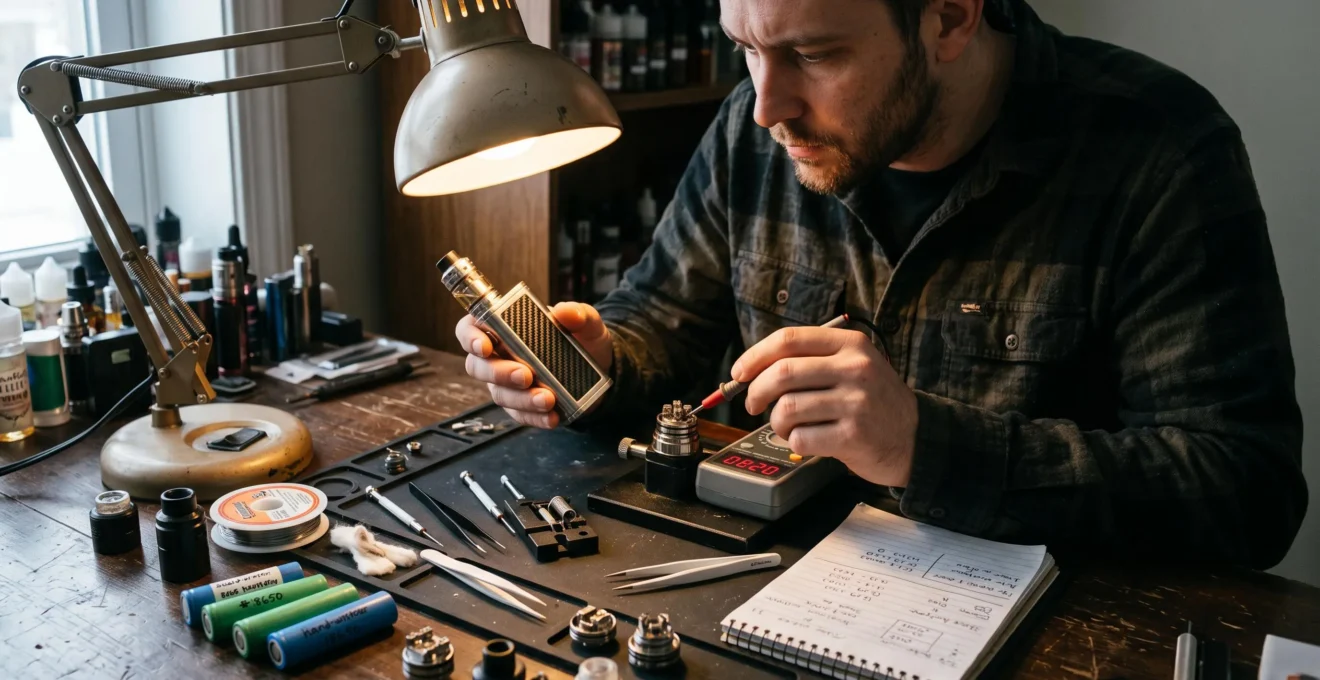
Modified vaping hardware can behave differently from the original device even when the alteration appears minor. Replacing a connector, changing an atomizer, adjusting battery contacts or modifying airflow can affect electrical resistance, heat transfer, mechanical alignment and the protections available during operation.
For experienced adult vapers, the central question is not simply whether two components can be assembled. It is whether the resulting configuration remains within the mechanical, electrical and thermal limits established for those components. A connection that fits physically may still create unreliable contact, an unintended current path or inadequate battery ventilation.
These distinctions become especially important when comparing regulated devices with mechanical or otherwise unregulated hardware. Electronic protections may help detect certain faults, but they cannot compensate for every physical defect, and some devices have no electronic protection at all.
The safest starting point is the original manufacturer’s configuration. Any proposed alteration should be assessed against that baseline, with particular attention to compatibility evidence, warning signs and whether the desired improvement could be achieved without modification.
Modified vape hardware: the essential considerations
- Physical fit is not proof of compatibility. Connector geometry, electrical contact, battery requirements and ventilation must all be considered.
- Modifications can compromise safeguards. Regulated devices have model-specific protections, while mechanical devices may lack electronic cutoffs entirely.
- Prefer adjustments and approved components. Reversible changes preserve more troubleshooting options, but reversibility alone does not establish safety.
- Why Can a Small Vape Hardware Modification Change Overall Device Behaviour?
- How Can You Check Whether a Hardware Modification Remains Mechanically Compatible?
- Reversible Upgrade or Permanent Modification: Which Creates Fewer Compatibility Issues?
- Which Vape Modifications Can Remove Important Built-In Safeguards?
- When Should You Try Setup Adjustments Before Modifying Vape Hardware?
- Which Compatibility Warning Signs Mean You Should Stop Fitting a Vape Component?
- Which Mechanical Warning Signs Mean a Vape Part Should Not Be Forced Together?
- Which Mechanical Limits Matter Most in High-Output Vape Hardware?
Why Can a Small Vape Hardware Modification Change Overall Device Behaviour?
A small vape hardware modification can change overall device behaviour because the battery, electrical contacts, control electronics, heating element and airflow system operate together. Altering one component can influence several operating conditions simultaneously. Even when a replacement part fits, differences in contact geometry, resistance or thermal behaviour may affect performance or create risks that are not immediately visible.
A vaping device is an interconnected electrical and thermal system rather than a collection of independent accessories. Electrical energy travels through contacts and a heating element, while air movement and liquid supply influence how heat is transferred and dissipated.
Changing one component can move the assembly away from its original operating conditions. Consider three hypothetical examples:
- A different 510 connector: a change in pin position or contact travel could produce an unreliable connection, even though the atomizer screws into place.
- A taller tank or altered chimney: different internal geometry could change airflow resistance, condensation patterns or the way heat accumulates around the atomizer.
- A modified airflow opening: changing airflow may alter coil cooling and perceived vapour temperature without changing the electrical power setting.
These examples illustrate possible mechanisms, not verified outcomes for any particular component combination. The actual effects depend on device geometry, materials, operating settings and component condition.
Another distinction matters: a modification may change the physical behaviour of a device without producing a fault that its electronics can recognise.
A regulated mod may monitor coil resistance, current or circuit-board temperature and reduce or interrupt output under certain conditions. However, its electronics cannot necessarily identify a damaged insulator, obstructed vent or poorly aligned mechanical contact.
On an unregulated mechanical device, the consequences are more direct. With no control chipset supervising output, the battery and connected electrical load determine the behaviour of the circuit. Mechanical defects therefore leave fewer opportunities for automatic intervention.
The important distinction is between a device that operates and a configuration whose behaviour remains within documented limits. That distinction leads directly to mechanical compatibility assessment.
How Can You Check Whether a Hardware Modification Remains Mechanically Compatible?
Mechanical compatibility should be assessed by comparing documented connector specifications, thread engagement, contact geometry, component dimensions and ventilation requirements before assembly. An atomizer that screws into a device is not necessarily electrically compatible. Missing dimensions, uncertain battery contact arrangements or unsupported connections should be treated as reasons to stop rather than invitations to experiment.
The starting point is the documentation for both components. Manufacturer specifications provide the strongest available reference for intended connections and supported accessories. Product photographs, seller descriptions and reports from other users may provide context, but they cannot establish the tolerances or safety of an individual assembly.
A pre-fit review should cover the following characteristics:
- Thread specification and engagement depth. Confirm the documented thread standard and whether the connector is intended for the particular component. Incorrect engagement can damage threads or produce unstable contact.
- Positive-pin geometry. Identify whether the contact is fixed or spring-loaded and whether the manufacturer specifies its position or protrusion. Do not assume that two visually similar 510 connections are interchangeable.
- Atomizer diameter and seating surface. Check whether the component fits without overhang that obstructs controls, ventilation or other functional surfaces.
- Ventilation clearance. Confirm that intended battery venting paths remain unobstructed when the components are assembled.
- Battery-contact travel. Check the manufacturer’s requirements for battery format and contact arrangement. Excessive compression, uncertain contact pressure or movement outside the intended range requires professional assessment.
Where dimensions are published, compare them in millimetres and record their sources. Community measurement discussions can help identify questions to ask, but should not substitute for original specifications or manufacturer confirmation.
Mechanical fit and safe electrical operation must be considered separately. A connection may engage smoothly while concealing inadequate insulation, intermittent contact or an airflow seal problem.
On suitable equipment, a resistance measurement performed with an appropriate standalone measuring instrument can help identify an apparent open circuit, unstable reading or unintended short before installation. Such a measurement cannot establish mechanical safety or prove that the completed assembly is suitable for use.
A powered firing test is not an appropriate way to investigate uncertain compatibility. If a component has undocumented contact geometry or produces inconsistent measurements, it should remain disconnected until the manufacturer or a qualified technician can establish whether the combination is supported.
Hybrid and hybrid-adjacent mechanical connectors require particular caution. In a direct-battery-contact arrangement, atomizer positive-pin geometry and insulation become critical because the electrical connection may not include the protective separation present in other connector designs. Visual appearance alone cannot establish suitability.
Five checks to document before considering a replacement component
- Identify both components. Record the exact device and replacement-part models in a compatibility note.
- Collect specifications. Save manufacturer documentation covering connector type, dimensions and approved component combinations.
- Check the physical interface. Record whether the specifications confirm thread engagement, seating and contact compatibility; mark unknowns explicitly.
- Review battery and ventilation requirements. Document approved battery formats, contact requirements and any openings that must remain unobstructed.
- Record the decision. Mark the combination as manufacturer-supported, requiring professional confirmation, or unsuitable. Do not proceed on the basis of unresolved safety-critical information.
Even when compatibility can be established, the next consideration is how easily the original configuration can be restored if performance changes or a fault develops.
Reversible Upgrade or Permanent Modification: Which Creates Fewer Compatibility Issues?
Reversible changes generally create fewer troubleshooting and restoration difficulties than permanent hardware modifications because the original configuration can be recovered. However, reversibility does not guarantee electrical or mechanical compatibility. Manufacturer-approved replacement parts are preferable, while permanent alterations introduce additional uncertainty by changing the device’s original geometry, materials or contact arrangements.
The practical difference is not simply whether a modification can be undone. It is whether the change preserves a known operating baseline against which unexpected behaviour can be assessed.
For example, replacing a worn seal with an approved spare part retains the manufacturer’s intended assembly. Drilling an airflow passage or cutting a contact spring changes the original component and may make subsequent comparison difficult or impossible.
Some changes occupy an intermediate category. Removable adapters, alternative O-rings and replaceable contact assemblies may leave the original parts physically intact, yet still introduce new compatibility questions.
The following comparison highlights the trade-offs without implying that any unapproved modification is safe.
| Evaluation criterion | Reversible or replaceable change | Permanent alteration |
|---|---|---|
| Return to original condition | Often possible if original parts remain undamaged | May require replacement of the altered component or entire device |
| Fault diagnosis | Original approved parts can provide a comparison baseline | Original geometry or operation may no longer be available |
| Compatibility evidence | May be available for manufacturer-approved replacements | Original specifications may no longer describe the altered assembly |
| Mechanical uncertainty | Depends on the replacement and additional interfaces | May include irreversible changes to contacts, seals or structural features |
| Manufacturer support | Depends on the approved part and applicable warranty terms | Unauthorised alterations may limit support or warranty coverage |
Semi-reversible changes deserve particular attention. An adapter might be removable, but it also introduces another mechanical interface and potentially another electrical contact. Stacking adapters creates additional points where alignment or conductivity may become unreliable.
Permanent alterations such as drilling, bonding contacts with adhesive or changing spring dimensions may affect functions beyond the intended adjustment. If heat, resistance or mechanical stability changes afterward, isolating the cause becomes more difficult.
There is also a practical support issue. Manufacturers may decline to service products altered outside their instructions, subject to the applicable warranty and consumer-protection rules. This should be checked before any modification rather than assumed afterward.
Electrical Safety First explicitly advises consumers against modifying vaping devices and recommends manufacturer-approved replacements in its advice on vapes and e-cigarettes.
“Don’t modify your vape and use only replacement parts approved by the manufacturer.”
The most significant concern arises when an alteration affects the features intended to prevent or limit electrical and thermal failures.
Which Vape Modifications Can Remove Important Built-In Safeguards?
Modifications involving electrical contacts, insulation, battery compartments, ventilation, coil resistance or control electronics can compromise important vaping-device safeguards. Some alterations bypass a protection directly, while others create faults that existing electronics cannot detect. Mechanical devices present a separate concern because electronic short-circuit, temperature and low-resistance cutoffs may never have been present.
Regulated vaping devices commonly incorporate several forms of electronic monitoring, although the specific protections and thresholds vary by model.
The distinction between a safeguard being physically removed and becoming ineffective under altered conditions is important. A device may retain its original circuit board while its modified mechanical components introduce risks outside what the board was designed to monitor.
Consider the relationship between common protections and potentially problematic alterations:
| Safeguard | Potentially relevant alteration | Resulting concern |
|---|---|---|
| Short-circuit protection | Changed connector geometry or damaged positive-pin insulation | An unintended current path may develop, particularly outside monitored circuitry |
| Over-current or low-resistance cutoff | Heating elements outside the device’s supported range | The chipset may reject the load, or the configuration may lack an appropriate protection margin |
| Temperature monitoring | Changes affecting heat transfer or sensor operation | Measured temperatures may not represent every component experiencing heat |
| Battery ventilation | Drilled, obstructed or repositioned enclosure features | Designed gas-release paths may be compromised |
| Electrical insulation | Altered contacts, damaged battery wraps or displaced insulating components | Conductive surfaces may contact parts intended to remain electrically separated |
An original manufacturer manual illustrates how specific protections operate. The Innokin Sensis EZ product manual documents short-circuit detection, resistance limits and circuit-board temperature monitoring.
For that particular model, the manual specifies an output range of 6–40 W and identifies coil resistance below 0.2 ohm or above 3.5 ohms as unsupported. It also describes output interruption in response to particular electrical faults and overheating conditions.
These figures are specific to the Sensis EZ. They must not be treated as universal limits for regulated devices, external-battery mods or mechanical hardware.
Passive safety features are equally important. Battery wraps and insulating rings help separate conductive battery surfaces from unintended contacts. Vent openings provide a designed path for gas release in certain failure conditions. Altering or obstructing these features can compromise safety without changing any displayed setting.
In a mechanical mod, the absence of electronic supervision means a modification cannot be evaluated on the assumption that a chipset will interrupt an unsafe operating condition.
A useful protection audit should answer three questions: which safeguards originally existed, which remain effective after the proposed change, and whether the manufacturer provides evidence supporting that configuration. Uncertainty about any safety-critical function is reason not to use the altered assembly.
Because modifying protection-related components introduces uncertainty that may be difficult to resolve, the next decision should be whether the desired performance improvement actually requires a hardware alteration.
When Should You Try Setup Adjustments Before Modifying Vape Hardware?
Setup adjustments should be considered before hardware modification whenever the problem involves flavour, vapour temperature, airflow, vapour output or the sensation of inhalation. Changes permitted by the manufacturer can often address these concerns without altering electrical contacts or structural components. Adjustments must remain within the supported coil, power and airflow specifications of the device.
The first step is to identify the actual problem. A vape that feels too warm, produces weak flavour or offers an uncomfortable draw does not necessarily have a mechanical limitation requiring modification.
Different symptoms call for different diagnostic questions:
- Excessive warmth: Is the selected power within the coil’s recommended range, and is the intended airflow unobstructed?
- Weak flavour: Is the coil worn, incorrectly seated or approaching the end of its service life?
- Uncomfortable draw resistance: Does the device provide an approved airflow adjustment that has not been explored?
- Inconsistent vapour: Are the installed coil, supported operating mode and recommended power setting correctly matched?
- Dry or burnt taste: Does the manufacturer recommend coil replacement or another maintenance action?
E-liquid characteristics can also influence perceived performance, but only liquids compatible with the device and its manufacturer’s requirements should be considered. Changes should not be used to compensate for an electrical or battery fault.
For example, a hypothetical user experiencing a warmer-than-expected draw might initially suspect inadequate tank ventilation. Before considering physical alteration, the relevant checks would be whether the installed coil is correct, whether its recommended power range is being respected and whether the adjustable airflow is set as intended.
Original manufacturer documentation can help separate intended performance from an actual fault. The Sensis EZ manual, for instance, identifies different recommended power ranges for its supported 0.25-ohm and 0.65-ohm coils and describes adjustable airflow and output settings.
That illustrates why settings cannot be transferred indiscriminately between coils or devices. A power level appropriate for one specified heating element may be outside another’s recommended operating range.
There are genuine limits to adjustment. A device cannot be made compatible with an unsupported battery format by changing wattage. An incompatible connector cannot be corrected through airflow settings. Similarly, a fixed physical airflow restriction may prevent a desired configuration from being achievable within the manufacturer’s design.
When the design cannot meet a requirement, choosing a different manufacturer-supported device or component is generally preferable to altering the original hardware.
If normal adjustments fail, the next step is not automatically modification. It is determining whether the component combination is supported and recognising any sign that installation should stop.
Which Compatibility Warning Signs Mean You Should Stop Fitting a Vape Component?
Stop fitting a vape component if resistance readings are abnormal, electrical contacts are uncertain, threads require force, battery insulation is damaged or ventilation is obstructed. Unexpected activation, repeated fault messages and unstable connector seating are also reasons to discontinue use. These conditions should be investigated with the device powered off, rather than tested through repeated firing or improvised adjustments.
Compatibility warnings can be divided into electrical indications and visible or mechanical symptoms. Either category can justify rejecting an installation independently.
Electrical hard-stop conditions include:
- Zero or near-zero resistance readings: these may indicate an unintended short or a measurement problem and require investigation before use.
- An open-circuit indication: the device or measuring instrument may be unable to detect a continuous electrical path through the intended load.
- Resistance outside the supported range: the combination does not meet the device’s documented electrical operating requirements.
- Repeated coil-detection errors: warnings such as CHECK COIL or short-circuit messages must not be overridden or ignored.
- Activation without the intended control input: unexpected firing is an immediate reason to stop using the device and avoid further handling that could trigger operation.
Mechanical warning signs include contact pins that retract unexpectedly, visible insulation damage, uneven connector seating, lateral movement, thread resistance or blocked battery vents.
Battery wrap damage is particularly important because the wrap is part of the cell’s electrical insulation. A damaged cell should not be installed or used. The appropriate response is to follow the cell or device manufacturer’s safety instructions rather than attempting to compensate through contact positioning.
The idea of a compatibility test should never involve forcing the assembly to work. Holding components at an angle, applying pressure to maintain electrical contact or stacking adapters to bridge an unexplained mismatch adds uncertainty rather than establishing suitability.
Online demonstrations also have limitations. A video showing that two components operate together does not verify the tolerances, wear condition, battery arrangement or internal insulation of another user’s device.
The U.S. Food and Drug Administration‘s guidance on avoiding vape battery fires and explosions advises following manufacturer instructions and using only recommended batteries. The agency recognises that battery-related problems may contribute to dangerous incidents, although their exact causes are not fully established.
Electrical faults are not always obvious. A connection can appear stable at rest yet become unreliable with movement, temperature change or continued wear.
Once a warning appears, the appropriate decision is to stop, document the symptom and seek manufacturer or qualified technical guidance. Increasing force or repeating activation attempts can aggravate an underlying mechanical problem.
Which Mechanical Warning Signs Mean a Vape Part Should Not Be Forced Together?
A vape part should not be forced into place when threads feel gritty, resistance increases during tightening, alignment is uneven or the component stops before reaching its intended seating position. These symptoms can indicate incompatible thread standards, manufacturing variation, wear or existing damage. Forcing the connection may deform contacts or insulation even if the components eventually appear to fit.
Mechanical interference has several possible causes, and identifying the category matters more than overcoming the resistance.
Incorrect interface specifications are a fundamental compatibility problem. Similar-looking connectors do not necessarily share the same geometry or intended engagement requirements. An incorrect thread pitch or connector arrangement cannot be made compatible through additional tightening.
Manufacturing tolerances may explain why nominally similar components behave differently. However, a perceived tolerance difference should not be treated as permission to machine, compress or reshape safety-related parts.
Wear and damage create another category. Previously damaged threads may begin to engage but become progressively tighter, while debris or deformation may produce a rough, gritty feeling during rotation.
Cross-threading occurs when mating threads engage incorrectly. A partially cross-threaded connection may look nearly assembled but place the components out of alignment. In electrically conductive connectors, the resulting contact may also be inconsistent.
Less visible damage can be more consequential over time. A forced installation may deform a spring-loaded contact, disturb an insulating component or bend part of the battery-contact structure. The assembly might continue functioning temporarily before the weakened component fails under ordinary use.
This is why resistance increasing during tightening should be interpreted as a warning, not as evidence that a secure connection is being formed.
A safe response is to stop immediately, leave the device unpowered and avoid further attempts to seat the component. If the cause is not clearly resolved through manufacturer-approved maintenance, the parts should be inspected by the manufacturer or a qualified technician.
Lubrication, improvised shims, thread cutting and deliberate deformation are not reliable substitutes for compatibility. They may conceal symptoms while changing the contact arrangement or introducing additional materials into the connection.
Mechanical limits are especially consequential when the device operates at higher output, where current delivery and heat accumulation make small weaknesses more significant.
Key takeaways before assessing high-output hardware
- Confirm electrical limits independently of physical fit. Connector engagement does not establish that the battery and heating element are appropriately matched.
- Preserve insulation and ventilation. These passive safeguards remain essential even when the device includes electronic monitoring.
- Account for repeated thermal stress. A component that appears unaffected after brief use may still deteriorate through recurring heating and cooling.
Which Mechanical Limits Matter Most in High-Output Vape Hardware?
In high-output vaping hardware, the most important mechanical and electrical limits involve battery current capability, contact integrity, heat dissipation, insulation and structural stability. Greater electrical demand can reduce the tolerance for poor connections or damaged components. Compatibility must therefore be established from the specific battery and device specifications, not from nominal power capability or short-term operation alone.
As output demand increases, electrical current, heating and the quality of conductive interfaces become increasingly important considerations. However, the precise relationship depends on circuit design, operating voltage, efficiency and the resistance of the connected load.
A high-output regulated device and a mechanical device should not be evaluated as though they operate identically. A regulated circuit controls output within its design limits, while an unregulated arrangement does not provide the same electronic control over battery discharge.
The principal constraints include:
- Battery discharge capability: the continuous-discharge rating and manufacturer-specified operating conditions must be appropriate for the device’s actual electrical demands.
- Electrical contact quality: damaged, contaminated or incorrectly aligned contacts can introduce unwanted resistance and localised heating.
- Heat dissipation: the assembly must manage heat generated during operation without exposing surrounding parts to conditions outside their intended limits.
- Insulation integrity: battery wraps, insulating rings and other insulating components must remain undamaged and correctly positioned.
- Structural stability: connectors, seals and contact mechanisms must retain their intended geometry under normal mechanical and thermal conditions.
The battery deserves particular attention because lithium-ion cell performance and safety depend on the electrical and thermal conditions imposed upon it. A capacity label alone does not establish suitability for a demanding application. Battery authenticity, documented discharge capability, physical condition and the device manufacturer’s recommendations are all relevant.
Official UK research published by the Office for Product Safety and Standards illustrates the scope of battery evaluation. Its research on testing vape batteries, commissioned from the Health and Safety Executive, describes tests involving 18650-format cells, including cycling, pulsed discharge, overcharge and short-circuit conditions.
The publication concerns a defined battery format and testing programme. It does not establish a universal safe operating threshold for modified vaping devices or validate any particular high-output assembly.
Thermal stress is also cumulative. Repeated heating and cooling can place demands on seals, joints, insulating materials and electrical contacts. A setup that appears functional during one brief operating period has not necessarily demonstrated long-term mechanical reliability.
For this reason, the absence of immediate overheating is not sufficient evidence of compatibility. Different parts may experience different temperatures, and an electronic sensor may monitor only a specific location rather than every vulnerable component.
Permanent modifications further complicate the assessment because the original manufacturer’s thermal and mechanical assumptions may no longer apply. Removing material, altering airflow passages or changing contact pressure can introduce interacting effects that cannot be evaluated reliably through casual observation.
The practical conclusion is that high-output operation leaves less room for undocumented hardware changes. When battery capability, contact design or thermal performance cannot be established from dependable specifications, the altered configuration should not be used.
Before using any proposed high-output combination, compare its documented requirements with the manufacturer’s supported configuration. If compatibility or protection margins remain uncertain, retain the original assembly or seek a manufacturer-supported alternative rather than proceeding with the modification.
Does a successful resistance reading prove that a modified vape is safe?
No. A stable resistance reading can provide information about the measured electrical load, but it does not establish the condition of all connectors, insulating components, battery contacts or ventilation paths. The reading must also be consistent with the specific device’s documented operating range. It is one diagnostic observation, not certification of a modified assembly.
Can a regulated vape detect every dangerous hardware problem?
No. Regulated devices may detect certain electrical faults and monitored temperature conditions, depending on the model. Their electronics cannot necessarily identify obstructed battery vents, damaged external insulation, mechanically weakened contacts or every possible source of localised heating. Built-in protections should not be treated as permission to use unsupported components.
Does using an adapter make incompatible vaping components compatible?
Not necessarily. An adapter may change the physical interface, but it also adds another set of mechanical and potentially electrical connections. Compatibility requires explicit support for the adapter and both connected components. An adapter should not be used to compensate for uncertain insulation, damaged threads or unsupported contact geometry.
What should you do if a modified vape becomes unusually hot?
Stop using it immediately. Do not repeatedly activate the device to investigate the problem. If it is safe to do so, switch it off and keep it away from combustible materials. Do not handle, open or attempt to remove a battery from a device that is rapidly heating, smoking, hissing or showing signs of battery failure. Move away and contact emergency services when necessary. Seek manufacturer or qualified technical guidance before considering further use.
Should compatibility specifications be checked again when replacing a worn component?
Yes. Replacement parts should be checked against the exact device model and manufacturer specifications, even when the original component appears visually similar. Different versions, production revisions and third-party parts may have different dimensions or electrical characteristics. Manufacturer-approved replacements provide a more dependable reference than appearance or product-category labels alone.