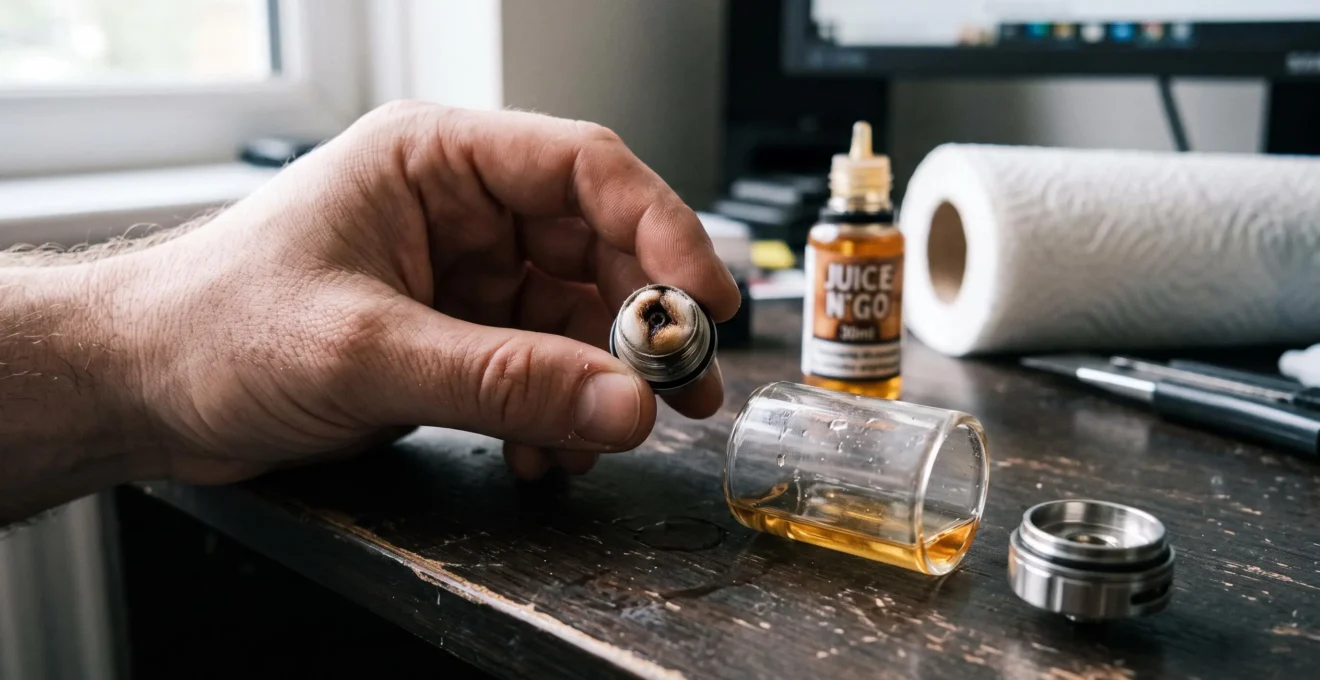
A vape tank can still contain plenty of e-liquid while its coil produces a harsh, burnt-tasting puff. The reason is that liquid inside the tank is not necessarily reaching the heated wick fast enough. A dry hit occurs when the heating element vaporizes the liquid available near it faster than the cotton can replace that liquid.
This imbalance can develop even with a full tank. Thick e-liquid, obstructed liquid-feed ports, compressed cotton, high wattage or closely spaced puffs can interrupt the supply. Sometimes the wick looks wet from the outside while the cotton closest to the heating element is already overheating.
The distinction matters because not every dry hit requires a new coil. An insufficiently saturated but undamaged wick may recover after the underlying problem is corrected. Cotton that has been scorched, however, may continue producing an unpleasant taste regardless of how much liquid remains in the tank.
Understanding how e-liquid moves from the reservoir to the heating element makes it easier to identify the cause, avoid additional overheating and decide whether the coil is still usable.
Why a filled vape tank can still produce dry hits
- Liquid level is not wick saturation: the coil can run dry when liquid-feed ports are exposed, obstructed or unable to replenish the cotton quickly enough.
- Power and liquid delivery must stay balanced: higher wattage, thick e-liquid and repeated puffs can make vaporization outpace capillary flow.
- Recovery depends on wick condition: stop after a dry hit, allow the coil to re-saturate and replace it if a persistent burnt taste indicates damage.
- Why Can the Wick Run Dry While E-Liquid Is Still Visible in the Tank?
- Why Can a Saturated-Looking Wick Still Produce a Dry Hit?
- Which Viscosity Mismatches Cause Flooding or Dry Hits in a Vape Tank?
- High Wattage or Poor Wicking: Which Is More Likely to Cause Your Dry Hits?
- How Can You Maintain Proper Wick Saturation Without Flooding the Coil?
- How Can You Restore Wick Saturation After a Dry Hit Without Immediately Replacing the Coil?
- Which Mistakes Can Turn One Dry Hit Into Permanent Wick Damage?
- When Should You Replace a Coil After Repeated Dry Hits?
Why Can the Wick Run Dry While E-Liquid Is Still Visible in the Tank?
A wick can run dry while e-liquid remains visible because the reservoir and the cotton surrounding the heating element are separate parts of the liquid-delivery system. If liquid cannot reach the feed ports, or capillary flow cannot replace liquid as quickly as it evaporates, the heating element may overheat despite the tank appearing adequately filled.
Most conventional replaceable-coil tanks depend on capillary action. E-liquid enters the coil through openings in its housing, soaks into the cotton and travels toward the heating wire or mesh. As liquid vaporizes, additional liquid must move into the spaces it leaves behind.
The tank’s fill level indicates how much liquid is available in the reservoir, not how much is present at the hottest part of the coil.
When the liquid level falls below the coil’s feeding openings, the remaining e-liquid may no longer make consistent contact with the wick. This is particularly relevant to tanks where liquid remains trapped in lower recesses or around the base. Tilting the tank briefly may restore contact, but it does not increase the volume of usable liquid or resolve an underlying feeding problem.
Even when the feed ports are submerged, several restrictions can interrupt delivery:
- Overpacked cotton: tightly compressed fibres can restrict liquid movement through the wick.
- Insufficient cotton contact: loosely packed material may leave gaps between the heating surface and the saturated fibres.
- Obstructed feed openings: deposits or poorly positioned cotton can limit liquid entry.
- Viscous e-liquid: thicker formulations may move too slowly through narrow openings or dense cotton.
- Aged wick material: accumulated residue can interfere with the cotton’s original feeding characteristics.
Chain vaping adds a time-dependent problem. Each puff removes liquid from the cotton, while capillary replenishment continues between puffs. If the interval becomes too short, the wick can develop a temporary shortage even though its feeding system functions normally during slower use.
The practical issue is therefore the relationship between liquid consumption and liquid replacement. A tank may have enough e-liquid for many additional puffs but still be unable to supply the coil at the rate demanded by the current settings.
Once external liquid supply is confirmed, the next question is whether the cotton is actually saturated where it touches the heating element.
Why Can a Saturated-Looking Wick Still Produce a Dry Hit?
A wick can look wet while producing a dry hit because its visible surface does not reveal the liquid distribution inside the cotton. Internal dry areas, uneven contact with the heating element or deposits that restrict capillary movement can leave the hottest part of the coil under-supplied even when the outer fibres appear saturated.
Cotton is not a uniform liquid reservoir. Its fibres form interconnected pathways through which e-liquid moves. The effectiveness of those pathways depends on fibre density, contact pressure, cleanliness and the physical arrangement of the wick.
In a rebuildable atomizer, for example, cotton that has been pulled too tightly through the heating coil may compress around the centre. Its exposed ends can look wet while liquid moves inefficiently toward the area under greatest thermal demand.
The opposite arrangement can also cause problems. If the cotton does not maintain consistent contact with the heating element, some areas may heat with less liquid available to absorb energy.
Dark cotton is not necessarily saturated cotton. Sweetened e-liquids can leave deposits on the heating surface and wick. The resulting staining may resemble accumulated liquid, but colour alone cannot establish whether the fibres are transporting fresh e-liquid effectively.
A useful initial assessment combines several observations:
- Check whether accessible cotton appears evenly moist, without isolated pale or scorched patches.
- Look for visible deposits around the heating element or feed openings.
- Allow the tank to rest and assess whether symptoms improve when liquid has time to redistribute.
- Compare the first puff after a rest period with later puffs taken at similar settings.
A gentle draw without activating the device may reveal obvious airflow obstruction or gurgling. However, an unpowered draw cannot reliably prove that the centre of the wick is saturated. Likewise, liquid dripping from an exposed coil after resting is not a universal saturation test: coil designs vary, and dripping can simply indicate excess liquid.
Do not energize an exposed or improperly installed coil to investigate its condition. Any inspection or reassembly should follow the device manufacturer’s instructions.
If dry hits occur immediately after a correctly primed coil is installed, unusual wick packing, poor internal contact or a defective coil assembly becomes more plausible. If they develop progressively, residue accumulation and declining liquid transport are more likely explanations.
Before concluding that the coil itself is responsible, consider whether the e-liquid’s viscosity matches the feeding system.
Which Viscosity Mismatches Cause Flooding or Dry Hits in a Vape Tank?
Viscosity mismatches cause problems when an e-liquid flows either too slowly or too readily for the coil’s feeding design. A high-VG liquid may struggle to replenish narrow or densely packed wicks, causing dry hits. A thinner, high-PG liquid may enter some coils faster than it is vaporized, contributing to flooding, gurgling or spitback.
Vegetable glycerin (VG) and propylene glycol (PG) are common base ingredients in e-liquids. VG is generally more viscous, while PG is less viscous. Their relative proportions influence how readily a liquid moves through the cotton, but the complete formulation also matters.
There is no universal VG/PG ratio that guarantees freedom from dry hits or flooding. Feed-port dimensions, cotton density, coil geometry, operating power and temperature can all change the result.
The following comparison describes likely tendencies rather than absolute compatibility rules.
| Coil or tank configuration | Thicker, higher-VG liquid | Thinner, higher-PG liquid |
|---|---|---|
| Small coil with narrow feeding openings | May replenish the wick slowly, especially during frequent puffs | May feed readily but can contribute to flooding if delivery exceeds vaporization |
| Coil with larger liquid-feed windows | Generally better positioned to accommodate thicker liquids, depending on wick construction | May require attention to leakage or excess liquid accumulation |
| Mesh heating element with substantial wick contact | Can work with thicker liquids when feed openings and cotton are appropriately designed | Performance depends on the amount of liquid delivered relative to heating demand |
| Restricted-flow, low-power tank | Can experience poor feeding if the liquid is too viscous for its small wick | Often accommodates relatively fluid formulations, subject to manufacturer guidance |
Mesh does not automatically eliminate dry hits. Although the geometry may distribute heat over a broader surface, the wick still needs sufficient liquid throughout that contact area.
Changing e-liquid can introduce another complication. A coil previously used with a sweetened or heavily depositing formulation may not behave like a clean coil, even if the replacement liquid is theoretically compatible. Existing residue can restrict liquid movement or retain unwanted flavours.
Ambient temperature also affects the balance. E-liquid generally becomes more viscous as it gets colder, making feeding more difficult in some devices. Warmer liquid flows more readily, potentially changing the tendency toward leakage or flooding.
This does not mean a tank should be deliberately heated or left in direct sunlight. Excessive heat introduces additional device, battery and liquid-storage risks. Use the product within its recommended storage and operating conditions.
When evaluating a viscosity mismatch, check the manufacturer’s recommendations before changing formulations. Also distinguish actual flooding from condensation in the airflow passage, which can produce similar gurgling or moisture symptoms without excessive wick feeding.
Even a compatible e-liquid can produce dry hits when the heating rate exceeds the amount that the wick can deliver.
High Wattage or Poor Wicking: Which Is More Likely to Cause Your Dry Hits?
High wattage is a likely contributor when dry hits appear primarily at stronger settings or during repeated puffs. Poor wicking is more likely when harsh, dry puffs occur even at conservative power after sufficient rest and correct priming. The causes often overlap because increasing wattage raises liquid demand and exposes weaknesses in the wick’s supply capacity.
Electrical power controls the energy delivered to the heating element. Within an atomizer’s effective vaporization range, increasing power generally increases e-liquid consumption. The cotton must supply the additional liquid to prevent overheating.
An experimental study of coil power and e-liquid consumption, published in 2018, evaluated 13 commercial atomizers. The researchers identified operating regimes involving insufficient heating, effective vaporization and overheating. Their findings illustrate why simply adding power does not always produce proportionally more vapor.
Once the available liquid cannot support further vaporization, additional energy may contribute to overheating instead.
13 atomizer models
The 2018 experimental investigation examined liquid consumption across 13 commercial atomizer models and found that their operating characteristics differed. Its device-specific results do not establish a universal wattage limit.
Soulet et al., International Journal of Environmental Research and Public Health, 2018.
The manufacturer’s rated wattage range is therefore a useful starting reference. Operating near its upper end can place greater demand on liquid replenishment, even when the setting is technically within the advertised range.
To distinguish the most likely causes, compare symptoms under controlled conditions without deliberately provoking additional burnt puffs.
| Observed behaviour | More likely cause | What to check |
|---|---|---|
| Harshness appears mainly at higher wattage | Power exceeds the current liquid-delivery capacity | Reduce power within the recommended range and allow the wick to recover |
| First puff is normal, subsequent puffs become dry | Liquid replenishment cannot keep pace | Puff intervals, liquid viscosity and feed openings |
| Burnt taste persists after resting at conservative power | Wick obstruction, scorching or another coil fault | Coil condition and correct priming |
| A new coil performs poorly immediately | Insufficient priming, inconsistent wick packing or faulty hardware | Installation, saturation and device compatibility |
| Dry hits begin after changing device settings | Power delivery or control-mode configuration | Wattage curve, preheat and temperature-control settings |
Some devices use aggressive preheat functions or customizable power curves that briefly deliver more energy than expected. Temperature-control modes can also behave incorrectly if the coil material or configuration is incompatible with the selected mode.
These settings deserve attention when symptoms begin immediately after a configuration change. Temperature control should not be treated as universal protection against insufficient liquid supply.
A PLOS ONE systematic review of vaping device design and aerosol toxicants reported that operating conditions influence aerosol composition. Inadequate liquid availability and excessive heating can be associated with increased concentrations of potentially harmful compounds.
Consequently, dry hits are more than a flavour-quality issue. Repeatedly activating an insufficiently saturated wick is not an appropriate diagnostic method.
When power settings are appropriate, preventing future dry hits depends on maintaining saturation without introducing so much liquid that the coil floods.
How Can You Maintain Proper Wick Saturation Without Flooding the Coil?
Proper wick saturation requires enough e-liquid to reach the heating surface consistently without accumulating faster than the coil can vaporize it. Prime a new coil according to its manufacturer’s instructions, allow time for absorption, start with conservative power settings and avoid excessively frequent puffs. Preventing dry hits and flooding depends on balancing liquid delivery with consumption.
Priming is particularly important because new coil cotton does not necessarily become fully saturated as soon as the tank is filled. Liquid needs time to penetrate the feeding openings and reach the fibres surrounding the heating element.
For compatible replaceable coils with accessible cotton, the general sequence is to:
- Confirm that the coil is compatible with the tank and that the e-liquid matches the manufacturer’s recommendations.
- Apply a small amount of e-liquid to accessible cotton feeding openings where the manufacturer explicitly recommends manual priming.
- Install the coil correctly, fill the tank without exceeding its intended capacity and avoid adding liquid into the central airflow passage.
- Allow the filled tank to stand for the saturation period specified for that coil.
- Begin at the lower end of the coil’s recommended power range, increasing gradually only if performance remains normal.
These steps serve different purposes. Direct priming, where appropriate, wets the exposed fibres. Filling the tank establishes the continuing liquid supply. The resting period allows liquid to penetrate internal wick pathways. Gradual power adjustment limits initial demand while the coil’s feeding performance becomes apparent.
Innokin’s coil troubleshooting instructions recommend priming compatible coils, allowing time for saturation and increasing power gradually from the lower end of the stated range. Its guidance includes a waiting period of at least 15 minutes for the coils covered by that advice; this is not a universal requirement for every product.
More liquid is not always better. Excessive priming can allow e-liquid to collect in the central airflow channel, leading to gurgling, leakage or droplets reaching the mouthpiece. If a coil is already flooded, adding more liquid may worsen the condition rather than improve saturation.
During normal use, leave enough time between puffs for the wick to replenish. As the liquid level approaches the feed openings, refill the tank before those openings become uncovered. A temporary change in orientation may restore contact in some designs, but it is not a substitute for maintaining the intended fill level.
Temperature-control and anti-dry-hit features can provide additional protection on compatible devices. They may help limit overheating under supported operating conditions, but they cannot correct obstructed feed ports, poorly installed cotton or an already damaged wick.
For consistent performance, treat puffing rhythm, wattage and e-liquid compatibility as parts of the same system rather than adjusting them independently.
Five checks for maintaining reliable coil saturation
- Confirm coil compatibility: identify the installed coil model and record the manufacturer’s specified operating range.
- Check liquid suitability: compare the e-liquid’s stated VG/PG formulation with the product guidance and note any potential mismatch.
- Verify correct priming: follow the coil’s installation and saturation instructions, completing the manufacturer’s required preparation before use.
- Review power and puff intervals: record the selected wattage and whether dry hits follow closely spaced puffs, without intentionally repeating a dry hit.
- Inspect the feeding system: check the visible liquid level, accessible feed openings and signs of flooding or deposits, recording any obstruction or persistent symptom.
If a dry hit has already occurred, however, the immediate priority changes from prevention to determining whether the cotton can recover without additional heating.
How Can You Restore Wick Saturation After a Dry Hit Without Immediately Replacing the Coil?
After a dry hit, stop activating the device and allow the coil to cool. Check that sufficient compatible e-liquid can reach the wick, then give the cotton time to absorb it. If there is no indication of scorching and the manufacturer permits reuse, cautious operation at conservative settings may be possible. Persistent burnt flavour calls for replacement.
The first response should be to stop vaping rather than take another puff to determine whether the problem has disappeared. A dry hit indicates that adequate liquid was not available at the heated surface under those conditions.
Continuing immediately can expose already stressed cotton to additional overheating.
A practical recovery sequence for a conventional replaceable-coil tank is:
- Stop activating the coil. Turn off or lock the device as appropriate and allow the atomizer to cool.
- Check liquid availability. Confirm that the tank contains enough compatible e-liquid and that the feeding openings are not exposed or visibly blocked.
- Allow time for re-saturation. With the tank properly assembled, let the wick rest for the period appropriate to its construction and the manufacturer’s instructions.
- Inspect for damage. Where the design allows safe inspection, check accessible cotton for clear signs of scorching or heavy deposits.
- Reassess operation only if appropriate. If no burnt smell or visible damage remains and the coil is correctly saturated, use the manufacturer’s recommended conservative settings. Stop if any burnt taste returns.
An unpowered draw is sometimes used to move liquid through a tank’s wick system. However, it is not a validated method for proving complete internal saturation and can contribute to flooding in some devices. It should not replace proper priming or the manufacturer’s procedures.
A dry hit on a newly installed coil may result from incomplete priming or insufficient resting time. If the cotton has not been scorched, following the complete priming procedure may restore normal liquid delivery. A new coil can also have manufacturing or installation defects, so inadequate priming should not be assumed to be the only possible cause.
Reapplication of e-liquid directly to the wick is appropriate only where the coil design and manufacturer allow it. Sealed pods or inaccessible coil assemblies should not be dismantled or modified simply to perform manual priming.
Recovery is not the same as reversing thermal damage. Re-saturation can correct a temporary shortage of liquid, but it cannot reliably restore cotton that has been visibly scorched.
Blackened patches, a continuing burnt smell or a persistent burnt taste after correct saturation suggest that the coil should be replaced. A metallic or otherwise unusual taste also warrants stopping use and checking the coil, its installation and the device rather than continuing to test it.
Even if vapour production appears to return to normal, this does not establish that a previously overheated wick is undamaged. Visible vapour alone is an insufficient condition check.
If the symptoms persist, avoid attempting to restore performance through stronger heating or excessive liquid application, as these responses can create additional problems.
Which Mistakes Can Turn One Dry Hit Into Permanent Wick Damage?
A single dry hit does not necessarily destroy a coil, but continuing to fire an under-saturated wick can turn a temporary liquid shortage into lasting damage. Repeated overheating may scorch cotton, leave deposits and impair liquid transport. Increasing wattage, ignoring burnt flavour or activating the coil before it has re-saturated can make the original problem worse.
The most damaging mistake is interpreting a dry hit as a temporary flavour problem that can be overcome by taking another, stronger puff.
When the cotton contains insufficient liquid, less energy is used for vaporization. Temperatures at the heating surface may rise, increasing the risk of scorching material in direct contact with the wire or mesh.
Further activation can therefore create a cycle: poor saturation contributes to overheating, overheating degrades the wick, and the degraded wick becomes less effective at transporting fresh liquid.
Several common reactions increase this risk:
- Continuing through a burnt taste: repeated activation can worsen overheating while the cause remains unresolved.
- Increasing wattage: greater energy input does not repair insufficient liquid transport.
- Restarting too quickly: the wick may not have had enough time to replenish after the previous puff.
- Adding excessive liquid: flooding the coil may temporarily change the taste or vapour behaviour without repairing a damaged area.
- Applying liquid while the coil is hot: this can create avoidable handling and leakage risks and is not a substitute for cooling and proper priming.
Immersing an unsuitable coil assembly in liquid, reversing the filling process or forcing e-liquid through its airflow channel can introduce flooding and conceal the original problem. These methods should not be used as improvised repairs.
Residue and thermal damage also need to be distinguished. Sweetened-liquid deposits may darken a wick over time without proving that all of its fibres have been carbonized. Conversely, a wick can have damaged regions that are not visible through the coil’s exterior feeding windows.
The critical indicator is the combination of symptoms and condition: persistent burnt taste, visible local scorching and recurring dry hits after the correct supply conditions have been restored.
A damaged wick may no longer distribute liquid normally, even when part of its surface remains wet. Further heating is unlikely to restore the original cotton structure.
One overheating incident does not prove irreversible damage, and the exact temperature or duration needed to scorch a particular wick depends on its construction and operating conditions. Nevertheless, a persistent burnt flavour is sufficient reason to stop using the coil rather than attempt further high-power testing.
When rest, appropriate power and correct liquid supply no longer restore normal performance, replacement is the more reasonable option.
Key takeaways before replacing a coil
- Correct the external cause first: a replacement coil will experience similar dry hits if the same liquid, power or feeding restriction remains.
- Treat persistent burnt flavour as a warning: renewed vapour production does not prove that overheated cotton has recovered.
- Look for recurring patterns: the relationship between dry hits, coil age, liquid formulation and wattage can reveal whether the problem is wear or unsuitable operating conditions.
When Should You Replace a Coil After Repeated Dry Hits?
Replace a coil when dry hits persist despite correct priming, compatible e-liquid, sufficient liquid supply and appropriate power settings. A continuing burnt taste, visibly scorched cotton, declining vapour production or recurring poor flavour are additional warning signs. If overheating has damaged the wick, adding liquid or lowering wattage will not reliably restore normal performance.
Replacement decisions should consider more than a single unpleasant puff. A brief shortage caused by an unusually long or closely spaced draw is different from a coil that produces dry, harsh vapour under otherwise normal conditions.
Before discarding a coil that has no clear signs of scorching, review the conditions surrounding the problem:
- Liquid supply: are the wick feeding openings submerged and unobstructed?
- Formulation: is the e-liquid compatible with the coil’s intended feeding characteristics?
- Power: is the device operating within the manufacturer’s recommended settings?
- Priming: was the coil given enough time to saturate before use?
- Condition: is there persistent burnt flavour, visible scorching, heavy residue or worsening vapour output?
If the first four conditions are correct but the fifth remains problematic, replacement becomes increasingly justified.
Where the manufacturer permits changing liquid with the same coil, a compatible formulation may help identify whether viscosity contributed to the original problem. However, repeatedly testing a coil with suspected thermal damage is not necessary and can expose it to further overheating.
Similarly, cleaning accessible tank components according to the manufacturer’s instructions may resolve an external blockage. It does not necessarily repair degraded cotton inside a sealed replaceable coil.
Repeated dry hits can also place thermal stress on other atomizer components, including the heating element and nearby insulating materials. However, a specific amount of metal, mesh or seal degradation cannot be inferred from the number of dry hits alone. Unusual resistance readings, electrical faults or visible hardware damage require stopping use and checking the manufacturer’s instructions.
Coil performance often changes gradually. Accumulated deposits may affect flavour and vapour production before a pronounced dry hit occurs. The useful replacement threshold is therefore based on reliable operation and visible condition, not a universal number of days or tank refills.
For example, Innokin Go-Z coil maintenance and troubleshooting instructions recommend replacing the coil when flavour quality deteriorates and vapour density decreases. The manufacturer also notes that added sweeteners may increase replacement frequency. These are product-specific maintenance indicators rather than a universal coil lifespan.
A short troubleshooting record can help distinguish premature failure from a repeated mismatch. Note the coil model, e-liquid formulation, selected wattage, approximate duration of use and circumstances surrounding each dry hit.
Patterns are more useful than isolated impressions. Dry hits appearing with the same thick liquid across multiple new coils may suggest a compatibility problem. A coil that initially performs normally but later develops persistent burnt flavour and declining vapour output is more consistent with progressive wear or contamination.
When replacing the coil, also inspect the tank for liquid-feed obstructions and follow the replacement coil’s full priming procedure. Otherwise, the new cotton may encounter the same conditions that caused the previous failure.
The next practical step is to verify liquid compatibility, correct the power settings and install a properly primed replacement if the old coil remains burnt or unreliable. Do not continue using a coil that repeatedly produces dry hits after these checks.
Can a vape produce a dry hit with a completely full tank?
Yes. A full tank does not guarantee that liquid reaches the heating surface. Thick e-liquid, blocked feeding openings, compressed cotton or insufficient priming can restrict delivery. High power may also consume liquid faster than the wick can replace it, creating dry-hit conditions without reducing the tank’s visible liquid level very much.
Does leaving a vape tank overnight always fix a dry wick?
No. Additional resting time can allow an undamaged wick to absorb liquid if the feeding pathway is open. It cannot reliably reverse scorched cotton, severe residue accumulation or a structural obstruction. If burnt flavour persists after proper saturation, replacement is generally more appropriate than further testing.
Why does a dry hit happen more often when the tank is nearly empty?
As the liquid level falls, the coil’s feeding openings may become partially exposed, interrupting consistent contact with e-liquid. The remaining liquid can still be visible in the tank while the wick receives too little. Refilling before the feed openings become exposed can help prevent this problem.
Can airflow settings affect dry hits even when wattage stays the same?
Airflow can influence the temperature and operating behaviour of an atomizer. Restricting airflow may reduce cooling under some conditions, while draw duration and intensity can change liquid consumption. The effect depends on device design, so airflow should be adjusted within the manufacturer’s recommendations rather than treated as a substitute for adequate wick saturation.
Does normal vapour production mean a coil has recovered from a dry hit?
Not necessarily. A coil may still generate vapour after some cotton has been scorched or contaminated. Persistent burnt flavour, unusual smell, visible wick damage or recurring harsh puffs are more important warning signs than vapour volume alone. Stop using the coil if these symptoms continue.