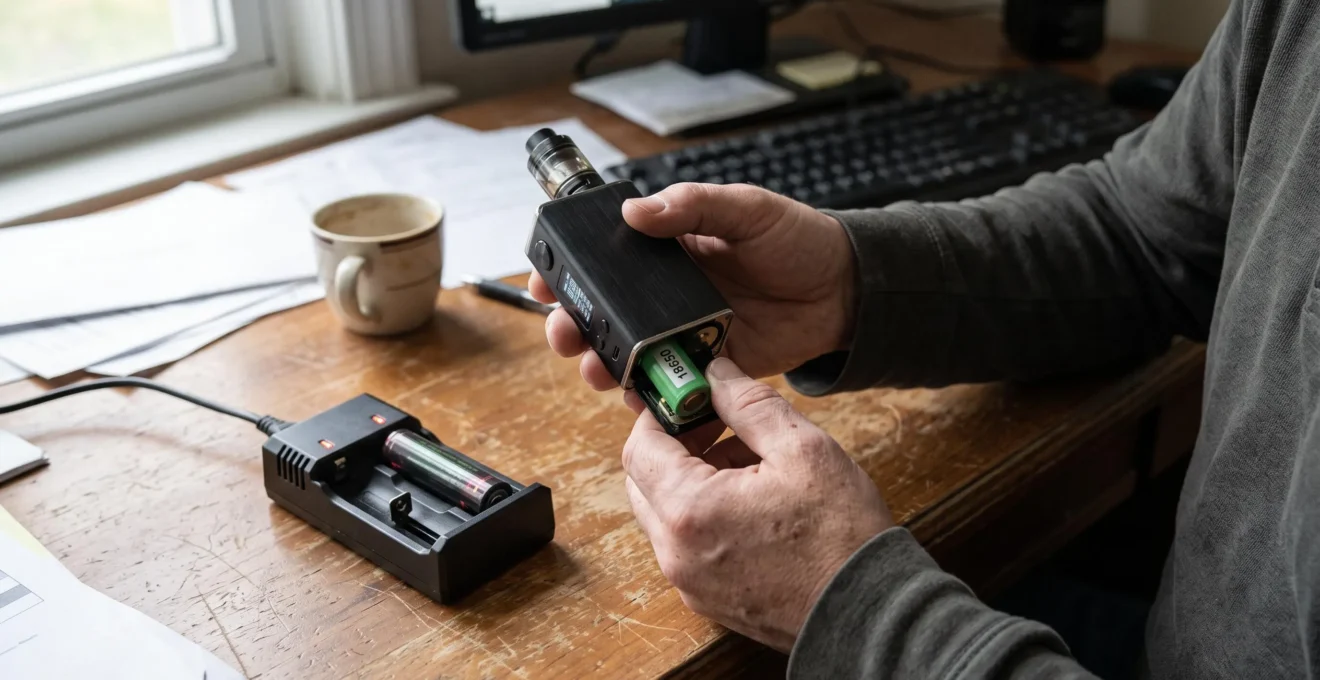
Battery efficiency can extend the practical runtime of a regulated vape device by reducing the energy lost between the battery and the heating coil. A battery’s milliamp-hour rating matters, but it cannot independently predict how many puffs a device will deliver before requiring another charge.
Every regulated device manages a changing electrical supply. Its control chip converts battery voltage into the voltage required by the selected wattage, while the screen, control electronics and standby circuitry consume additional energy. Higher power settings increase energy demand, and ageing cells may provide less usable energy even when their original capacity rating remains unchanged.
Understanding these relationships makes battery runtime easier to estimate and troubleshoot. Instead of assuming that a larger battery is always necessary, users can compare stored energy with actual power demand, identify avoidable electrical losses and determine when a modest settings adjustment is worthwhile. The objective is not to extract every possible watt-hour from a cell, but to achieve predictable runtime while respecting the device’s operating limits and battery safety requirements.
What determines real vape battery runtime?
- Stored energy matters more than mAh alone: watt-hours provide a better starting point for comparing batteries and configurations.
- Power demand controls consumption: higher wattage, longer puffs and conversion losses reduce the number of puffs available per charge.
- Efficiency and battery condition matter: voltage regulation, ageing, electrical contacts and operating temperature influence how much stored energy remains usable.
- How Does Battery Capacity Translate Into Real Vape Runtime?
- Why Does Vape Battery Runtime Drop Quickly at Higher Wattage?
- How Does a Vape Chip Adjust Voltage to Hold the Same Wattage?
- Which Hardware Problems Can Reduce Vape Battery Efficiency?
- How Can You Estimate Whether a Vape Battery Will Last Through Your Daily Routine?
- How Can You Improve Vape Battery Runtime Without Changing the Battery?
- Bigger Battery or Lower Power Demand: Which Improves Vape Runtime More?
- When Should You Lower Vape Power to Prioritise Battery Runtime?
How Does Battery Capacity Translate Into Real Vape Runtime?
Battery capacity translates into vape runtime through the amount of electrical energy available and the rate at which the device consumes it. Milliamp-hours describe charge capacity, not directly usable energy. To estimate runtime, convert battery capacity into watt-hours, account for power-conversion losses and compare the result with the energy required by the user’s actual puffing pattern.
A battery’s nominal capacity is usually expressed in milliamp-hours (mAh). This indicates the electrical charge a cell can deliver under specified test conditions. It does not state how efficiently a particular vape device will use that charge or how much energy remains available at high discharge currents.
For a straightforward estimate, multiply the battery’s rated ampere-hour capacity by its nominal voltage:
Stored energy (Wh) ≈ Capacity (mAh) × Nominal voltage (V) ÷ 1,000.
This calculation is a starting point rather than a measurement of the energy delivered to the coil. Real operation introduces conversion losses, voltage sag, operating limits and additional electrical loads.
Consider a purely hypothetical battery rated at 3,000 mAh with a nominal voltage of 3.6 V. Its nominal stored energy would be approximately 10.8 Wh. If a hypothetical regulated circuit delivered 85% of that energy to the heating element, around 9.18 Wh would reach the coil. Neither figure establishes the actual runtime of a commercial device.
The distinction becomes especially important when comparing battery configurations. Two devices can use cells with the same mAh rating but store different total amounts of energy. A two-cell series arrangement increases pack voltage while retaining the series string’s ampere-hour capacity; a parallel arrangement increases the combined ampere-hour capacity while retaining the cell voltage. With equivalent cells, both arrangements can provide greater total energy than a single cell, although their electrical behaviour and device requirements differ.
Watt-hours are therefore more informative than mAh when comparing complete battery systems. The comparison must still account for converter efficiency, current limits and the manufacturer’s specified usable operating range.
Rated capacity also changes with age. Lithium-ion batteries gradually lose usable capacity through operation and storage. The National Renewable Energy Laboratory research on battery lifespan identifies temperature, charge and discharge rates, operating conditions and cycling patterns as factors influencing degradation.
A device that once lasted through a full routine may consequently require earlier charging even when its wattage settings and usage habits remain similar. There is no universal annual percentage of capacity loss applicable to every vape battery.
Once the battery’s available energy is understood, the next variable is how quickly the device consumes that energy at different wattage settings.
Why Does Vape Battery Runtime Drop Quickly at Higher Wattage?
Vape battery runtime falls at higher wattage because the heating coil consumes more energy during every second of activation. Doubling output power approximately doubles coil energy consumption for an equally long puff. Actual runtime may fall even faster or slower because conversion efficiency, battery voltage sag, puff duration and usage frequency also change with power settings.
The relationship follows a basic electrical principle: energy equals power multiplied by time. A device operating at higher wattage draws more energy for each second that its heating element remains active.
For example, in a hypothetical comparison involving identical three-second puffs, a 20 W output consumes 60 joules at the coil, while a 40 W output consumes 120 joules. The higher setting requires twice as much output energy per puff before any conversion losses are considered.
This does not automatically mean that the battery delivers precisely half as many puffs. A user may shorten puffs at higher power, take fewer puffs over the day or change their usage pattern in response to increased vapour production. Conversely, frequent long puffs at high wattage can accelerate energy consumption considerably.
The regulated circuit adds another variable. Because battery voltage and required coil voltage are not always equal, the control electronics must convert electrical power. Some input energy is dissipated as heat during this process.
Conversion efficiency varies with circuit architecture and operating conditions. Higher current can increase resistive losses, while demanding voltage-conversion ratios can introduce additional switching and conduction losses. However, an extreme wattage setting is not necessarily the least efficient operating point of every device.
Coil resistance also matters. The electrical relationship between output power, voltage and resistance determines what the converter must deliver. At a fixed wattage, a lower-resistance coil requires higher output current and lower output voltage than a higher-resistance coil. Depending on the converter, this can affect its operating efficiency and proximity to current limits.
A larger tank does not inherently improve battery efficiency. Tank volume affects e-liquid storage, not the basic electrical energy required for a puff. Similarly, taking a longer drag at high wattage increases energy use unless the power or another operating variable changes sufficiently to offset it.
Power per puff and total daily puff duration should therefore be considered together. Neither wattage nor puff count alone fully describes battery demand.
Even with steady puff duration, the circuit’s method of maintaining the selected wattage determines how efficiently battery energy reaches the coil.
How Does a Vape Chip Adjust Voltage to Hold the Same Wattage?
A regulated vape chip maintains selected output power by adjusting the voltage delivered to the coil as electrical conditions change. It monitors relevant operating parameters and controls a power-conversion circuit to approach the requested wattage. As battery voltage falls, the circuit may increase the voltage-conversion ratio, draw more battery current or eventually reduce output or stop operation.
Unlike a simple direct-battery arrangement, a regulated device does not necessarily expose the heating element directly to the battery’s instantaneous voltage. Its control electronics manage the output according to the selected operating mode, coil resistance and available electrical supply.
Two conversion functions help explain the process. A buck regulator reduces voltage when a lower output is required. A boost regulator raises voltage when the necessary output exceeds the available input. A buck-boost system can manage both situations within its design limits.
Analog Devices‘ technical explanation of buck-boost regulators describes how these circuits can maintain a controlled output as a lithium-ion battery’s voltage changes during discharge.
For a regulated vape, this means that the selected power can remain relatively consistent through much of a discharge cycle. A user may therefore experience similar coil heating at different indicated battery charge levels, provided the circuit has enough input voltage and current to maintain regulation.
Maintaining output power does not mean that battery demand remains unchanged. As input voltage decreases, the battery current necessary to supply a given output power generally increases, assuming comparable efficiency. Greater current can produce additional internal losses and voltage sag.
Engineering example: regulated heating-element power conversion
Texas Instruments documents a two-cell battery-powered heating-element reference design intended for applications including electronic cigarettes. Its synchronous four-switch buck-boost circuit uses an LM5175 controller and supports adjustable output voltage.
The design specifies an input range of 6 V to 8.6 V, an adjustable output range of 1 V to 10 V and efficiency above 90% under its specified operating conditions, with a reported peak of 98%. These specifications demonstrate the capabilities of that particular engineering design, not the measured performance of commercial vape devices generally.
The reference design illustrates why efficient voltage conversion can preserve more usable battery energy. It does not establish a universal efficiency percentage, and its operating characteristics should not be assumed for unrelated devices.
Regulation also has a lower operating boundary. Once battery voltage falls below the circuit’s acceptable range, or the available battery current can no longer support the demand, the device may display a low-battery warning, limit power or shut down.
Not all nominally stored energy remains accessible at the selected power level. The remaining battery charge may be unusable under a demanding load even though the cell is not completely depleted.
When runtime becomes unexpectedly short, it is therefore important to distinguish normal power-management behaviour from additional losses caused by battery or hardware deterioration.
Which Hardware Problems Can Reduce Vape Battery Efficiency?
Hardware problems can shorten vape runtime by increasing electrical resistance, reducing usable battery capacity or interrupting normal power delivery. Ageing lithium-ion cells, damaged battery contacts, worn connectors and defective atomiser assemblies can contribute to inconsistent performance. However, a shorter runtime does not prove that a specific component is faulty; settings, usage patterns and battery condition must be assessed together.
An ageing cell can develop greater internal resistance while losing capacity. Under load, increased internal resistance contributes to voltage sag and heat generation. A regulated device may consequently reach its voltage or current limits earlier, particularly at higher wattage.
The battery compartment is another potential source of trouble. Contaminated or mechanically damaged contacts may introduce unwanted resistance or intermittent electrical connections. Removable-cell devices can be particularly sensitive to contact condition, fit and the integrity of battery insulation.
The atomiser connection deserves attention as well. A dirty or worn 510 connection can cause unstable resistance readings or unreliable power delivery. The specific effects depend on the device’s protection features and circuit design, so increased consumption should not automatically be attributed to every visible contact defect.
Coil deterioration can complicate diagnosis. Deposits, damaged heating elements and poor electrical contact may change heating behaviour or resistance readings. A degraded coil does not inherently force a properly functioning wattage-regulated device to consume more energy at exactly the same output wattage, but faults can change regulation, activation patterns or the user’s puff duration.
Temperature adds another layer. Heavy electrical loads generate heat, while exposure to hot surroundings can accelerate battery ageing. Charging a device that is still unusually hot after intensive use may create additional thermal stress. Manufacturer-specified charging conditions should take priority over convenience.
The FDA recommendations for avoiding vape battery fires and explosions advise using the batteries specified for the device, avoiding mismatched batteries and protecting equipment from extreme temperatures. These are safety precautions rather than quantified battery-runtime improvements.
For removable-battery devices, cell authenticity and compatibility are particularly important. Unverified capacity claims, incorrect cell specifications, damaged wrappers and unsuitable combinations of cells create potential performance and safety problems. Source replacement cells from reputable specialist vendors and follow the manufacturer’s exact requirements.
A simple comparison can help narrow down the cause of unexpectedly short runtime:
- If runtime has declined across several compatible atomisers and unchanged settings, investigate battery ageing and device condition.
- If the problem occurs only with one atomiser, examine its coil, electrical connection and resistance readings.
- If the problem occurs mainly at high wattage, consider increased battery demand, voltage sag and current limits.
- If the device becomes unusually hot, shows erratic readings or reports persistent errors, stop using it until the cause is established.
Only perform maintenance permitted by the manufacturer’s instructions. Turn the device off before inspecting accessible parts, keep electrical contacts dry and never attempt to repair damaged lithium-ion cells or bypass protective circuitry.
Once obvious hardware faults have been excluded, tracking the device’s real consumption provides a more useful basis for deciding whether the available battery energy matches daily demand.
How Can You Estimate Whether a Vape Battery Will Last Through Your Daily Routine?
To estimate whether a vape battery will cover a normal day, calculate its approximate stored energy and compare it with the energy required by your typical wattage, puff length and daily puff count. Allow for circuit losses and other electrical consumption. Then compare the estimate with observed charging patterns, because actual behaviour and operating limits can differ substantially from theoretical assumptions.
The most practical starting point is a short usage audit. Record the selected wattage, approximate number of puffs and typical activation duration. These measurements describe the energy delivered to the coil more accurately than a daily puff count alone.
A useful calculation is:
Daily coil energy (Wh) ≈ Wattage × Seconds per puff × Daily puffs ÷ 3,600.
To approximate the energy required from the battery, divide the calculated coil energy by an assumed overall delivery efficiency expressed as a decimal. This remains a simplified model because actual efficiency and auxiliary electrical consumption vary.
Consider a hypothetical user taking 200 three-second puffs daily at 20 W. The calculated coil energy is approximately 3.33 Wh. If the assumed energy-delivery efficiency is 85%, the estimated battery energy required for coil heating becomes approximately 3.92 Wh, before any additional standby or display consumption omitted from that assumption.
This is an illustrative calculation, not a measured consumption rate or guaranteed puff count. Real users vary their puff duration, and the device’s actual conversion efficiency may not be known.
Usage patterns affect how reliable the estimate will be. Short puffs distributed throughout the day allow intervals between high-current loads, while concentrated sessions can increase device temperature and activate protective limits in some designs. Screen activation and standby current may also differ between frequent brief sessions and prolonged periods of inactivity.
Rather than relying on calculation alone, compare battery indicators at consistent times over several ordinary days. Note the starting charge level, wattage, approximate activity and the point when recharging becomes necessary. A charge indicator may not track remaining energy linearly, but repeated observations can still reveal a useful pattern.
Five-step daily battery-runtime audit
- Record battery specifications. Note the manufacturer’s stated capacity, nominal voltage and approved configuration. Deliverable: a written approximate nominal energy value in Wh.
- Record normal usage. Note wattage, estimated daily puff count and typical puff duration. Deliverable: a daily usage baseline.
- Estimate energy demand. Calculate coil energy in Wh and identify any assumptions used for conversion losses. Deliverable: a labelled approximate daily energy requirement.
- Track real performance. Record starting charge indication, recharge times and comparable usage for several days. Deliverable: a short consumption log.
- Identify the limiting factor. Compare the estimate and observations, then note whether settings, charging access or hardware condition needs attention. Deliverable: one practical next action.
If the estimated demand exceeds available usable energy, the realistic choices are to recharge during the day, use manufacturer-approved replacement batteries or compatible charging equipment, or reduce energy consumption. A spare removable cell must be carried in a protective case rather than loose with metal objects. Portable power banks should only be used where the device manufacturer permits compatible USB charging.
Once the daily energy requirement is reasonably understood, modest reductions in power demand can be evaluated without immediately changing batteries or devices.
How Can You Improve Vape Battery Runtime Without Changing the Battery?
You can improve vape battery runtime without replacing the battery by reducing energy consumed per puff, limiting unnecessary activations and maintaining reliable electrical connections. Lower wattage, shorter puffs and sensible standby management can help. However, these adjustments cannot restore capacity lost through battery ageing, and their effectiveness depends on the device’s electrical design and the user’s actual behaviour.
The most direct adjustment is reducing wattage within the atomiser manufacturer’s recommended operating range. Lower power reduces coil energy consumption for an equally long activation. Whether it increases the number of satisfactory puffs depends on how puff duration and frequency respond to the change.
Shortening puff duration offers another way to reduce per-puff energy without changing the selected wattage. Reducing the number of activations affects total daily consumption. These are separate variables: wattage determines the rate of energy use during activation, duration determines energy per puff, and puff frequency determines how frequently that demand occurs.
These relationships make it useful to change one variable at a time rather than assuming that every low-power setting automatically improves practical battery life.
Standby consumption can matter as well. The screen, control electronics and sensors require energy while the device is not actively heating its coil. Their contribution depends on the specific hardware and firmware, so the savings from turning a device off between sessions cannot be assigned a universal percentage.
For devices with suitable power-off or locking functions, following the manufacturer’s instructions helps prevent unintended activation. Locking may prevent firing without eliminating standby consumption; complete shutdown and standby modes are not electrically identical.
Maintenance also supports consistent operation. Clean and correctly fitted components can reduce intermittent electrical problems, but cleaning should be limited to manufacturer-approved procedures. Contact maintenance is not a substitute for replacing a damaged connector or unsafe battery.
Charging and storage habits primarily protect future battery capacity rather than increase energy available from the current charge. Avoiding excessive heat, inappropriate charging conditions and prolonged storage in unsuitable environments can reduce avoidable degradation.
Nevertheless, users should not override built-in charging controls or deliberately manipulate cell voltage outside the manufacturer’s instructions. A regulated device’s battery-management system defines the appropriate charging and discharge boundaries.
It is also important to separate efficiency improvements from capacity recovery. A degraded cell cannot regain its original electrochemical capacity merely because the user lowers wattage, cleans contacts or changes charging habits.
If runtime has declined substantially despite unchanged settings and consistent operation, battery condition deserves investigation. For devices with sealed internal batteries, follow the manufacturer’s service or replacement guidance rather than attempting unsupported repairs.
When those adjustments are insufficient, the remaining choice is between accepting greater battery capacity and reducing the power required to sustain the preferred vaping routine.
Bigger Battery or Lower Power Demand: Which Improves Vape Runtime More?
A bigger battery and lower power demand can both extend vape runtime, but they solve different constraints. Additional usable battery energy increases the potential operating time without necessarily changing coil output. Lower wattage reduces energy consumed during activation and requires no new hardware. The better approach depends on device compatibility, preferred power settings, actual usage and the amount of extra runtime needed.
Under otherwise comparable conditions, increasing usable stored energy increases the energy budget available to the device. Reducing coil power decreases the rate at which that energy budget is spent during active use.
For example, a hypothetical 25% increase in usable energy could support approximately 25% more equal-energy puffs if device consumption and efficiency remained unchanged. Reducing coil wattage by 25% could reduce energy per equally long puff by approximately 25%, although conversion losses and user behaviour may change the overall result.
Halving power demand would approximately halve the coil energy required for each equal-duration puff. That could theoretically double the coil-energy-limited puff count if efficiency and other losses were unchanged. Such an outcome should not be treated as guaranteed real-world runtime performance.
The practical difference is that more capacity preserves the selected heating power, while less power changes how the coil operates.
The following comparison highlights the main trade-offs.
| Decision factor | More usable battery capacity | Lower power demand |
|---|---|---|
| Primary effect | Increases available stored energy | Reduces energy used during activation |
| Vaping experience | Can preserve existing wattage and coil behaviour | May change warmth, vapour production and flavour perception |
| Cost | May require approved replacement cells or another device | Usually requires no additional purchase |
| Portability | Higher-capacity systems may add size or weight | No additional hardware to carry |
| Electrical stress | Depends on cell specifications and configuration | Can reduce operating current and heat under comparable conditions |
| Main limitation | Battery and device compatibility | Coil operating range and preferred output |
A physically larger battery does not automatically provide better performance. Cell chemistry, rated capacity, discharge capability, manufacturer restrictions and device design all matter. Removable batteries must never be replaced with cells that merely appear to fit if their electrical specifications are unsuitable.
Users who want to preserve their existing settings may prefer a device designed with greater usable energy capacity or access to properly specified spare batteries. Users comfortable with a different heating profile can evaluate reduced wattage first.
Lower power can also reduce current demand and thermal stress under comparable operating conditions. Because temperature and discharge conditions influence battery ageing, lower-demand operation may support longer-term capacity retention. The magnitude of this benefit cannot be predicted without cell-specific information and usage measurements.
The most economical first step is often to determine whether a modest reduction in energy demand achieves sufficient runtime without compromising normal operation.
The final decision should be based on the occasions when battery endurance actually becomes limiting, rather than assuming every device needs the greatest possible capacity.
Key takeaways before adjusting your device
- Determine whether reduced runtime comes from daily energy demand, normal voltage limits or deteriorating hardware before changing settings.
- Use estimated watt-hours and observed charging patterns to establish how much additional endurance is genuinely necessary.
- Choose adjustments permitted by the coil and device specifications; safety and reliable operation take priority over extracting extra runtime.
When Should You Lower Vape Power to Prioritise Battery Runtime?
Lowering vape power makes sense when available battery energy is unlikely to cover the remaining period without charging and the atomiser supports a lower operating setting. Long outings, travel days and limited charging access are practical examples. The adjustment should be modest, remain within the coil manufacturer’s recommended range and preserve safe, predictable device operation.
The clearest reason to prioritise endurance is a predictable shortage of charging opportunities. If the normal daily audit indicates that the available charge will be insufficient, reducing energy consumed during activation may provide a useful margin.
A second situation is an ageing battery that still operates safely but no longer provides its previous capacity. Lowering power can reduce energy demand, although it cannot repair the cell or eliminate the need for replacement when deterioration becomes significant.
Long journeys and extended outings create a similar choice. The most practical solution may be a combination of a full charge before departure, approved charging arrangements and an appropriately reduced operating setting.
Power reduction should be approached as a controlled adjustment rather than an attempt to operate the coil at the lowest possible wattage.
Every coil has an intended operating range. Running substantially below that range can produce insufficient heating, muted flavour or changes in liquid vaporisation. Depending on atomiser design and usage, unsuitable settings may also contribute to poor performance or leaking.
Some users may find that slightly longer, slower puffs compensate for a modest reduction in heating power. However, longer activation increases the energy consumed per puff, so the runtime advantage depends on whether the reduction in wattage outweighs the increase in puff duration.
For instance, in a hypothetical comparison, reducing output from 30 W to 25 W while extending a three-second puff to four seconds would increase coil energy from 90 joules to 100 joules. Despite the lower displayed wattage, that particular puff would consume more energy.
This illustrates why lower wattage does not automatically mean lower daily consumption. Changes should be evaluated through actual usage rather than the displayed setting alone.
When battery endurance is the priority, use a straightforward decision sequence:
- Check the battery, contacts and atomiser for signs of damage or abnormal operation.
- Estimate the remaining energy requirement from typical puff duration, frequency and wattage.
- Determine whether approved charging access is available before the next expected recharge.
- If additional endurance is needed, consider a modest wattage reduction within the recommended coil range.
- Compare actual battery performance with the previous setting and retain the adjustment only if it provides a practical benefit.
If the device reports battery faults, becomes unusually hot or behaves inconsistently, lowering wattage should not be used to conceal a safety problem. Stop using the affected equipment and follow manufacturer guidance.
For the next normal charging cycle, record your usual wattage and puff duration, verify that the hardware is operating correctly, and compare a manufacturer-approved lower-power setting with your existing routine. The useful result is a repeatable balance between energy consumption, charging frequency and safe device operation—not merely the lowest wattage displayed on the screen.
Does a regulated vape use battery power when it is not being fired?
Yes. Depending on the device, its control chip, sensors, display or standby electronics may consume energy while the heating coil is inactive. The amount varies by design and operating mode. Turning a device off according to manufacturer instructions may reduce unnecessary consumption, but no universal standby-saving percentage applies.
Why can a battery indicator show remaining charge shortly before the device stops firing?
A charge indicator is an estimate, not a direct measurement of the energy available at every load. During firing, battery voltage can sag under current demand. If the voltage reaches the device’s operating or protection threshold, the chip may stop delivering the selected power even when the resting charge indicator still shows some remaining capacity.
Can two vape batteries with the same mAh rating deliver different runtimes?
Yes. Nominal voltage, cell condition, discharge behaviour, operating limits and conversion efficiency all affect usable energy. If nominal voltage differs, equal mAh ratings can correspond to different watt-hour capacities. Even cells with similar nominal specifications may behave differently under the electrical loads imposed by a regulated device.
Does charging a vape battery more frequently permanently reduce its capacity?
Lithium-ion cells gradually degrade through use and storage, but charging frequency alone cannot predict capacity loss. Temperature, state of charge, charging conditions, depth of discharge and cell chemistry also influence ageing. Follow the device manufacturer’s charging guidance rather than relying on a universal charging schedule.
Is a lower-resistance coil always less efficient for battery runtime?
No. Coil resistance alone does not determine battery consumption in a wattage-regulated device. At a fixed output wattage, resistance changes the required output voltage and current, while actual battery consumption also depends on converter efficiency and activation duration. Different coils may require different operating wattages, so practical comparisons should account for their intended power ranges and actual use.