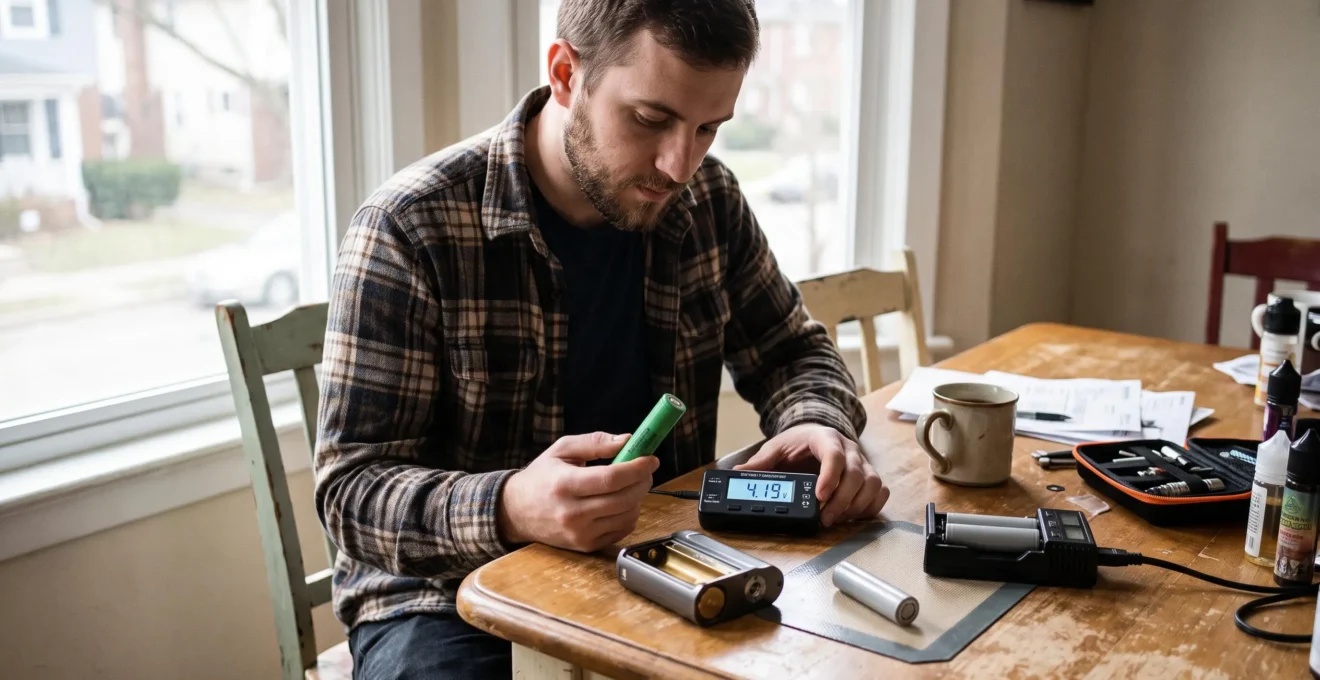
A vape battery rated at 3,000 mAh does not provide a fixed number of puffs or guarantee a full day between charges. Its capacity describes how much electrical charge it can deliver under specified conditions. Actual runtime depends on how quickly the device consumes energy, how efficiently its electronics operate, and when its battery protection system stops discharging.
For adult vapers comparing battery specifications, the useful distinction is between nominal capacity, stored energy, and usable runtime. A higher mAh rating can support longer operation when other conditions are comparable, but it does not independently determine how much power a battery can safely supply.
Wattage, puff duration, discharge current, cell condition, and temperature all affect the result. Understanding their combined influence makes it possible to estimate daily runtime more realistically, select compatible cells, and recognize when disappointing battery life reflects usage rather than a defective battery.
Vape battery runtime: the essentials
- Battery capacity in mAh indicates nominal charge storage; watt-hours provide a more meaningful starting point for estimating available energy.
- Higher wattage and longer or more frequent puffs consume energy faster, while voltage sag and conversion losses further reduce usable runtime.
- Capacity must be considered alongside continuous discharge rating, battery compatibility, cell condition, and the device manufacturer’s requirements.
- Why Can Two Vape Batteries With the Same Capacity Last Different Amounts of Time?
- How Can You Estimate Whether a Vape Battery Will Last Through Your Daily Routine?
- Higher Capacity or Smaller Battery: Which Better Fits a Portable Vape?
- Why Is Battery Capacity Alone Not Enough to Choose a Vape Cell?
- When Does Reduced Vape Runtime Suggest a Battery Is Ageing?
- Why Does Vape Battery Runtime Drop Quickly at Higher Wattage?
- Matched Battery Pair or Mixed Cells: Which Is Appropriate for a Dual-Battery Vape?
- How Can Battery Efficiency Extend Runtime in a Regulated Vape Device?
Why Can Two Vape Batteries With the Same Capacity Last Different Amounts of Time?
Two vape batteries with identical mAh ratings can provide different runtimes because their advertised capacities are measured under specific discharge conditions, not under every vaping load. Differences in internal resistance, voltage behaviour, usable discharge range, and device efficiency affect how much stored energy reaches the atomizer before the device switches off.
A milliamp-hour rating describes electrical charge, rather than directly specifying energy or power capability. For example, Samsung SDI’s INR18650-30Q has a nominal capacity of 3,000 mAh and a nominal voltage of 3.6 V. Its nominal capacity is specified under a 0.2C discharge test with a 2.5 V cutoff, rather than at an arbitrary vaping wattage.
The Samsung SDI INR18650-30Q technical specification also identifies a minimum standard rated discharge capacity of 2,900 mAh under its specified 10 A, 25°C conditions. This illustrates why a manufacturer’s testing conditions matter when interpreting an advertised capacity.
3,000 mAh at 3.6 V
Samsung INR18650-30Q nominal specifications, corresponding to approximately 10.8 Wh of nominal stored energy. This calculated value is not a guarantee of usable energy at the atomizer.
Samsung SDI, INR18650-30Q specification, March 2014.
A regulated vape may stop drawing power when its chipset detects a low battery voltage, even though the cell’s laboratory discharge specification allows a lower cutoff. Consequently, some of the nominal capacity remains inaccessible in that device. Higher discharge current can also produce greater voltage sag, bringing the cutoff forward.
Conversion efficiency adds another variable. A regulated mod changes battery voltage to maintain its selected output. Depending on circuit design, input voltage, output voltage, and load, some energy is lost as heat. A larger input-to-output voltage difference does not automatically mean lower efficiency; the converter’s operating characteristics determine the losses.
Cell authenticity also matters. A relabelled, counterfeit, or degraded battery may display a plausible mAh figure without delivering the corresponding capacity under load. Manufacturer identification, traceability, and appropriate technical specifications are therefore more useful than an impressive printed rating alone.
The practical comparison is not simply 3,000 mAh versus 3,000 mAh. It is the energy each verified, compatible cell can supply under the device’s actual operating conditions. That distinction becomes especially important when translating specifications into a daily usage estimate.
How Can You Estimate Whether a Vape Battery Will Last Through Your Daily Routine?
Estimate vape battery runtime by converting nominal capacity into watt-hours, dividing by the device’s power consumption, and adjusting for conversion losses and actual puff duration. The result estimates cumulative firing time, not elapsed time between charges. Recording personal usage over several typical days makes this calculation considerably more useful.
The basic energy conversion is:
Nominal battery energy (Wh) = Capacity (mAh) × Nominal voltage (V) ÷ 1,000
For a hypothetical regulated setup using a 3,000 mAh, 3.6 V cell, nominal energy is 10.8 Wh. To illustrate how this translates into vaping time, assume a fixed 80% fraction of nominal energy ultimately reaches the atomizer. This is a deliberately hypothetical calculation assumption, not a measured efficiency or usable-energy figure for any particular vape device.
Hypothetical runtime calculation
Nominal energy: 3,000 × 3.6 ÷ 1,000 = 10.8 Wh. Assuming 80% of that energy reaches the atomizer, the available output energy would be 8.64 Wh.
At a constant 20 W, estimated cumulative firing time is 8.64 ÷ 20 = 0.432 hours, approximately 25.9 minutes. If each puff lasts three seconds, that corresponds mathematically to about 518 puffs. At 40 W, the corresponding figures are approximately 13 minutes or 259 three-second puffs.
These values illustrate the calculation only. Actual results depend on the cell, device cutoff, conversion losses, puff profile, and conditions of use.
To estimate whether a battery will last through a daily routine, compare predicted cumulative firing time against actual daily use. A device recording puff count and puff duration can help, although counters should not be assumed to measure battery energy precisely.
Battery percentage displays introduce further uncertainty. Many devices estimate remaining charge from voltage or a battery-management algorithm. Because the relationship between voltage and state of charge is nonlinear and changes under load, a displayed 20% does not guarantee 20% of the original runtime remains.
Temperature, partial recharges, charging interruptions, and standby consumption can also change the observed interval between charges. Overnight charging should not be used as a method of guaranteeing full-day runtime; charging should follow the device manufacturer’s instructions, with appropriate supervision.
Build a personal vape battery runtime estimate
- Record the battery’s verified capacity and nominal voltage, then calculate its nominal watt-hours in a short specification note.
- Write down the wattage and operating mode used during a typical day, producing a record of the actual settings.
- Record puff count and approximate duration over a representative day, creating a daily firing-time total.
- Compare that firing-time total against a clearly labelled theoretical estimate, noting charging interruptions, temperature, and battery cutoff behaviour.
- Repeat the observation under comparable conditions and record the resulting runtime range rather than relying on a single day’s result.
A reasonable estimate is therefore a range supported by observation, not a guaranteed number. Once the expected demand is established, the next decision is whether greater battery capacity is worth the accompanying size and discharge-performance trade-offs.
Higher Capacity or Smaller Battery: Which Better Fits a Portable Vape?
A higher-capacity vape battery is generally preferable when longer intervals between charges matter more than device size, provided the cell meets the required discharge limits. A smaller battery may better suit portability and lower-power use. The appropriate choice depends on wattage, charging access, battery format, and whether the device supports removable cells.
Portable devices involve competing priorities: stored energy, weight, dimensions, operating current, and convenience. A larger cell may hold more energy, but it may require a larger mod. Within the same cell chemistry and physical format, designs optimized for high capacity also commonly involve compromises in continuous discharge capability.
These differences are particularly relevant when comparing lower-power mouth-to-lung (MTL) use with higher-wattage direct-to-lung (DTL) setups.
| Decision factor | Lower-power portable setup | Higher-power setup |
|---|---|---|
| Primary battery priority | Suitable energy capacity and compact dimensions | Adequate safe discharge-current capability |
| Typical energy demand | Lower during comparable firing periods | Higher during comparable firing periods |
| Portability | Smaller and lighter devices may be practical | Larger cells or multiple cells may be required |
| Recharge planning | Depends on personal puff frequency and duration | Requires closer attention to cumulative energy consumption |
| Cell selection | Capacity remains subject to manufacturer compatibility | Discharge rating is a critical requirement alongside capacity |
An 18650 and a 21700 are different physical cell formats, not universal indicators of performance. A compatible 21700 can offer greater available energy than some 18650 alternatives, but model-specific specifications determine the actual capacity and discharge limits. A device designed exclusively for one format must not be forced to accept another.
Removable batteries provide a different form of convenience: a compatible spare can be exchanged when the installed cell is depleted. Spare cells must be carried in suitable protective cases, never loose with conductive objects. Integrated-battery devices avoid routine cell swapping but may be harder to keep using after their internal battery deteriorates, depending on manufacturer servicing options.
Importantly, capacity does not directly increase a regulated vape’s output power. The chipset controls output within its design limits, and the battery must safely supply the required input current.
For modest power demand, usable energy and portability may dominate the decision. As power requirements rise, current capability becomes less negotiable, which is why advertised capacity cannot serve as the sole cell-selection criterion.
Why Is Battery Capacity Alone Not Enough to Choose a Vape Cell?
Battery capacity alone is insufficient because it measures nominal charge storage, not the maximum current a cell can safely deliver. A suitable vape battery must also meet the device’s discharge-current requirements, physical specifications, and manufacturer compatibility guidance. Selecting solely by mAh can result in premature shutdown, poor performance, excessive heating, or unsafe operation.
The key complementary specification is the continuous discharge rating (CDR), expressed in amperes. It describes the current a manufacturer rates a cell to deliver continuously under stated conditions. This is different from capacity, which is expressed in ampere-hours or milliampere-hours.
For example, the Samsung INR18650-30Q specification identifies a nominal capacity of 3,000 mAh alongside a maximum continuous discharge current of 15 A at 25°C. Those values describe different characteristics of the same cell. Neither can substitute for the other.
Battery selection also depends on whether the vape is regulated or unregulated. In a regulated device, the battery current is related to the output wattage, conversion efficiency, battery voltage, and number and arrangement of cells. The coil resistance alone does not determine battery current.
In an unregulated arrangement, Ohm’s law relates current directly to the applied voltage and circuit resistance. These are fundamentally different electrical operating conditions. Applying a coil-resistance calculation intended for an unregulated circuit to a regulated mod can substantially misrepresent battery demand.
Datasheets provide additional information that mAh labels do not:
- Discharge curves: how cell voltage changes as stored charge is consumed at specified currents.
- Voltage sag: the drop in terminal voltage under load, which can lead to earlier device cutoff.
- Temperature limits: the manufacturer’s conditions for charging, storage, and discharge.
- Internal resistance: a factor influencing voltage drop and resistive heating.
- Cycle-life conditions: how measured capacity changes after repeated use under defined testing conditions.
Cells without verifiable specifications, uncertain provenance, or credible signs of relabelling should not be selected on the strength of a printed capacity claim. A product marketed for vaping is not necessarily approved for every vape design.
Manufacturer documentation and device compatibility instructions take priority over generalized calculations. For removable-cell devices, the required current capability should be established from the complete device specification and its intended operating range, not from an isolated mAh value.
Once a suitable cell has been identified, maintaining its condition matters just as much as its original specifications. A battery that initially performed adequately can eventually deliver substantially less useful runtime as it ages.
When Does Reduced Vape Runtime Suggest a Battery Is Ageing?
Reduced vape runtime suggests battery ageing when a cell consistently lasts significantly less time than it did when new under comparable settings, temperatures, and usage patterns. Faster voltage decline, increasingly frequent low-battery cutoffs, and abnormal heating can also indicate deterioration. However, reduced runtime alone does not prove that the battery is defective.
Lithium-ion batteries deteriorate through both cycle ageing and calendar ageing. Repeated charging and discharging gradually change the cell’s internal chemistry, while deterioration can also occur during storage. The resulting changes may reduce available capacity and increase internal resistance.
Higher internal resistance is especially relevant to vaping because it increases voltage sag during demanding firing periods. A battery may retain a reasonable measured capacity at a low discharge rate yet trigger a regulated device’s low-voltage protection much sooner when operated at higher power.
The Samsung INR18650-30Q specification includes cycle-life testing, demonstrating that capacity retention is evaluated under defined charge-discharge conditions. Its specified minimum capacity after 250 test cycles is 1,800 mAh. This is a model-specific laboratory criterion, not a universal replacement threshold or a prediction that every vape battery will reach the same capacity after 250 cycles.
The most useful practical comparison is between current and historical runtime at the same wattage, with similar puff durations, charge starting points, and ambient temperatures. A sudden reduction after increasing power or using a device outdoors in cold weather is not, by itself, evidence of permanent battery degradation.
Other causes should be considered before attributing shorter runtime to ageing. A different coil, altered puff frequency, inadequate charging, dirty device contacts, or changes in charging equipment may affect the observed result. Intermittent performance or unexpected shutdowns can also indicate a device problem requiring professional inspection.
Physical damage is a separate and more urgent concern. A torn insulating wrap, damaged insulator ring, deformation, swelling, leakage, unusual odour, or excessive heat requires immediate attention. A cell showing potentially dangerous damage should be taken out of service, not tested repeatedly to confirm its remaining capacity.
Do not charge, puncture, crush, dismantle, or continue using a battery suspected of serious damage. If it is hot, smoking, or otherwise unstable, avoid handling it and follow local emergency guidance. Removed lithium-ion cells should be taken to an appropriate battery recycling or hazardous-waste collection service with their terminals protected against short circuits, according to local instructions.
A gradual and reproducible reduction in runtime is useful diagnostic evidence, while physical damage demands action regardless of remaining capacity. Before concluding that a healthy battery is underperforming, however, it is also necessary to account for the substantial influence of wattage.
Why Does Vape Battery Runtime Drop Quickly at Higher Wattage?
Vape battery runtime decreases at higher wattage because the atomizer consumes stored energy more quickly. If firing duration, efficiency, and usable battery energy remain constant, doubling output power approximately halves cumulative firing time. At high current, additional voltage sag and conversion losses can reduce actual runtime further than this simplified relationship predicts.
Electrical power measures energy consumed per unit of time. A regulated device operating at 40 W transfers energy to its atomizer twice as quickly as one operating at 20 W while both are actively firing, assuming the displayed power accurately represents delivered output.
The basic relationship is:
Output energy consumed (Wh) = Output power (W) × Firing time (hours)
For example, in a hypothetical comparison involving a fixed 8 Wh of usable output energy, continuous firing time would be approximately 24 minutes at 20 W and 12 minutes at 40 W. These values follow directly from the assumed energy budget; they are not measured runtimes for a particular battery or mod.
Real vaping patterns complicate the comparison. Puff duration and frequency frequently change with the selected wattage. Someone using shorter puffs at higher power might not double total daily energy consumption, whereas longer or more frequent puffs can increase demand beyond what the power setting alone suggests.
Higher wattage also generally requires more input power from the battery. As discharge current increases, internal resistance produces a larger voltage drop and greater resistive heating. The regulated mod may therefore reach its battery cutoff earlier, leaving some nominal energy unused.
Coil resistance is relevant but should be interpreted correctly. In regulated power mode, the chipset adjusts electrical output to achieve the selected wattage within its supported operating limits. Two compatible coils operated at the same actual output power do not necessarily demand dramatically different total battery energy for identical firing periods, although voltage requirements and conversion efficiency can differ.
Chipset design further explains why two regulated devices may produce different runtimes at the same wattage. Their converters, voltage thresholds, power limits, standby consumption, and responses to voltage sag are not necessarily identical.
The most informative comparison is therefore energy consumed per puff and across a full day, rather than wattage or capacity considered in isolation. In devices using two removable batteries, the way those cells are combined adds another essential consideration.
Matched Battery Pair or Mixed Cells: Which Is Appropriate for a Dual-Battery Vape?
A dual-battery vape designed for removable lithium-ion cells should use a matched pair of batteries approved for that device, rather than a mixture of cell models, ages, or charge states. Matching helps reduce imbalance, premature cutoff, and unequal stress. The manufacturer’s instructions remain essential because series and parallel configurations operate differently.
In a series configuration, two cells increase the total battery-pack voltage while sharing the same current. For otherwise identical cells, the pack’s ampere-hour capacity remains equal to that of one cell, although its nominal energy in watt-hours doubles.
If a series-connected pair contains a weaker cell, that cell can reach its discharge limit earlier. The device’s safety monitoring may then shut down the pack even while the stronger cell still retains usable energy.
In a parallel configuration, nominal pack voltage remains unchanged while the combined charge capacity increases for matched cells. Current distribution depends on cell characteristics and connection resistance. Differences in cell voltage or condition can result in unequal current sharing and potentially harmful equalization currents.
The Battery University explanation of series and parallel battery configurations describes these electrical distinctions and emphasizes matching cell type, voltage, and capacity in multi-cell arrangements.
For a regulated dual-battery vape, a sensible approach is to purchase compatible cells together, identify them as a dedicated pair, and use them together throughout their service life.
Practical pairing involves more than choosing the same printed mAh rating. Cells should be the same verified model, purchased together where possible, maintained at comparable charge levels, and used under similar conditions. Their physical condition should be inspected before insertion or charging.
A charger with individual-slot monitoring can help identify differences in charging behaviour. Some regulated devices also monitor individual cells, but monitoring or balancing circuitry does not make mismatched batteries equivalent to a properly paired set. Charging features and protection arrangements vary by manufacturer and model.
The U.S. Food and Drug Administration advises against mixing batteries of different brands, different charge levels, or different ages in vaping devices. Its guidance on vape battery fires and explosions also recommends using only batteries specified for the device and following the manufacturer’s charging instructions.
Where a paired set shows a substantial performance mismatch or either cell develops concerning damage, the set should no longer be treated as a reliable matched pair. A battery exhibiting unsafe physical symptoms must be removed from service regardless of the other cell’s condition.
Matching cells supports safer, more predictable pack behaviour, but it does not eliminate energy losses inside the device. Even with a suitable battery configuration, regulated electronics influence how much of the stored energy becomes useful atomizer output.
Key takeaways before evaluating device efficiency
- Compare usable energy delivered under real operating conditions, not the printed mAh value alone.
- Confirm cell compatibility and discharge limits before attempting to improve runtime through battery changes.
- Assess whether runtime losses come from the battery, operating settings, or device electronics before replacing equipment.
How Can Battery Efficiency Extend Runtime in a Regulated Vape Device?
Battery efficiency extends runtime when a regulated vape converts more of its stored electrical energy into useful atomizer output rather than dissipating it as heat. Appropriate power settings, compatible coils, sound battery condition, and efficient conversion electronics all contribute. Efficiency improvements have limits, however, and cannot compensate for an unsuitable or unsafe battery.
Regulated mods use electronic conversion circuits to control electrical output despite the battery’s changing voltage. A converter operating below 100% efficiency necessarily consumes more battery energy than the energy delivered to the atomizer.
For perspective, Texas Instruments specifies efficiency reaching up to 96% for its TPS63027 buck-boost converter. The Texas Instruments TPS63027 converter documentation illustrates that efficient voltage conversion is technically possible while remaining dependent on operating conditions.
This figure must not be treated as a measured efficiency for vaping devices. The cited component is not identified as a converter installed in any particular vape mod, and its maximum published efficiency does not establish performance at every input voltage, output voltage, or load.
In principle, converter efficiency can be expressed as useful output energy divided by electrical input energy. Improving conversion efficiency means less energy is lost for the same useful output. The practical difference depends on the device’s actual operating efficiency, which cannot be inferred reliably from the mAh rating.
Settings can matter as much as electronics. Operating a compatible coil within its recommended power range, avoiding unnecessary power increases, and choosing a suitable output mode can help control total energy demand.
Temperature-control modes may also influence consumption in compatible setups by adjusting power according to the device’s resistance-based temperature estimate. However, temperature control does not automatically deliver better runtime or an identical vaping experience. Results depend on coil material, calibration, device implementation, and usage.
Battery care influences runtime over a longer period. Avoiding prolonged exposure to high temperatures, unnecessary deep discharge, and extended storage at full charge can help limit lithium-ion ageing. These are general battery-preservation considerations, not reasons to interrupt manufacturer-required charging procedures or bypass a device’s built-in protections.
Cold conditions introduce a separate, often temporary effect. Lower temperatures can increase internal resistance and reduce available voltage under load. A healthy battery may consequently trigger low-battery warnings sooner during winter use, without having permanently lost the same proportion of its capacity.
Any battery that has become excessively cold or hot should be handled according to its manufacturer’s temperature limits. A cold cell should not be heated rapidly or charged outside its permitted charging-temperature range.
The most reliable improvements generally come from understanding consumption, ensuring suitable equipment, maintaining safe battery-handling practices, and comparing performance under consistent conditions. No single efficiency figure guarantees a particular number of puffs or hours between charges.
For a practical next step, record the cell’s verified specifications, the device’s wattage, and cumulative daily firing time. Compare those observations against nominal watt-hours and the manufacturer’s operating limits before deciding whether a different compatible battery or a change in settings is warranted.
Does a 3,000 mAh vape battery guarantee more runtime than a 2,500 mAh battery?
No. At the same nominal voltage and under comparable conditions, a 3,000 mAh battery represents 20% more nominal charge capacity than a 2,500 mAh battery. However, the amount of energy actually delivered to the atomizer depends on discharge behaviour, current demand, voltage cutoff, cell condition, and converter efficiency. A higher rating is therefore not a guaranteed runtime advantage in every practical comparison.
Can vape battery runtime be calculated from mAh without knowing the voltage?
Not reliably. Milliamp-hours describe charge, whereas runtime at a given wattage depends on energy. Nominal voltage is needed to convert mAh into approximate watt-hours. Additional information about device efficiency, discharge conditions, and usable voltage range is required for a realistic runtime estimate.
Does a larger battery increase the maximum wattage of a regulated vape?
Not automatically. A regulated device’s maximum output is constrained by its electronic design and supported operating limits. A physically larger or higher-capacity cell does not override those limits. The battery must also satisfy the device’s current requirements, and only manufacturer-approved cell formats should be used.
Why can a vape display low battery even when the cell still contains charge?
A regulated vape may stop firing when voltage falls below its operating threshold, particularly when voltage sag occurs under high current. Charge can remain in the cell even after the device has stopped using it. This is part of the device’s operating and protection behaviour, not evidence that its cutoff should be bypassed.
Should an unused removable vape battery be stored fully charged?
For longer-term storage, lithium-ion cells generally benefit from a moderate state of charge rather than remaining fully charged for extended periods. They should be stored in protective cases, away from conductive objects and excessive temperatures, with the manufacturer’s storage recommendations taking precedence. Damaged batteries should never be stored for later use as if they were serviceable.